
BlendedBoris
BlendedBoris Blog: Simple Blockchain Ownership Registration

Copyright Cases: 30+ Landmark Copyright Cases and What They Mean for 3D Artists (1884-2026) | Blended BORIS | Digital Art IP

Copyright cases 1884-2026: landmark rulings from Feist and Warhol to Cox v. Sony and the AI training lawsuits, explained for 3D artists
TL;DR: copyright cases

Copyright cases are court decisions that set the rules everyone else follows: what counts as original, when copying is fair use, who owns a commissioned work, and when a platform is liable for its users. This guide covers more than 30 landmark copyright cases from 1884 to 2026, grouped by what they decided, with the lesson each one holds for 3D, Blender and digital artists.

The short version: exact copies of real things are not protected (Meshwerks v. Toyota), a car design can be a protected character (DC Comics v. Towle, the Batmobile case), making something "new" is not enough for fair use when it competes with the original (Warhol v. Goldsmith), you need a registration before you sue in the US (Fourth Estate), and in 2026 the courts are still deciding how copyright applies to AI training.
Key takeaways
  • Originality, not effort, decides protection. Faithful copies of photos, paintings or real products get little or no copyright, however long they took.
  • Fair use turns on purpose. Since Warhol v. Goldsmith (2023), a new look or meaning is not enough if your use serves the same market as the original.
  • Commissioned work belongs to the artist unless a signed agreement says otherwise (CCNV v. Reid).
  • Platforms are rarely liable for users after Cox v. Sony (March 2026): knowing about infringement is not enough. You still act against the uploader.
  • AI is the open front: pure AI output has no US copyright, the first appeals court to rule on AI training (September 2026) found it was not fair use for a competing tool, and 3D artists are now suing over models taken from Sketchfab.

What are copyright cases and why do they matter?

Copyright law is written in statutes, but courts decide what the words mean. A decision of the US Supreme Court binds every US court; a federal appeals court binds the courts in its circuit; in the EU, rulings of the Court of Justice (CJEU) bind all 27 member states. That is why a handful of copyright cases shape what you can do with every model, texture and render you make. For the practical problems these cases grew out of, see the most common copyright issues for 3D artists; for the rules themselves, start with copyright basics for 3D artists.
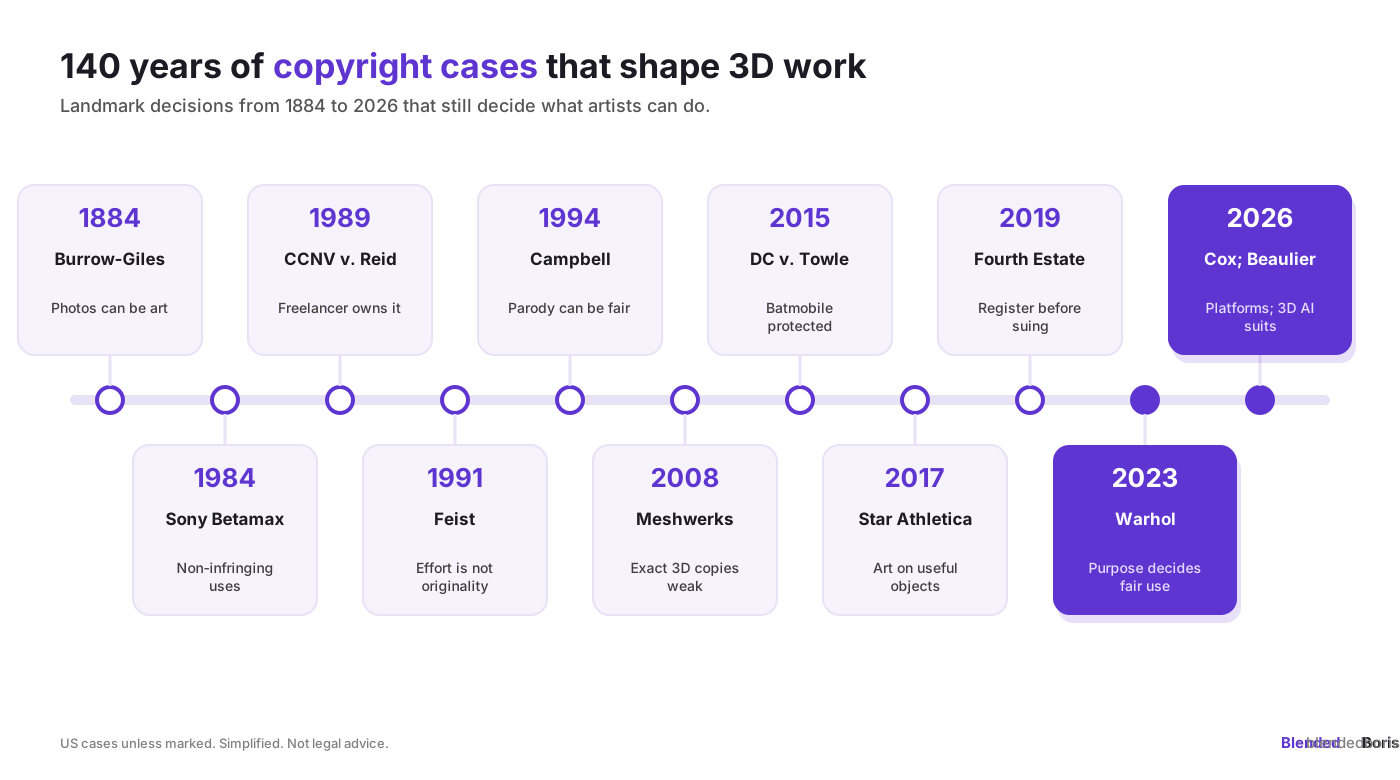
Timeline of landmark copyright cases from 1884 to 2026: Burrow-Giles v. Sarony, Sony Betamax, CCNV v. Reid, Feist, Campbell, Meshwerks, DC Comics v. Towle, Star Athletica, Fourth Estate, Google v. Oracle, Warhol v. Goldsmith, Thaler v. Perlmutter, Cox v. Sony and the 2026 3D model AI lawsuits
140 years of copyright cases that still decide what artists can do today.

Copyright cases on what is protected

These cases answer the first question in any dispute: is there a protected work at all? They matter most for 3D artists, because so much 3D work copies real objects.
CaseCourt and yearWhat it decidedLesson for 3D artists
Burrow-Giles v. SaronyUS Supreme Court, 1884A photograph of Oscar Wilde was protected because of the photographer's creative choices of pose, light and costumeCreative choices, not the machine, make a work protected; this is the root of the human-authorship rule
Feist v. Rural TelephoneUS Supreme Court, 1991A phone book's white pages were not original; hard work ("sweat of the brow") does not earn copyrightHours of modelling do not create protection by themselves; creative decisions do
Bridgeman v. CorelUS district court, 1999Exact photos of public domain paintings were not originalFaithful reproductions of public domain art can be used freely in the US
Meshwerks v. ToyotaUS 10th Circuit, 2008Wireframe models that faithfully copied Toyota cars were not originalAn exact digital twin of a real object gets little or no copyright
InfopaqCJEU, 2009Originality means the author's own intellectual creation; even 11 words can qualifyThe EU test: your free and creative choices, not effort or size
PainerCJEU, 2011Portrait photos can be protected through choices of setting, pose and lightingLighting and camera choices in a render count as creative choices
Lucasfilm v. AinsworthUK Supreme Court, 2011Stormtrooper helmets made as film props were not "sculptures", so no UK copyright; UK courts can still hear claims under US copyrightProps and functional objects are treated differently from art, and the answer can change at the border
DC Comics v. TowleUS 9th Circuit, 2015The Batmobile is a protected character; selling replica kits infringedA vehicle or prop design can be protected like a character; fan replicas are risky
Star Athletica v. Varsity BrandsUS Supreme Court, 2017Artistic features of a useful article are protected if they can be imagined as art on their ownDecoration on a 3D-printed product can be protected; the function cannot
CofemelCJEU, 2019Designs get copyright if they are original; no extra aesthetic testProduct models and designs can be protected in the EU like any other work
Brompton BicycleCJEU, 2020A shape dictated only by its technical function is not protected, but creative choices within it can beFunctional parts are free to model; creative shapes are not
Mio / konektraCJEU, 4 December 2025Applied art needs only ordinary originality, no higher threshold; infringement means recognisable copying of the creative elementsFurniture, product and prop models are judged by the same test as art
Put together, these copyright cases draw a clear line for 3D work: the real object you copy is usually not yours, the creative choices you add are. Read do 3D models automatically have copyright protection? and designing functional 3D printed objects for where that line sits in practice, and what has no copyright for the full list of unprotected material.

Fair use copyright cases
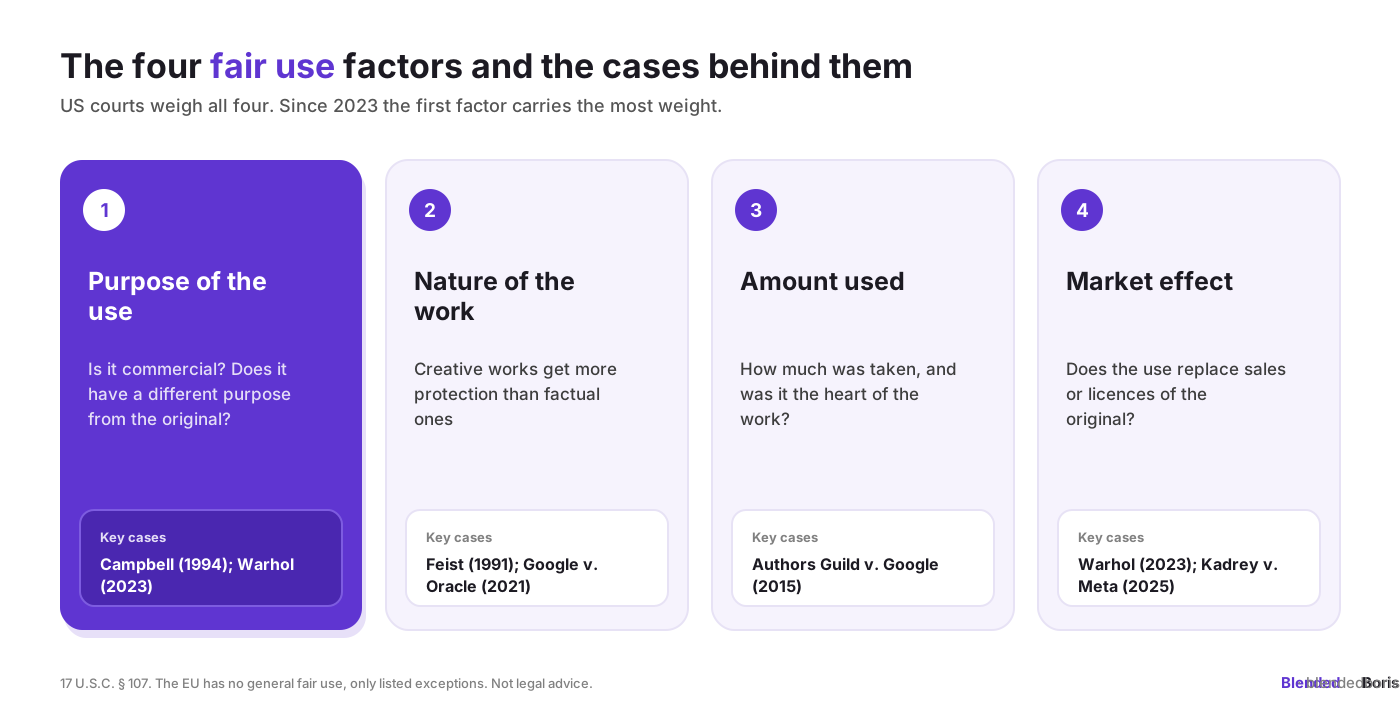
The four fair use factors with the copyright cases that defined them: purpose and transformation (Campbell, Warhol v. Goldsmith), nature of the work, amount used (Authors Guild v. Google), and market effect, with Warhol v. Goldsmith as the turning point
Fair use is decided case by case; these decisions show how the four factors are weighed.
CaseCourt and yearOutcomeWhat it means for artists
Campbell v. Acuff-RoseUS Supreme Court, 19942 Live Crew's commercial parody of "Oh, Pretty Woman" could be fair useParody that comments on the original can qualify, even for money
Cariou v. PrinceUS 2nd Circuit, 201325 of Richard Prince's 30 artworks reusing Cariou's photos were fair useA high point for appropriation art; later narrowed by Warhol
Authors Guild v. GoogleUS 2nd Circuit, 2015Scanning millions of books to make them searchable was fair useCopying whole works can be fair when the use is very different and shows only snippets
Google v. OracleUS Supreme Court, 2021Reusing the Java API's declaring code to build Android was fair useReimplementing an interface can be fair; relevant for add-on and tool developers
Andy Warhol Foundation v. GoldsmithUS Supreme Court, 2023 (7-2)Licensing Warhol's "Orange Prince" to a magazine was not fair useA new style or meaning is not enough when your use competes with the original's licensing market
Sedlik v. Von DrachenbergUS jury 2024; 9th Circuit 2026A jury found Kat Von D's tattoo of a Miles Davis photo not infringing; the full 9th Circuit reheard the case in September 2026, decision pendingHow courts compare two works for similarity may change for the whole Western US
The Supreme Court's opinion in Warhol v. Goldsmith is the one to read: it asks whether your use has the same purpose as the original, not only whether it looks different. For fan art, references and remixes, that is the deciding question. Practical guides: fair use guidelines for digital artists and fair use in digital art.

Copyright cases on ownership and registration

CaseCourt and yearWhat it decidedWhat to do
CCNV v. ReidUS Supreme Court, 1989A sculptor commissioned by a charity was an independent contractor, so he owned the copyright, not the charity that paidFreelancers keep copyright unless they sign it away; clients should get a written assignment
Fourth Estate v. Wall-Street.comUS Supreme Court, 2019You can sue only after the Copyright Office registers the work (or refuses it), not when you applyRegister valuable work early; processing takes months
Unicolors v. H&MUS Supreme Court, 2022Honest mistakes in a registration, of fact or of law, do not make it invalidSmall errors in your application will not cost you the case
These copyright cases are why registration and contracts matter more than any notice. Step-by-step help: how to register copyright and copyright notice and licence examples.

Copyright cases on platforms and secondary liability

CaseCourt and yearWhat it decided
Sony v. Universal (Betamax)US Supreme Court, 1984Selling VCRs was lawful because they had substantial non-infringing uses; home time-shifting was fair use
MGM v. GroksterUS Supreme Court, 2005A file-sharing service that actively encouraged infringement was liable for its users
Cox v. Sony MusicUS Supreme Court, 25 March 2026 (9-0)An internet provider is not liable just because it knew some users infringed; liability needs inducement or a service tailored to infringement. A $1 billion verdict was set aside
For artists, Cox v. Sony means you cannot expect to win against a platform simply because it was told about infringement. Your route is a takedown against the specific upload and, if needed, action against the uploader: see the DMCA takedown guide for artists and legal remedies for digital art infringement.

AI copyright cases in 2025 and 2026
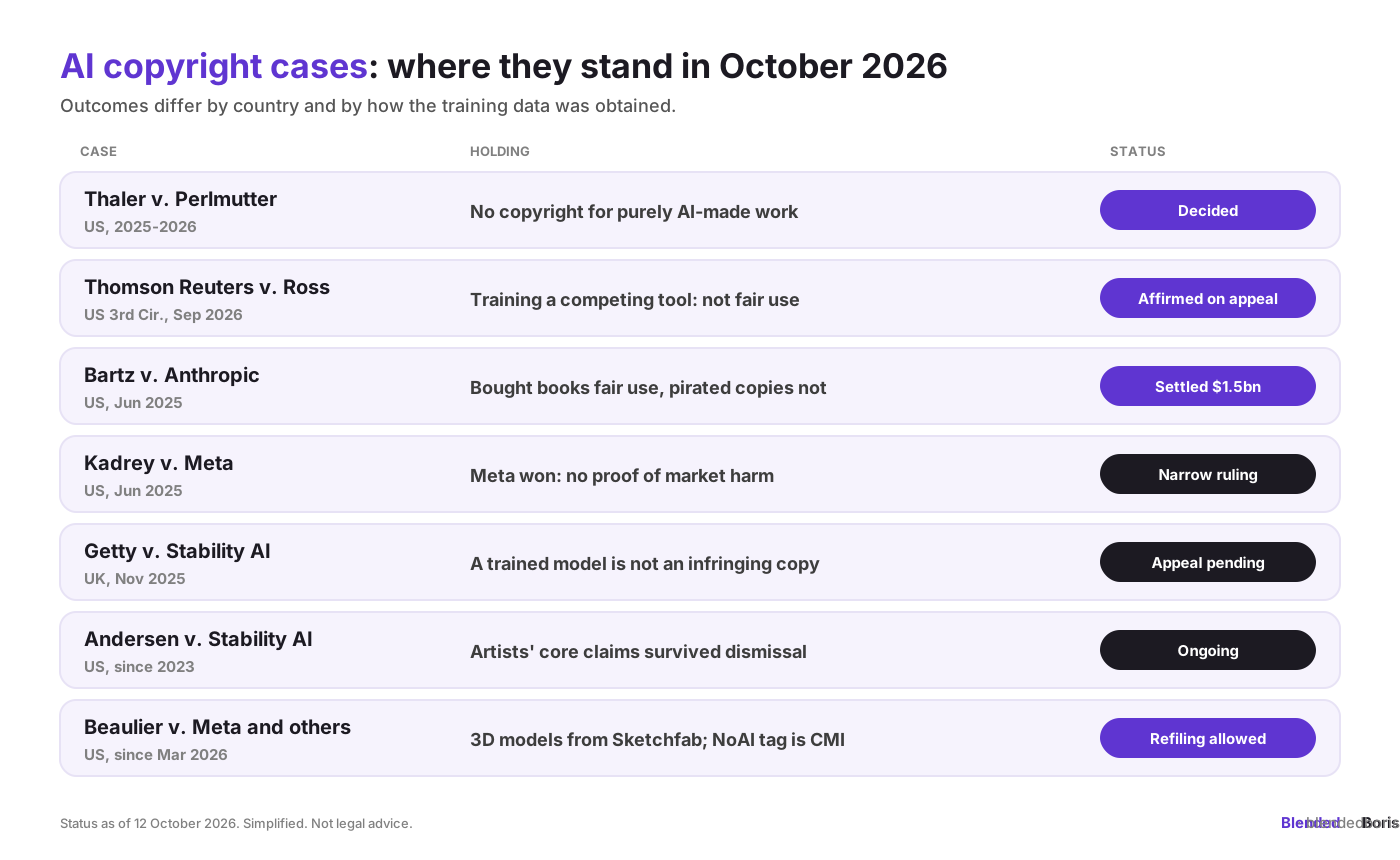
AI copyright cases tracker 2025 to 2026: Thaler v. Perlmutter on AI authorship, Thomson Reuters v. Ross, Bartz v. Anthropic, Kadrey v. Meta, Getty Images v. Stability AI in the UK, Andersen v. Stability AI, and the Beaulier lawsuits over 3D models taken from Sketchfab, each with its status
Where the main AI copyright cases stand in October 2026.
CaseCourt and dateStatus and holdingWhy 3D artists should care
Thaler v. PerlmutterUS D.C. Circuit, March 2025; Supreme Court denied review March 2026Work made entirely by an AI system cannot be registered; human authorship is requiredYour modelling, edits and arrangement are protectable; raw AI output is not
Thomson Reuters v. RossUS 3rd Circuit, 29 September 2026The first appeals-court ruling on AI training: copying Westlaw headnotes to train a competing, non-generative legal search tool was not fair use, partly because it harmed a developing market for licensing training dataTraining that builds a direct competitor is the weakest fair use case; generative AI was left open
Bartz v. AnthropicUS district court, June 2025Training on lawfully bought books was fair use, but keeping pirated copies was not; the case settled for $1.5 billionHow the training data was obtained matters as much as the training itself
Kadrey v. MetaUS district court, June 2025Meta won because the authors did not prove market harm; the judge stressed the ruling was narrowEvidence that AI output replaces your sales may decide future cases
Getty Images v. Stability AIUK High Court, November 2025A trained model is not an "infringing copy"; only limited trademark infringement found; appeal pendingUK law currently gives artists little against training itself
Andersen v. Stability AIUS district court, filed 2023Artists' core copyright claims against Stability AI, Midjourney and others survived dismissal; still being litigatedThe leading image-generator case for visual artists
Beaulier v. Meta, Nvidia, Microsoft, RobloxUS courts, filed March 2026A 3D artist's claims over Creative Commons models taken from Sketchfab with a "NoAI" tag; the Meta claims were dismissed in August 2026 with leave to amend, but the court accepted the NoAI tag as copyright management informationThe first copyright cases about 3D models in AI training datasets
These AI copyright cases are moving fast, and outcomes differ between countries. Keep authorship records for anything you make with AI help, and use the opt-out tools you have: legal precedents for AI art ownership, AI art ownership precedents, how to opt out of AI training datasets and international AI art copyright laws.

US vs EU: how copyright cases differ

QuestionUnited StatesEuropean Union
Originality testModest creativity (Feist)The author's own intellectual creation (Infopaq, Painer)
Designs and useful objectsOnly separable artistic features (Star Athletica)Protected if original, no higher bar (Cofemel, Mio / konektra)
ExceptionsOpen-ended fair useA closed list of exceptions, such as quotation, parody and text and data mining
RegistrationNeeded before suing over a US work (Fourth Estate)No registration system for copyright
AI trainingBeing decided case by case under fair useAllowed for commercial text and data mining unless the rights holder opts out
If you sell worldwide, the same model can be treated differently in each market. See international copyright protection for Blender artists and international copyright protection.

7 lessons from copyright cases for 3D and digital artists
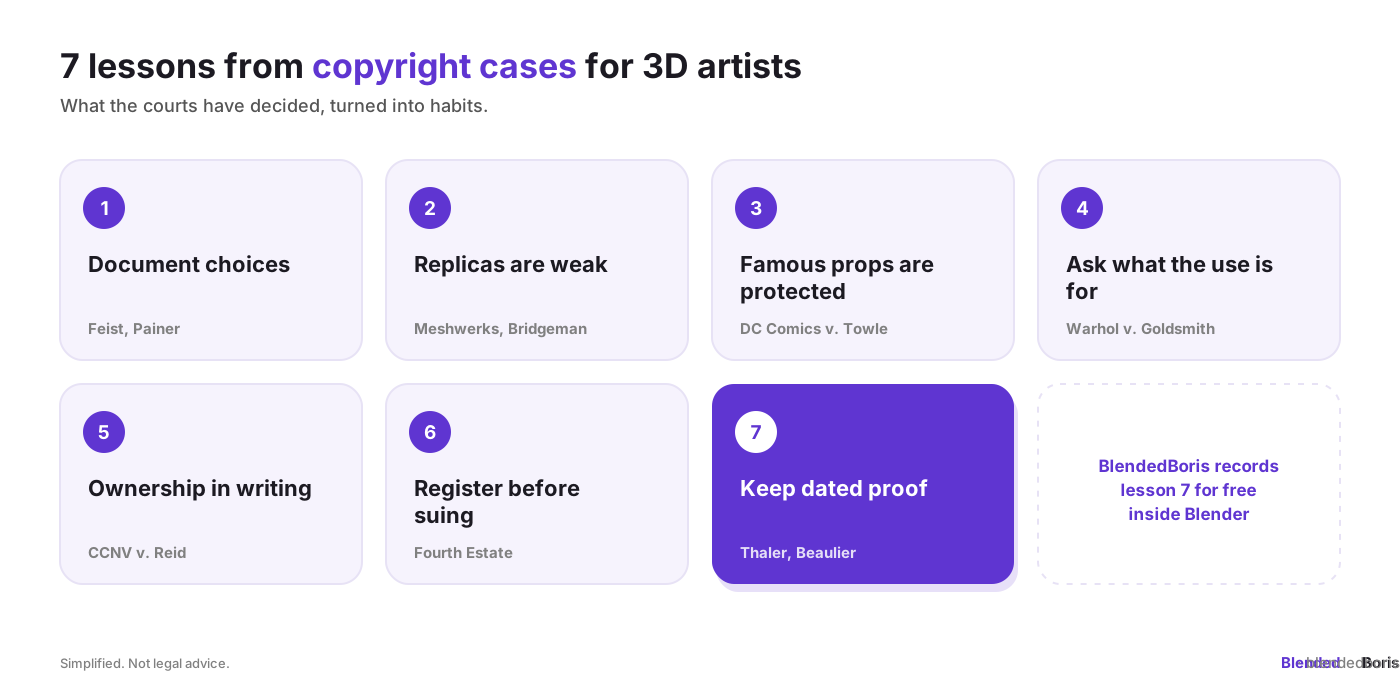
Seven lessons from copyright cases for 3D artists: creative choices not effort, exact copies are weak, characters and vehicles can be protected, fair use depends on purpose, get ownership in writing, register before you sue, and keep proof for AI-era disputes
What 140 years of copyright cases mean for your next model.
  1. Document your creative choices. Courts protect choices, not hours (Feist, Painer). Keep versions that show your decisions.
  2. Do not rely on copyright for exact replicas. A faithful digital twin is weak (Meshwerks, Bridgeman); add your own design or protect it by contract.
  3. Treat famous vehicles, props and characters as protected. The Batmobile was (DC Comics v. Towle); selling replicas without a licence is risky.
  4. Ask what your use is for. After Warhol, a remix that competes with the original's market is unlikely to be fair use.
  5. Put ownership in writing. Without a signed transfer the freelancer owns the work (CCNV v. Reid).
  6. Register valuable work early in the US. No registration, no lawsuit (Fourth Estate); early registration also unlocks statutory damages.
  7. Keep dated proof for the AI era. Authorship and metadata were decisive in Thaler and Beaulier; a record of what you made, and when, is your strongest evidence.
Litigation is the expensive end of all this: copyright litigation costs and when to hire an IP attorney help you decide whether a case is worth bringing. For trademarks and patents alongside copyright, read copyright vs trademark vs patent.
Copyright cases are won with evidence. BlendedBoris is a free plugin for Blender that records your 3D model on the blockchain and gives you a lifetime ownership certificate. It creates a digital fingerprint that links the model to you, so if your work ends up in a dispute, a takedown or an AI dataset, you can show a dated record of every version you made.

👉 Get the free BlendedBoris plugin

Copyright cases in numbers

FactFigure
Oldest case in this guide still cited on authorship1884 (Burrow-Giles v. Sarony)
US Supreme Court vote in Warhol v. Goldsmith (2023)7-2 against fair use
US Supreme Court vote in Cox v. Sony (2026)9-0 for the internet provider
Verdict set aside in Cox v. Sony$1 billion
Settlement in Bartz v. Anthropic (2025)$1.5 billion
Prince artworks found to be fair use in Cariou v. Prince25 of 30
AI lawsuits filed by one 3D artist on 26 March 20264
First US appeals-court ruling on AI training and fair use29 September 2026 (Thomson Reuters v. Ross)
US statutory damages for a registered work$750 to $30,000 per work, up to $150,000 if willful

Conclusion

Copyright cases turn general rules into concrete answers. For 3D artists, the most important ones say that creative choices are protected and faithful copies are not, that famous designs can be protected like characters, that fair use depends on whether you compete with the original, that ownership needs a signature and US lawsuits need a registration, and that AI training is still being decided. You do not need to memorise case names: keep proof of what you made, put deals in writing, register what matters, and check the lessons above before you build on someone else's work.

This is general information, not legal advice. Case law changes and differs by country; for a real dispute, talk to an IP lawyer.

FAQ: copyright cases

What are the most famous copyright cases?

In the US: Feist v. Rural (originality), Sony v. Universal (the Betamax case), Campbell v. Acuff-Rose (parody), Google v. Oracle (software) and Warhol v. Goldsmith (fair use). In the EU: Infopaq and Cofemel.

Which copyright cases matter most for 3D artists?

Meshwerks v. Toyota (faithful 3D copies of cars), DC Comics v. Towle (the Batmobile), Star Athletica (useful objects), Lucasfilm v. Ainsworth (Stormtrooper helmets) and, since 2026, the Beaulier lawsuits over 3D models used for AI training.

What did Warhol v. Goldsmith decide?

That licensing Warhol's "Orange Prince" to a magazine was not fair use, because it served the same purpose as Goldsmith's photo. A new look or meaning alone does not make a use fair.

Is a 3D model of a real car protected by copyright?

Usually only weakly. In Meshwerks v. Toyota, faithful wireframe models of Toyota cars were not original. Your own design choices can be protected, and the car's brand is protected by trademark.

Can a car or prop be copyrighted as a character?

Yes, in some cases. In DC Comics v. Towle the Batmobile was treated as a protected character, and selling replica kits infringed.

What was decided in Cox v. Sony in 2026?

The US Supreme Court ruled 9-0 that an internet provider is not liable for users' infringement just because it knew about it. Liability requires inducement or a service tailored to infringement.

Can AI-generated art be copyrighted after Thaler v. Perlmutter?

Not if it was made entirely by AI. The courts require a human author; your own creative contributions to AI-assisted work can still be protected.

Is training AI on copyrighted work fair use?

Not settled. In September 2026 the US 3rd Circuit held that training a competing, non-generative tool on Westlaw headnotes was not fair use; a 2025 trial court found training on lawfully bought books fair use; generative AI cases are still pending.

Do I need to register copyright before going to court?

In the US, yes, for US works: Fourth Estate requires a registration decision before you sue. In the EU there is no registration system.

Where can I find a list of copyright cases?

Court databases and legal research sites keep full lists. This guide groups the cases that matter most for digital and 3D artists by what they decided.

Copyright cases glossary

TermMeaning
Case lawLaw made by court decisions, which later courts follow
PrecedentAn earlier decision that binds or guides courts in later cases
OriginalityThe threshold for protection: modest creativity in the US, the author's own intellectual creation in the EU
Fair useA US defence weighing purpose, nature of the work, amount used and market effect
Transformative useA use with a new purpose or meaning; after Warhol, not enough on its own
SeparabilityThe test for when artistic features of a useful object can be protected
Work made for hireWork owned by the employer or commissioner from the start under US law
Secondary liabilityLiability for someone else's infringement, such as a platform for its users
En bancA rehearing by the full appeals court instead of a three-judge panel
CertiorariThe US Supreme Court's decision to hear a case; a denial leaves the lower ruling in place
Guides
