
On 22 October 2026, Etsy changed its rules on AI. Every listing for a physical item now needs at least one unedited photo of the real item against a real background. Patterns, recipes and instructions made with AI are banned, and so are listings created by bots with no human involvement. AI-generated art is still allowed, as long as the seller played a clear creative role and discloses the AI use.
Etsy announced the changes in a post by James Ossman, its vice president of customer operations, and in a longer Seller Handbook article. The same day, it updated its Listing Image Requirements, part of the House Rules every seller agrees to. Etsy did not ban AI tools. Instead it chose clearer image rules, stronger detection of misleading listings and a new way for shoppers to report suspected AI imagery.
For Blender artists, the timing matters. Two weeks ago we wrote about the flood of AI knock-offs on Etsy, when Etsy said it had more work to do. This is that work. If you sell 3D-printed figures, jewellery cast from Blender models, STL files or render packs on Etsy, here is what changes for your listings and how to show buyers that a real person made the thing they are buying.
TL;DR: Etsy's new AI rules for Blender sellers
Physical items, including 3D prints, need at least one unedited photo of the actual item against a real background. A Blender render cannot be that photo. Your other images may be edited, even with AI, as long as they show what the buyer gets. Digital downloads such as STL or .blend files need a visual preview of the content. AI-generated instructions and bot-made listings are banned. AI art is still allowed with disclosure. If a buyer gets an item that is materially different from your images, you may have to pay for the refund.
What did Etsy change on 22 October 2026?
Etsy grouped the update into three parts: clearer policies, stronger detection and enforcement, and new features for buyers and sellers. The guiding line in the Seller Handbook is that "AI should support your creativity and craftsmanship, not replace them", and that buyers should always understand the role the seller played in an item.
The policy changes are short. For most products you must now include one photo that has not been edited or changed at all. All other photos must show the item accurately, without hiding flaws or changing how it looks. Functional guides, which Etsy describes as patterns, recipes or instructions, must be your own work and must show a real result made from them. Bot-generated listings will be removed and can cost you your shop.
Etsy explained why. According to the Seller Handbook, many active buyers say they cannot tell which items involve AI-generated content, and that has become "a top-three barrier to shopping more often on Etsy". Etsy also says nearly six million creative entrepreneurs sell on the platform and nearly 90% run their shops alone, which is why it did not want a blanket ban on tools that save sellers time.
Can you still use Blender renders in Etsy listings?
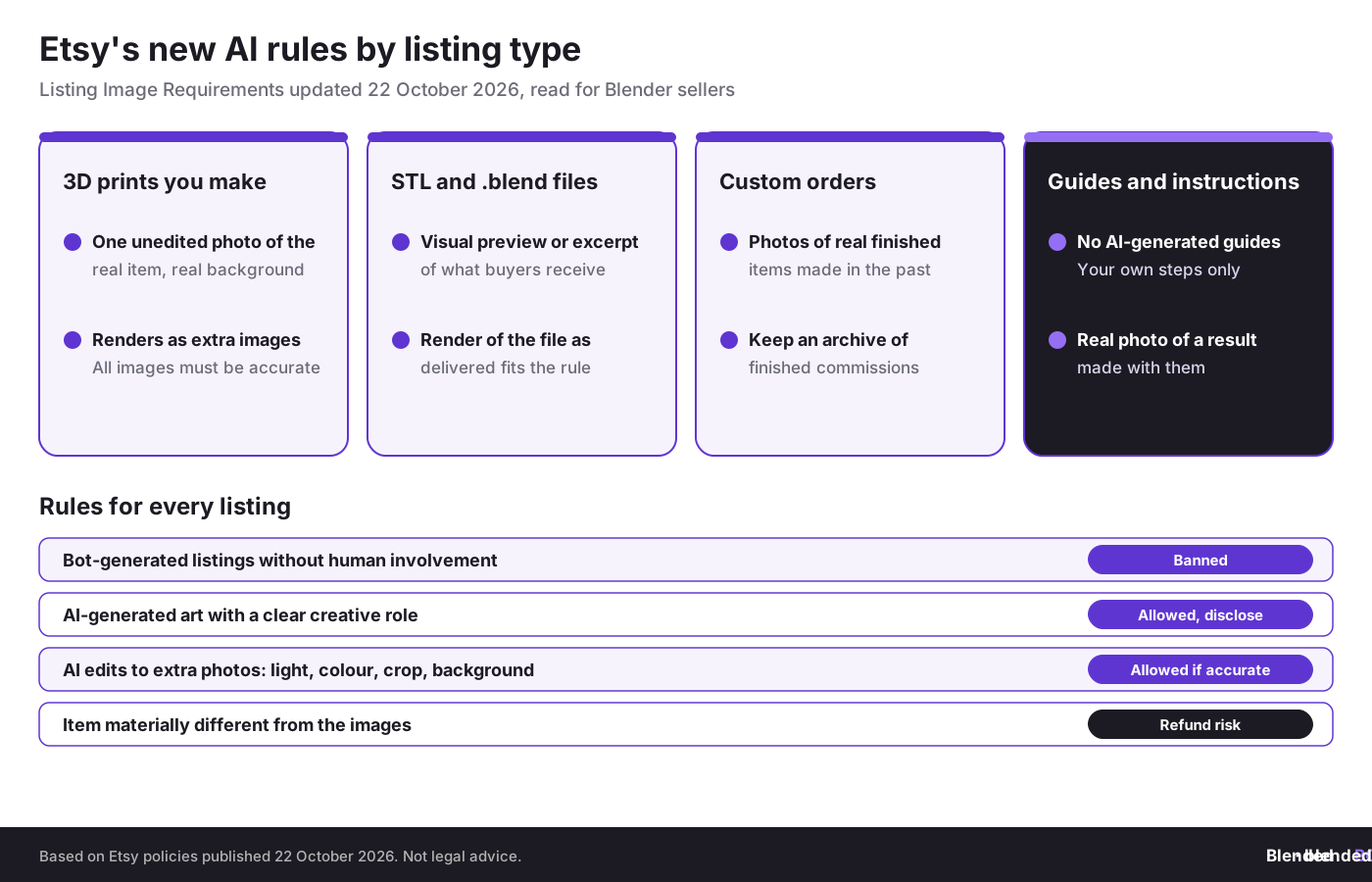
Yes, but not as your only images for a physical item. The new Etsy Listing Image Requirements say that most products need at least one unedited photo of the actual item against a real background. A render of your Blender model is not a photo of the actual item, so in our reading it cannot be that required image, however realistic your Cycles setup is. Print the piece, photograph it, and make that photo the clearest image in the listing.
Renders remain useful next to that photo. Etsy allows edits on your other images, including AI tools, to adjust lighting or colour, crop, resize or replace a background, as long as the product is shown accurately. What it forbids is changing the item's colour, texture or condition, hiding defects, or using AI to change the core design or features of a physical item. A render that shows a smoother surface, a finer print layer or a paint job the buyer will not receive is exactly the kind of image that can now cost you a refund.
This already matched Etsy's Creativity Standards. Since June 2025, items you make with a 3D printer count as made by a seller only if they come from your own original design, and their listings must use original photos or video of the final product. Our guides to creating jewellery models in Blender for 3D printing and designing functional 3D printed objects show how to get a model ready for a real print you can photograph.
What about STL files, .blend files and other digital downloads?
Digital downloads have their own rule. Items with no visual content, such as audio files, may use representative imagery, including AI-generated images, if it does not mislead buyers. All other digital downloads should include a visual preview or excerpt of what the buyer receives. For a Blender seller, a render or viewport capture of the model you are selling is the natural preview. Etsy does not name renders specifically, so make sure the preview shows the file as delivered, not a scene the buyer will not get.
Watch the difference between the model and the presentation. If you sell an STL of a figurine, a render of the printed and painted figure with a full background is an advertisement for what buyers might make, not the file itself. Add a plain preview of the mesh too, and say in the description what is included, such as file formats, supports and polygon count. Our article on selling STL files on Cults3D, Thingiverse and MyMiniFactory covers similar listing details on other platforms.
Under the Creativity Standards, a digital download must be your own original design to count as designed by a seller. AI prompt bundles and bundles of someone else's work do not qualify. Those exclusions were already in place before October, but the new enforcement tools make them more likely to be checked.
Show buyers a real person made it.
BlendedBoris records a blockchain timestamp of your Blender work from inside Blender, so you have dated proof of authorship to back up your listings, disclosures and takedown notices.
👉 Protect your Blender work with BlendedBoris
Are AI-made print guides and instructions banned?
Yes. Etsy says that if you sell functional guides like patterns, recipes or instructions, the information buyers rely on must be your own work, not generated by AI. AI-generated functional guides are no longer allowed on Etsy. You must also show an actual result made using your instructions, not an AI-generated or simulated result.
For 3D creators, this reaches further than crochet patterns. A PDF that explains how to print, assemble and paint a kit, a Blender modelling guide sold as a download, or a set of slicer instructions are all things buyers rely on to make something. The safest reading is that the steps must be written by you and tested by you, with at least one real, unedited photo of the finished result. A render of the model is not a result made from the instructions.
Is AI-generated art still allowed on Etsy?
Yes. The Seller Handbook FAQ says Etsy will continue to allow AI-generated art when sellers play a clear creative role and are open about their process. Its example is a fantasy scene based on a seller's original prompt or inputs. Sellers must still disclose AI use in the listing and may not present AI-generated work as handmade or as entirely their own creation.
For Blender artists who mix tools, honest labelling is the safe course. If you used AI for a texture, a background or an upscale, say so in the description, and say what you made yourself. That matches the direction we described in our article on the Steam AI disclosure fight: marketplaces increasingly want to know how a work was made. Whether the AI-assisted parts are protected by copyright is a separate question, covered in our legal guide to AI art and copyright in Blender and the sister blog's article on copyrighting AI-generated art.
Etsy also points sellers in the United States to a California law. According to Etsy, under SB 1050 listing images or videos may count as advertisements and may need a clear disclosure if they prominently feature an AI-generated synthetic performer, meaning a realistic human figure that is not a real person. Etsy says the law takes effect on 1 January 2027. If your product shots use AI-generated models to show a print in someone's hand, check whether that applies to you.
How will Etsy enforce the new rules?
Etsy describes enforcement in stages. When you add new images to a listing and Etsy detects AI-generated images, the listing form will show tips. Over time, that guidance will extend to images already on listings. Etsy says it is investing in tools to tell authentic images from misleading ones and to remove listings that use AI to create fraudulent inventory, and that it will test enforcement carefully and expand removals in the coming months. It gave no start date.
Buyers get a new reason in the existing "Report this item to Etsy" flag for listings that may use misleading AI imagery. At first, Etsy says, those reports will help it understand how members see AI misuse and will not lead to immediate enforcement. If your listing is removed, you can appeal through the Policy violations page in Shop Manager.
The money risk is already live. If your images do not meet the requirements and a buyer opens a case because the item is materially different from the listing, Etsy may refund the buyer and you may be responsible for the amount. Repeated violations can lead to shop removal. Existing listings that do not meet the new requirements need to be updated, so this is not only about new uploads.
What should Blender artists who sell on Etsy do now?
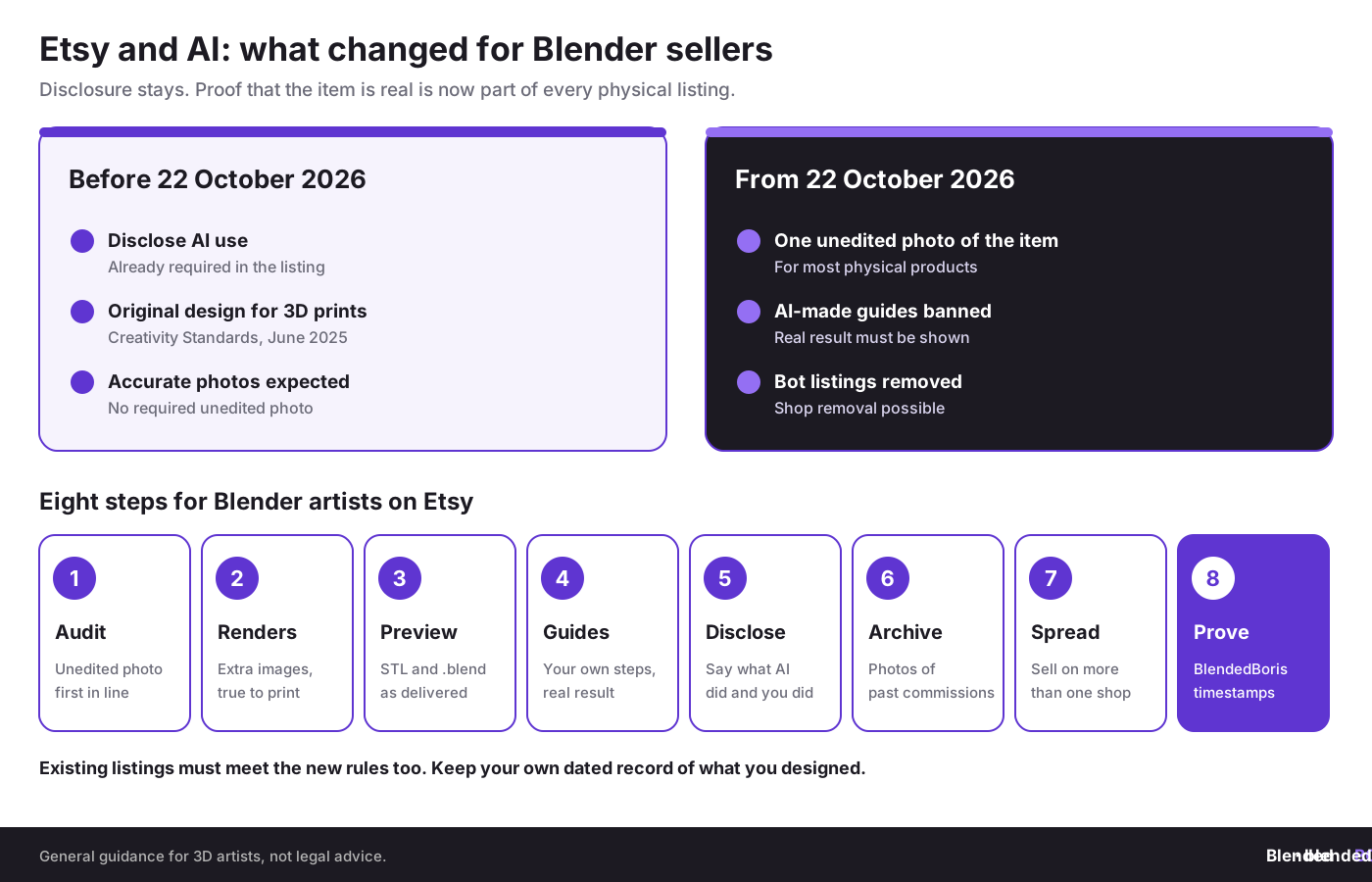
- Audit every physical listing. Check that each one has at least one unedited photo of the real item against a real background, and make it the first image.
- Keep renders honest. Use Blender renders as extra images only, and make sure the colour, finish and scale match what ships.
- Fix digital previews. For STL and .blend downloads, add a plain preview of the file as delivered and list formats and contents.
- Write your own guides. Print, assembly and painting instructions must be your work, with a real photo of a result made from them.
- Disclose AI use. If AI touched a texture, background or concept, say so in the listing and describe your own role.
- Archive real work. Keep photos of finished commissions, so custom and made-to-order listings can show past results.
- Compare platforms. Our 3D marketplace fee comparison and the sister blog's guide to selling 3D models help you spread sales beyond one shop.
- Keep dated proof. Timestamp your .blend files before you list, so you can show who made a design first if a copy appears. Our DMCA takedown guide for Blender artists covers the next step.
Where does this fit in the bigger picture?
Etsy says it will build tools that help sellers demonstrate their authorship. Until those exist, the proof is up to you. A photo of a real print shows the item exists, but it does not show who designed it or when. That is where your own records count: the working .blend file, early versions, and a dated record such as the ones explained in our guide to registering artwork, 3D models and renders. Our article on the Content Credentials timestamp flaw shows why a timestamp should cover the whole file, and the German case in our report on the Frankfurt "it was AI" ruling shows how raw versions helped a creator prove authorship.
The sister blog explains immutable proof of art creation, and our guide to passive income with Blender looks at assets, courses and templates beyond Etsy. Our sister sites covered other questions of proof and access this week:
- Prior use and patents. The Unified Patent Court of Appeal held that a Gucci wallet sold before a patent was filed counted as public prior use, because experts could work out the method by analysing the product: what the UPC prior-use patent ruling means on cadchain.com.
- VPN zero-day. CISA added two more Ivanti Connect Secure flaws to its list of exploited vulnerabilities after attacks on fully patched devices: what the Ivanti Connect Secure vulnerability means for SOLIDWORKS teams on solidboris.com.
- Hidden admin actions. A VMware ESX logging flaw that lets an administrator act without the actions being recorded is now on CISA's exploited list: what the VMware ESXi vulnerability means for Inventor teams on borisinventor.com.
Conclusion
Etsy's 22 October update does not ban AI, but it raises the bar for showing what is real. For Blender artists, that mostly works in your favour: you can print the item, photograph it, write your own guide and show a finished result, which a bot shop cannot. The cost is some work on older listings and more care with renders that look better than the print. Disclose AI use honestly, keep photos of real work, and hold your own dated proof of what you designed and when.
Your designs, your dates, your proof.
BlendedBoris adds a blockchain timestamp to your Blender work from inside Blender, giving you dated proof of authorship to use alongside listing photos, AI disclosures and copyright registrations.
👉 Get started with BlendedBoris
FAQ: Etsy's AI policy update and Blender artists
When did Etsy's new AI rules start?
Etsy announced the update and published its revised Listing Image Requirements on 22 October 2026. Enforcement tools and wider removals will be tested and expanded in the coming months, with no fixed date.
Can I use a Blender render as the main image for a 3D-printed item?
Not as the only image. Most physical items now need at least one unedited photo of the actual item against a real background. Renders can be extra images if they accurately show what the buyer receives.
Do STL or .blend file listings need a real photo?
Digital downloads follow a separate rule: they should include a visual preview or excerpt of the content buyers will receive. A preview of the model as delivered fits that rule.
Can I still sell AI-generated art on Etsy?
Yes, if you play a clear creative role and disclose AI use in the listing. You cannot present AI-generated work as handmade or entirely your own creation.
Are AI-written printing or assembly guides allowed?
No. Etsy now bans AI-generated functional guides such as patterns, recipes and instructions, and requires a real result made from your instructions to be shown.
What happens if my listing breaks the image rules?
If a buyer opens a case because the item is materially different from the listing, Etsy may refund the buyer and you may be responsible for the amount. Listings can be removed, and repeated violations can lead to shop removal.
Do I need to change my existing listings?
Yes. Etsy says listings that do not meet the new Listing Image Requirements need to be updated, not only new ones.
How can BlendedBoris help?
BlendedBoris records a blockchain timestamp of your Blender work from inside Blender. That gives you dated proof of authorship to support your listings and any takedown notice if your design is copied.


