
Epic Games CEO Tim Sweeney has called Steam's AI disclosure rules a forced political statement. On Friday 23 October 2026, he replied on X to a developer who called AI content disclosures absurd, and over the weekend he defended Epic's own Fab marketplace, which also requires AI labels, as a business-to-business store whose buyers need to know where content comes from. Neither Valve nor Epic has announced any change to its rules.
The argument started when developer Matt Workman posted that the premise of an AI-generated content disclosure is absurd in 2026. Sweeney agreed, writing that the requirement amounts to “Forcing developers to write a political statement to be used against them”, and added, as Kotaku reported on 26 October, that such statements feed hate campaigns and carry a real economic cost for developers on a store that already takes 30% of sales.
Critics quickly pointed out that Fab, Epic's own 3D asset marketplace, makes sellers label AI-generated products and lets buyers hide them. Sweeney's answer is the part 3D artists should read twice: Fab is different, he said, because studios that buy assets have contracts, including Steam's own, that require them to know the provenance of every piece of content in their games. In other words, the head of the company that runs Fab says business buyers cannot buy assets without knowing how they were made.
TL;DR: the Steam AI disclosure fight in one paragraph
Tim Sweeney says Steam's rule that games disclose generative AI content is a political label that hurts developers. Valve has not responded and its rule stands. Epic's Fab still requires a "Created with AI" label on assets, and Sweeney defends it because studio buyers must know the provenance of what they buy. For Blender artists who sell models, textures or animations, the message from both sides is the same: buyers want to know how your work was made. Label honestly, keep your source files and process records, and keep dated proof that a human made the work.
What exactly does Steam require developers to disclose?
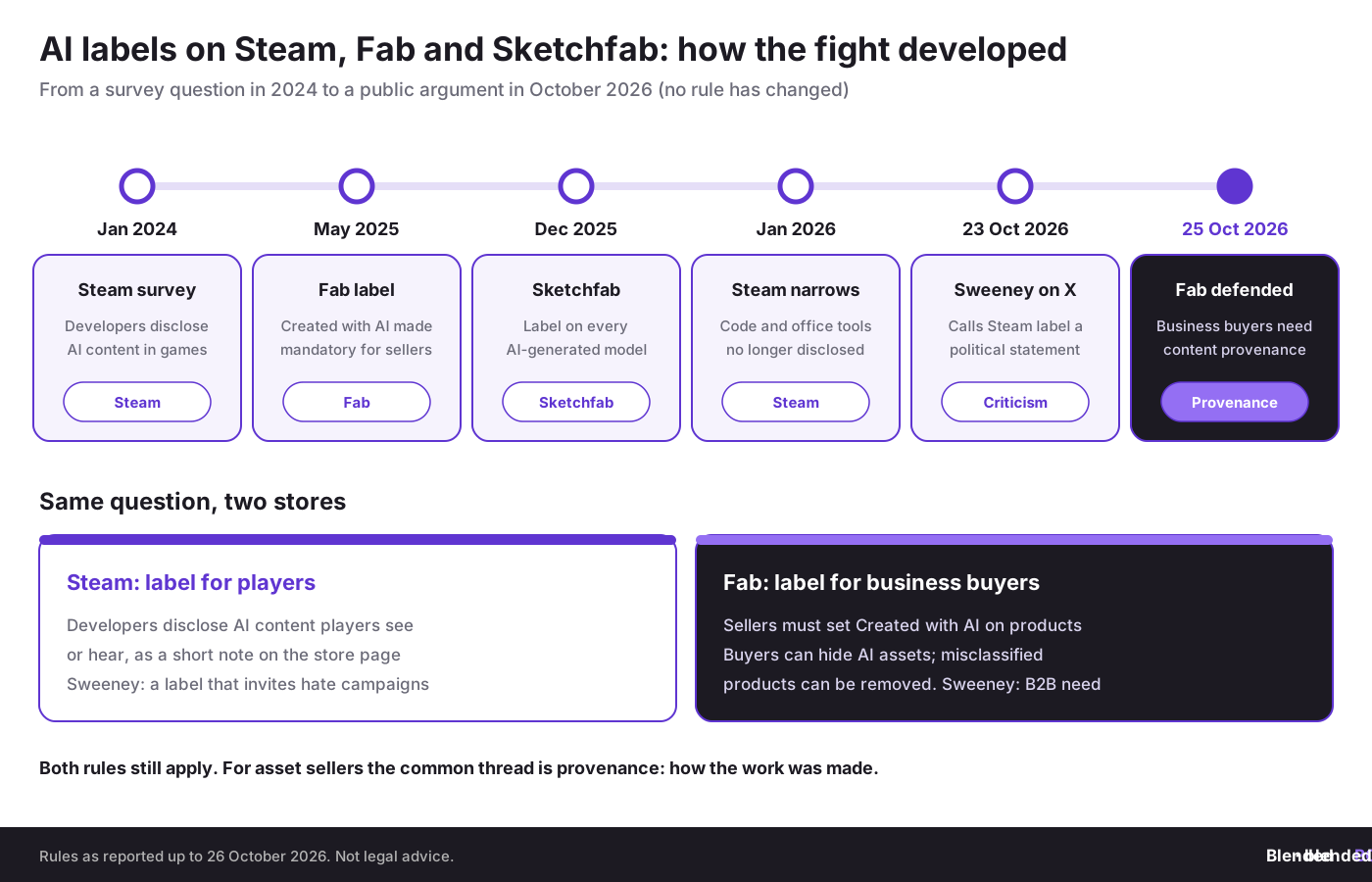
Valve added an AI section to the Steamworks content survey in January 2024. It splits AI use into two kinds. Pre-generated content is anything made with AI tools during development, such as textures, models, voice lines, text or store art. Live-generated content is created by AI while the game runs, and for that Valve also asks developers to describe the guardrails that stop illegal output and lets players report problems through the Steam overlay.
In January 2026, Valve narrowed the form. Tools that never reach the player, such as coding assistants, bug checkers and office software, no longer have to be disclosed; the updated survey says efficiency gains from such tools are not its focus. What still counts is AI content that players actually see or hear. The disclosure appears as a short note on the game's store page, and developers stay responsible for making sure the AI content does not infringe anyone's copyright.
The labels are already common. In July 2025, an analysis by Ichiro Lambe of Totally Human Media found that 7,818 of roughly 114,000 games on Steam had disclosed generative AI use, up from around 1,000 a year earlier. For a 3D artist, that means many buyers of your assets are developers who must decide what to write in that box.
What did Tim Sweeney say, and why does it matter?
Sweeney's argument is that a label invites harassment: once a store page says AI was used, players can target the game. Kotaku notes that Valve has loosened its own rule this year rather than tightened it, and GamingOnLinux argues that a disclosure does not force anyone to avoid AI games; it only gives players the same choice Fab gives developers, and it calls the difference between the two stores a double standard.
Sweeney's reply on 25 October was short:
“This is a business to business marketplace.”
Tim Sweeney, Epic Games CEO, on X, 25 October 2026, about Fab's AI labels
Whatever you think of the politics, this reply quietly concedes the point that matters to asset creators. Studios that ship on Steam sign a distribution agreement and must stand behind every asset in their game. When they buy a model from you, they inherit your choices. If you used an AI generator for a base mesh or a texture and did not say so, the studio may now be filing a wrong disclosure on Steam, or shipping content whose copyright status it cannot defend.
What does Fab require from 3D asset sellers?
Fab's rules come from a May 2025 clean-up. After one seller published more than 41,000 AI-generated assets in a short time and flooded search results, Epic removed that seller's work and, in an announcement on its developer forums, made the "Created with AI" setting a mandatory question in the publishing flow. Content that is not identified properly with that setting violates Fab's terms, and products that are intentionally misclassified can be removed. Buyers can hide AI-labelled assets through the content preferences menu, and the community can report unlabelled ones.
Epic also updated its distribution agreement so that Fab can apply the label itself where it has compelling reasons to think a product is misconfigured. Sketchfab, which Epic agreed to sell to KitBash together with ArtStation in August 2026, went further: from 11 December 2025, every AI-generated model on Sketchfab must carry the label, whether or not it is for sale or download, and Sketchfab may assign it automatically. Fab also offers a NoAI tag that lets creators say their products should not be used to train generative AI, a signal we looked at in the NoAI tag ruling in the Roblox case.
Other marketplaces handle AI content in different ways, from outright bans to simple tags. Our guide to Blender marketplace copyright policies and the 3D marketplace fee comparison cover where each platform stands, including how each one treats listing terms and licences.
Buyers want provenance. Give them proof.
BlendedBoris is a Blender add-on that timestamps your Blender work on a blockchain, so you can show a buyer, a platform or a court dated proof of when your files existed and that they came from your own workflow.
👉 See how BlendedBoris works
Steam vs Fab vs Sketchfab: how do the AI labels compare?
The three platforms ask similar questions for different reasons. The table sets out their rules as reported up to 26 October 2026. It is a simplified overview, not legal advice.
Does AI use change who owns a 3D asset?
Yes, and that is why provenance is not only a political question. In its January 2025 report on copyrightability, the US Copyright Office said that material generated by AI from prompts alone is not protected, while human selection, arrangement and modification of AI output can be. A model that is mostly AI output may give a buyer far fewer rights than a model you sculpted, retopologised and textured yourself. We explained the line in the lessons on AI-generated art and copyright, and the sister blog covers the registration side in copyrighting AI-generated art.
Terms of AI tools matter as well. Some generators keep rights in free-plan output or grant it under an open licence, as we saw in the Meshy Edit terms. If such output ends up inside a paid asset pack, the buyer may receive less than the licence promises. And in the EU, the AI Act's transparency rules, which apply from 2 August 2026, ask AI providers to mark generated output in a machine-readable way, so hidden AI use is likely to become easier to detect, not harder.
None of this means AI-assisted work cannot be sold. It means the buyer needs an honest answer about how it was made, and you need records that support that answer if someone challenges it. Our list of the 12 most common copyright issues for 3D artists shows how often disputes come down to exactly that.
What should Blender artists who sell assets do now?
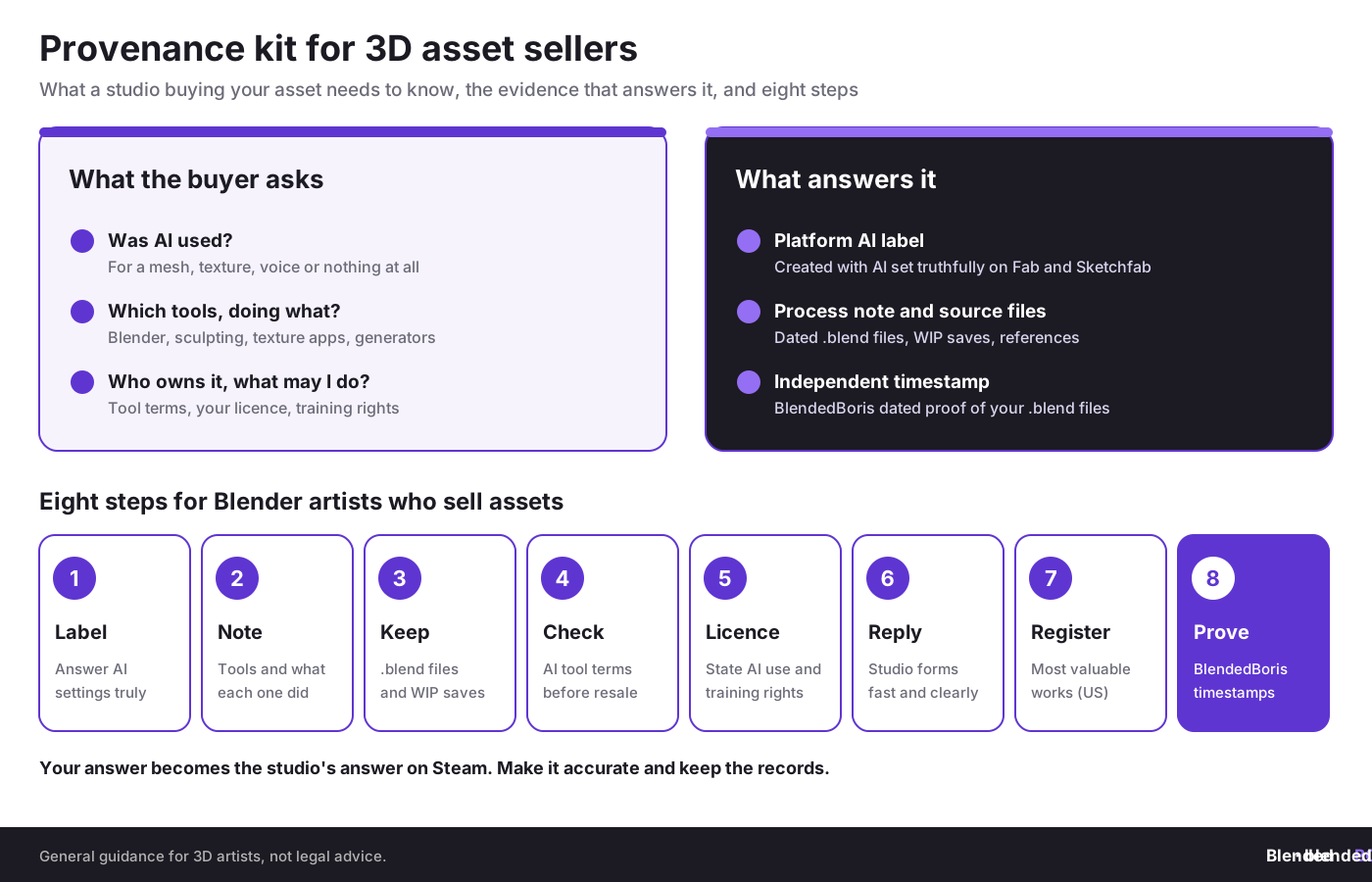
The fight between Epic and Valve is about consumer labels. Your situation is simpler: business buyers want accurate information and a clean chain of rights. These steps work whatever the platforms decide next.
- Answer AI questions truthfully. Set the Fab and Sketchfab labels correctly for every product, including older listings.
- Write a short process note per product. List the tools used, such as Blender, a texture app or an AI generator, and what each one did.
- Keep your source files. Save the .blend file, sculpt layers, bakes and reference boards with their dates.
- Check the terms of any AI tool you used. Make sure you own the output and may resell it before it goes into a pack.
- Put provenance in the licence. State whether AI was used and whether the buyer may use the asset for AI training. See Creative Commons vs copyright for Blender assets.
- Answer studio questionnaires quickly. A studio filling in Steam's survey will ask you; a ready process note wins repeat work.
- Register your most valuable works. In the US, registration decides what you can claim in court. See how to register copyright as a 3D artist.
- Prove authorship as you work. Timestamp your Blender files when you finish them, so provenance never rests on your word alone.
How does this connect to the wider fight over AI and 3D art?
Disclosure is one part of a bigger shift. Marketplaces are struggling with floods of AI copies, as in the Etsy AI copies story, and stock libraries are rewriting their business, as in the Getty Images bankruptcy. Blender itself is building better ways to deliver assets, with tokens and hashes in Blender 5.3 online asset libraries, but none of those features records who made a model or how.
For a fuller view, see art registration and provenance options for 3D artists, our guide to selling Blender 3D models, the sister blog's take on how human and AI art can coexist, and its guide to immutable proof of art creation.
What are our sister sites covering this week?
Our sister sites looked this week at what happens to design files when rules, courts and software change.
- Timing decides trade secret cases. A $452 million verdict over medical device CAD files was thrown out as filed too late, and the court has now refused to pause that ruling while the case heads to the Supreme Court: what Insulet v. EOFlow means for trade secrets on cadchain.com.
- Part files for repairers. A French draft decree would make manufacturers hand repairers 3D printing files of unavailable spare parts within 15 working days: France's 3D-printed spare parts decree on solidboris.com.
- Web systems around your designs. Autodesk says Inventor is not affected by the php2shell PHP flaws, but websites and portals around design data may be: what the php2shell vulnerability means for Inventor teams on borisinventor.com.
Conclusion
Tim Sweeney wants Steam to drop a label he sees as political, and Valve has not moved. Fab's label stays, because, in Sweeney's own words, it serves business buyers who need to know where content comes from. For Blender artists who sell assets, that is the useful part of the argument: studios want provenance, and the artists who can show how their work was made, with honest labels, source files and dated proof, are the ones they will trust and pay.
Make the provenance of your assets provable.
BlendedBoris records a blockchain timestamp of your Blender files from inside Blender, giving you dated proof of authorship to share with buyers alongside your AI labels, licences and copyright registrations.
👉 Get started with BlendedBoris
FAQ: Steam AI disclosure, Fab labels and 3D artists
Has Steam changed its AI disclosure rules after Sweeney's comments?
No. As of 26 October 2026, Valve has not commented and its rule stands. Developers still disclose generative AI content that players see or hear; coding and other internal tools have been excluded since January 2026.
Does Fab still require AI labels on assets?
Yes. Sellers must answer the Created with AI setting when they publish, buyers can hide labelled assets, and products that are deliberately misclassified can be removed. Sweeney defended the rule on 25 October 2026.
Do I have to label a model if I only used AI for a texture?
Read each platform's current wording. In general, if AI generated part of what the buyer receives, such as a texture or base mesh, say so. If in doubt, disclose and describe what the AI did.
Why do game studios care how my asset was made?
They sign distribution agreements and fill in disclosures such as Steam's content survey, and they must be able to defend the copyright of everything they ship. Your answer becomes their answer.
Can I copyright a 3D model made with AI tools?
In the US, material generated by AI from prompts alone is not protected, but your own modelling, editing, selection and arrangement can be. Keep records of what you did by hand.
What counts as proof of how an asset was made?
Source .blend files with dates, work-in-progress saves, reference boards, a short process note, platform upload dates and an independent timestamp of your files.
How can BlendedBoris help?
BlendedBoris timestamps your Blender files on a blockchain from inside Blender. That gives you dated proof that a file existed at a certain time, which supports your AI labels, licences and copyright registrations but does not replace them.


