
A German appeal court has rejected the argument that a work loses its copyright because "it was made by AI". In a decision dated 1 October 2026 and made public on 20 October, the Higher Regional Court of Frankfurt am Main (case 11 U 2/26) ruled that a songwriter's lyrics stayed protected even though AI was later used in producing the song, and that a rival artist who took the lyrics had infringed her rights.
The case is about music, but the argument at its centre is one every Blender artist should expect to hear sooner or later. When someone copies your work and you complain, the easiest defence today is to say your work was never yours in the first place: it came out of a generator, so there is nothing to protect. In Frankfurt, a copier tried exactly that, backed by an expert report, and lost.
The ruling was made in urgent interim proceedings, so it is not a final judgment on the merits, and it cannot be appealed. It does not say that AI output is protected. What it does show, very clearly, is how a court handles an AI objection in practice: it looks for the human raw version, asks whether that raw version was creative, and checks whether its creative elements survived into the copy. For 3D artists, that raw version is your blockout, your sculpt layers and your saved .blend files.
TL;DR: the Frankfurt "it was AI" ruling in one paragraph
A woman wrote song lyrics, her partner produced and released the song using the AI music tool Suno, and about three months later another artist released versions of a song built on the same lyrics. When the author asked for an injunction, the other side claimed the lyrics were AI-generated. The court accepted the author's sworn statements, rejected the expert's signs of AI, and held that later AI use does not remove protection from a human-made raw version whose creative elements are still in the published work. For Blender artists, the lesson is practical: if your work is ever challenged as AI-made, the strongest answer is dated evidence of your own raw version.
What did the Frankfurt court decide?
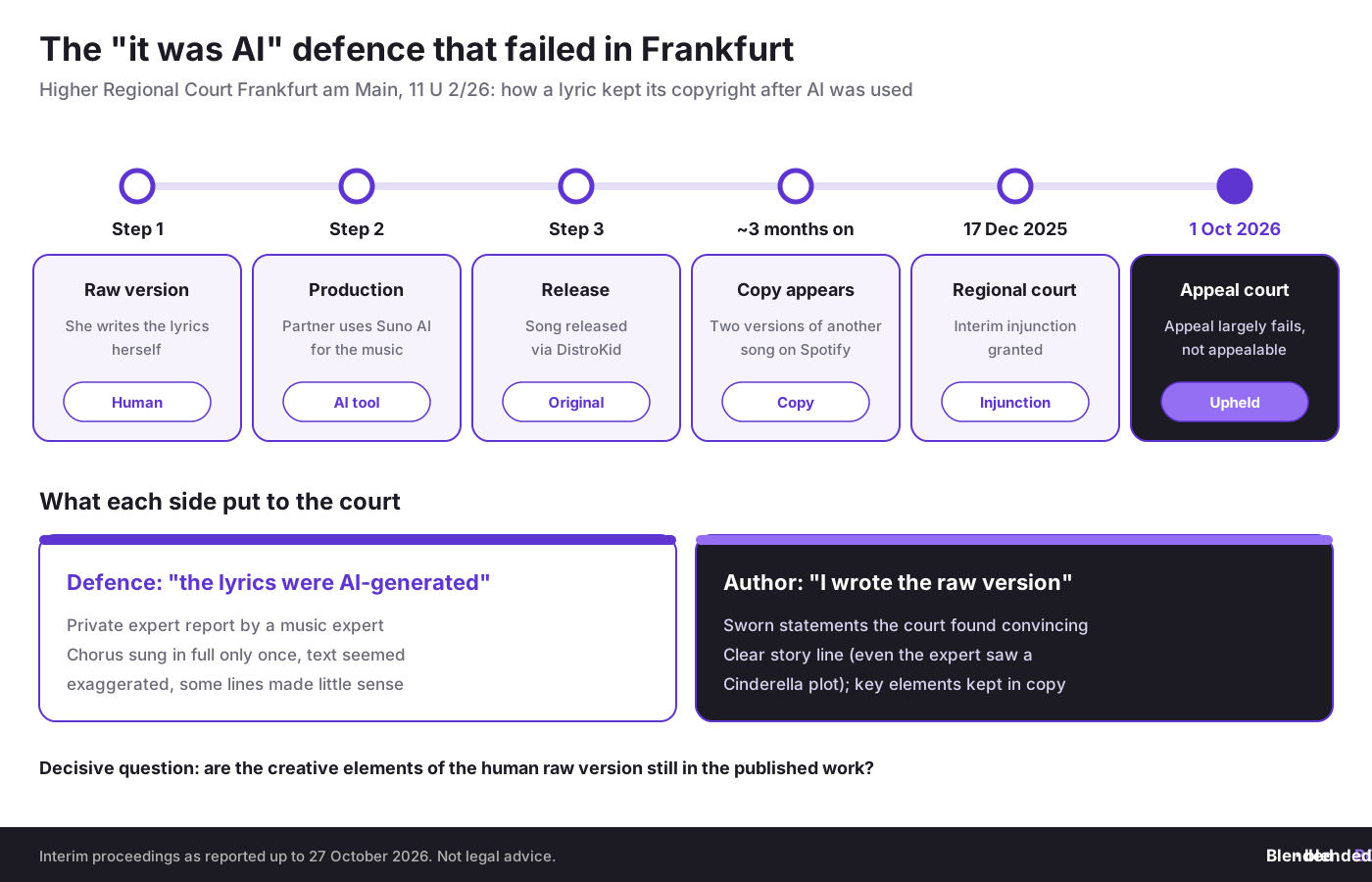
According to the court's summary as reported by beck-aktuell on 20 October 2026, a woman said she wrote the original text of a song herself. Her partner released the song through the distribution service DistroKid and used the AI system Suno when producing the music. Around three months later, another artist released two versions of a song on Spotify that, the woman said, contained essential parts of her lyrics. The artist even promoted it by telling fans to listen before the song was blocked, and said she was going on tour with a song that did not belong to her.
The author applied for an interim injunction. The Regional Court of Frankfurt granted it, and the other side appealed. Its main argument was that the lyrics had not been written by the woman at all but generated by AI, and it submitted a private expert report from a music expert to prove it. The appeal court, the 11th Civil Senate, largely rejected the appeal on 1 October 2026 and confirmed the injunction. Because this was an urgent procedure, the decision is final for this stage and cannot be challenged, but the parties could still fight the full case in main proceedings.
The parties' names and the song title have not been published. No damages were set in this decision, and the full text of the judgment was not yet public when we wrote this article.
Why did the "it was AI" argument fail?
The court looked at three things. First, who made the raw version. The author had made it credible, through sworn statements the court found internally convincing, that she wrote the first version of the lyrics herself. In German urgent proceedings, a party only has to make its case credible rather than prove it fully, and a sworn statement is an accepted way to do that.
Second, whether the signs of AI held up. The expert pointed out that the chorus was only sung in full once, that the text seemed exaggerated and that some sentences made little sense in combination. The court said none of this allowed a conclusion that AI wrote the text without further explanation. It also noted a clear narrative thread, which the expert himself had described as a Cinderella plot. Reporting on the earlier stage of the case adds a related point: the lower court said stylistic breaks can simply be artistic freedom, and that a party facing concrete indications of AI output must explain its own creative process in detail.
Third, whether the creative core survived. The decisive question, the court said, was whether the creative elements of the self-made raw version were still contained in the published version. They were, and the rival's song recognisably took essential creative parts of them. That was enough for infringement.
What did the court leave open?
Just as important for artists is what the judges did not decide. They did not decide whether, or how far, Suno changed the first version of the lyrics during production. They did not need to, because the protected human elements survived either way. According to legal commentary on the decision, the court also restated that pure AI output is generally not protected under German copyright law because it lacks human creative work, and it left open whether a particularly creative prompt could ever be enough.
So the ruling is not a licence to label AI output as your own. It protects the human part of a mixed workflow, provided that human part existed first, was creative, and can be shown. That is the same line drawn in the US, where the Copyright Office's January 2025 report said prompts alone do not give enough control, while human selection, arrangement and modification of AI output can be protected. We explained that line in the lessons on AI-generated art and copyright.
When someone says "it was AI", show the file history.
BlendedBoris is a Blender add-on that timestamps your Blender work on a blockchain, so you can show a buyer, a platform or a court dated proof that your raw version existed and came from your own workflow.
👉 See how BlendedBoris works
How does Frankfurt compare with other AI copyright decisions?
Courts and offices are slowly building a common picture of where human authorship begins and ends. The table sets out the main reference points as reported up to 27 October 2026. It is a simplified overview, not legal advice.
What does this mean for Blender artists?
Most 3D work today is already a mixed process. You might block out a character by hand, sculpt the forms, then use an AI tool to upscale a texture, generate a pattern or suggest variations. Under the Frankfurt approach, that later AI step does not wipe out your rights in the parts you made yourself, as long as your creative choices are still visible in the finished model. The same idea runs through our guide on whether 3D models automatically have copyright.
The flip side is that the burden of showing those choices falls on you. A copier who takes your model, your character or your environment and is caught may now say what the defendant said in Frankfurt: it looks generated, so it is free. The Frankfurt author won partly because the court believed her account and partly because the copier's evidence was weak. A 3D artist can do better than a sworn statement, because Blender work leaves a trail: incremental saves, sculpt layers, modifiers, render history and reference boards.
This matters most in three situations. When you send a takedown to a marketplace, as in the cases in our guide to cease and desist letters. When a client or platform questions whether an asset is AI-generated, a growing issue since the Steam and Fab AI label fight. And when you register work, because registration offices now ask what was made by a person and what by a machine, as explained in how to register copyright as a 3D artist.
What should Blender artists do now?
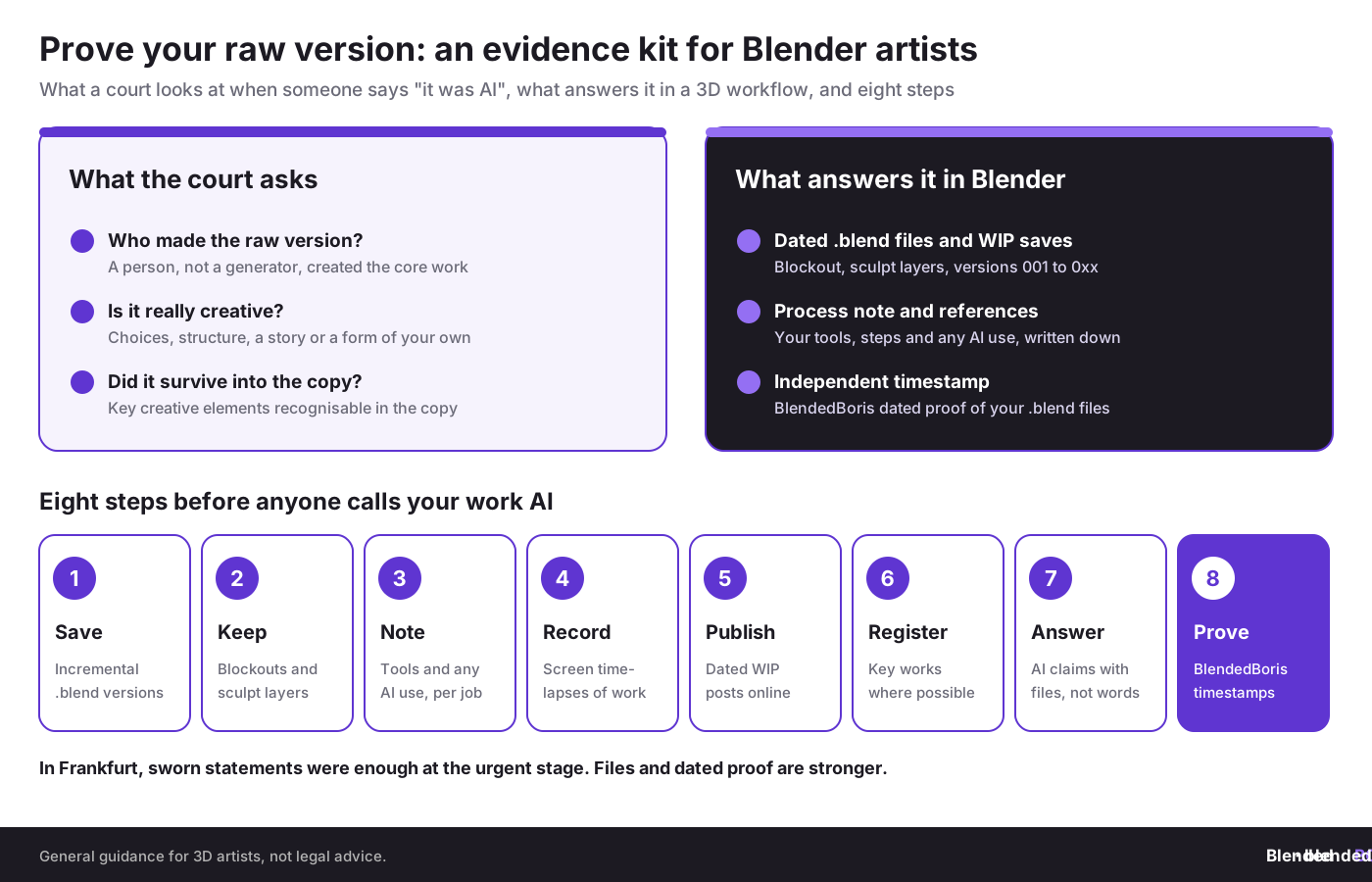
None of these steps needs a lawyer. They make it easy to show, quickly and with documents, that a human raw version existed and what happened to it.
- Save incrementally. Use numbered .blend versions (scene_001, scene_002) instead of overwriting one file.
- Keep blockouts and sculpt layers. Early shapes show your creative choices before any texture or AI step.
- Write a short process note per project. List your tools, what each did and where AI was used, if at all.
- Record some sessions. A short screen time-lapse of modelling is strong, easy-to-understand evidence.
- Publish dated work in progress. WIP posts on your portfolio or socials create a public record of dates.
- Register key works where you can. In the US, registration decides what you can claim in court. See art registration and provenance options.
- Answer AI claims with files, not opinions. If someone says your work is AI-made, reply with your version history and timestamps.
- Prove authorship as you work. Timestamp your Blender files when you reach milestones, so your raw version has an independent date.
How does this connect to the wider fight over AI and 3D art?
German courts have become one of the busiest places for AI and copyright disputes, from the music cases we covered in the Gruffalo AI copies story to authorship questions like this one. In the US, the main fights are about training data, as in the Thomson Reuters v. ROSS fair use ruling, and about copies offered for sale, as in the AI meme generator lawsuit. Each case adds a piece to the same question: who made this, and can they show it?
For a fuller view, see our 30+ landmark copyright cases for 3D artists, the 12 most common copyright issues for 3D artists, our overview of international AI art copyright laws, and the steps to navigate AI art and copyright in Blender. The sister blog covers the registration side in copyrighting AI-generated art, the bigger picture in how human and AI art can coexist, and evidence in immutable proof of art creation.
What are our sister sites covering this week?
Our sister sites looked this week at what happens when design files leave the people who made them.
- Spies around defence suppliers. German prosecutors arrested a suspected Russian agent accused of gathering information on defence production and people in the European defence industry: what the German spy arrest means for defence suppliers on cadchain.com.
- Copyright in CAD drawings. A Canadian court found copyright in a supplier's valve drawings but held that a useful-article exception covered the 3D CAD model: what the CAD drawings copyright ruling means on solidboris.com.
- Drawings taken by a departing engineer. China's Supreme People's Court upheld a judgment of 381.63 million yuan after an engineer took tens of thousands of drawings to a rival: what the Jingdiao trade secrets case means for Inventor teams on borisinventor.com.
Conclusion
The Frankfurt decision does not make AI output protected, and it is not the final word in this dispute. But it sends a useful message to anyone who copies creative work and hopes to hide behind the word "AI": courts will look for the human raw version and check whether its creative core survived. For Blender artists, the practical takeaway is simple. Your saved versions, sculpt layers, process notes and dated proof are what turn "I made this" from a claim into evidence.
Make your raw version provable.
BlendedBoris records a blockchain timestamp of your Blender files from inside Blender, giving you dated proof of authorship to use alongside your version history, licences and copyright registrations.
👉 Get started with BlendedBoris
FAQ: the Frankfurt AI copyright ruling and 3D artists
What did the Frankfurt court decide on 1 October 2026?
The Higher Regional Court of Frankfurt am Main (11 U 2/26) confirmed an interim injunction for a songwriter. It held that her lyrics stayed protected even though AI was used later in producing the song, because the creative elements of her own raw version survived in the published work.
Is the ruling final?
It was made in urgent interim proceedings and cannot be appealed, but it is not a judgment on the merits. The parties could still argue the full case in main proceedings.
Does this mean AI-generated art is protected by copyright?
No. According to commentary on the decision, the court restated that pure AI output is generally not protected because it lacks human creative work. It protected the human-made raw version, not the AI contribution.
How did the author prove she wrote the lyrics?
With sworn statements that the court found convincing. In German urgent proceedings, a party only has to make its case credible. In a full trial, stronger evidence such as drafts and dated files would help.
Can someone avoid infringement by claiming my 3D model was AI-made?
In Frankfurt, that argument failed because the claimed signs of AI were weak and the author's account was credible. Your best protection is dated evidence of your own process, such as incremental .blend files and timestamps.
Does using an AI texture or upscaler remove my copyright in a model?
Under the Frankfurt reasoning, later AI use does not remove protection from the parts you created yourself, as long as your creative choices remain in the result. Disclose AI use honestly and keep records of what you did by hand.
How can BlendedBoris help?
BlendedBoris timestamps your Blender files on a blockchain from inside Blender. That gives you dated proof that a file existed at a certain time, which supports your version history, licences and copyright registrations but does not replace them.


