
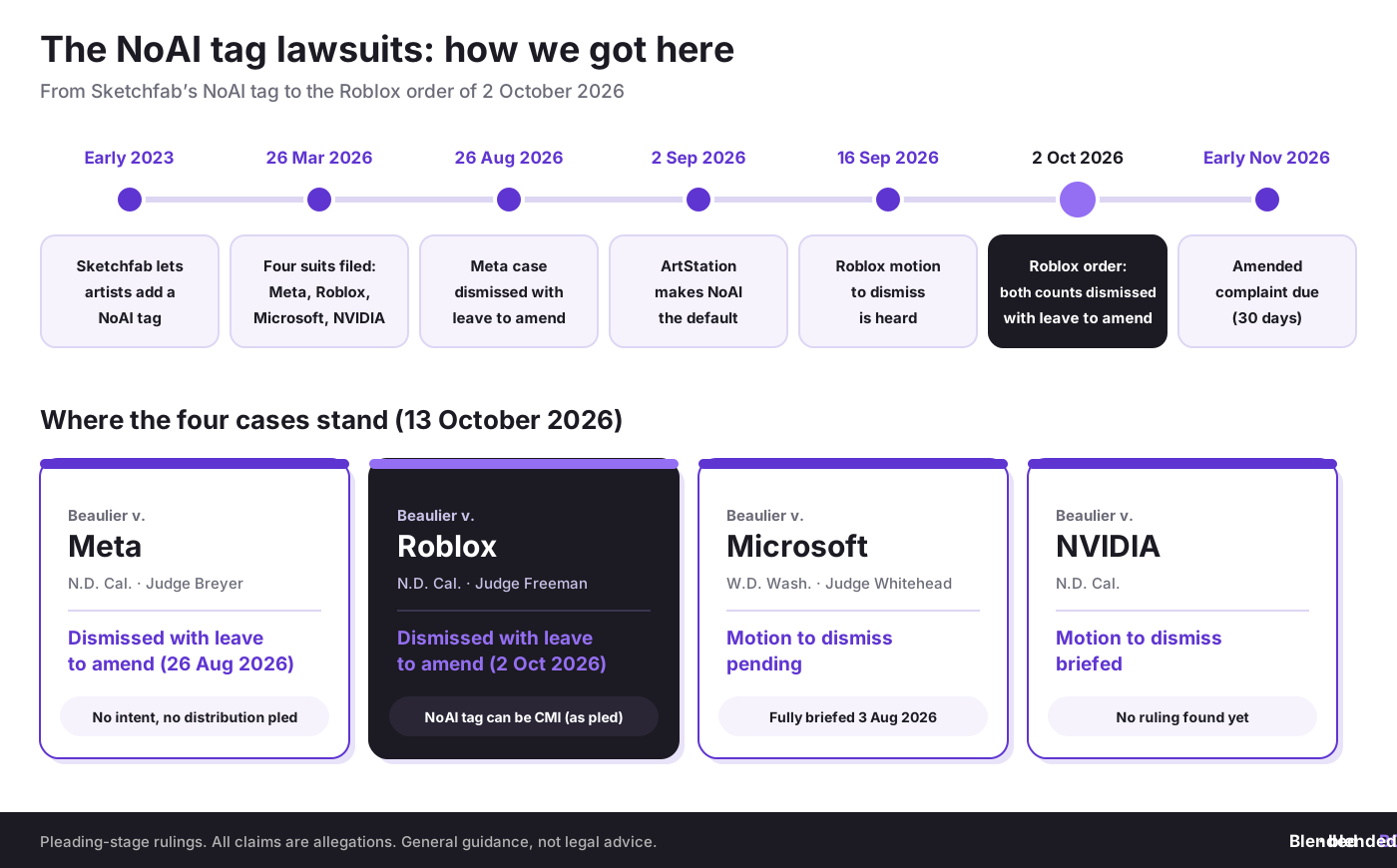
On 2 October 2026, a US federal judge in San Jose dismissed a 3D artist's AI-training lawsuit against Roblox, but not before finding that he had adequately alleged that a Sketchfab NoAI tag can count as copyright management information. Roblox won this round. The artist, Austin Beaulier, has until early November to file an amended complaint.
The case is Beaulier v. Roblox Corporation, decided by Judge Beth Labson Freeman of the Northern District of California. Beaulier makes 3D models for a living and has published more than 400 of them on Sketchfab, each one manually tagged NoAI. He alleges that Roblox obtained his models through the Objaverse-XL dataset and that its machine-learning pre-processing stripped his attribution, licence and NoAI information. These are allegations only; no court has found that Roblox removed anything.
For Blender artists who publish on Sketchfab, ArtStation or a marketplace, it is the clearest court discussion so far of 3D models, platform tags and AI training. It also exposes a practical gap: a tag on a web page is not information inside your file. Here is what the court decided, and what you can do in Blender today.
TL;DR: the NoAI tag ruling in one paragraph
At the pleading stage, Judge Freeman accepted that Beaulier has standing and that a Sketchfab NoAI tag, applied model by model, can plausibly qualify as copyright management information (CMI) under the DMCA. She still dismissed both DMCA counts, with leave to amend, because the complaint did not plausibly show intentional removal of that information or any distribution. The practical lesson for 3D artists: a platform tag lives on the listing page, not in the model. Put your name and licence inside the files you share, choose your licence on purpose, keep dated originals, and register or timestamp the work that matters.
What did the court decide in Beaulier v. Roblox?
Beaulier brought two claims under Section 1202(b) of the US Copyright Act, the part of the DMCA that protects copyright management information. Count I alleged that Roblox removed his CMI. Count II alleged that Roblox distributed works knowing the CMI had been removed. Roblox asked the court to dismiss both. The order, which you can read in full on CourtListener (court order, PDF), went point by point:
“But internal use is not distribution.”
Judge Beth Labson Freeman, US District Court for the Northern District of California, order of 2 October 2026
The order also noted that the Ninth Circuit, in Doe 1 v. GitHub (16 September 2026), appeared to reject the identicality rule Roblox urged.
What is the Sketchfab NoAI tag, and why could it count as CMI?
Since early 2023, Sketchfab has let creators mark models with a NoAI tag. Technically, it adds an HTML meta tag to the model's web page that asks AI crawlers not to use the work. Beaulier added it by hand to every one of his more than 400 models, and he published them under the CC-BY (attribution) licence.
Under 17 U.S.C. §1202(c), CMI includes the author's name, the copyright owner and the terms and conditions for use of a work. The court found two facts persuasive at this stage. Because the tag was applied model by model, each tag was tied to a specific work. And because its intended reader was a crawler, the tag was plausibly connected to the work itself, not just floating on a website. That is a meaningful signal for artists, but remember what it is: a finding that the allegation is plausible, not a ruling that NoAI tags are CMI.
Why did Roblox still win this round?
A DMCA §1202 claim needs more than a missing tag. The court treated removal as the gatekeeper to the whole case.
Removal versus a failure to preserve
The complaint described the pipeline steps (format conversion, mesh normalisation, rendering and voxelisation) as a transformation of the models. The court read that as consistent with Roblox simply not carrying the CMI along, which is different from actively removing it.
Intent
The court rejected Roblox's view that intent requires a process built to target CMI, but held that a uniform process where loss of CMI is a by-product is not enough. The complaint's own description of removal as an inherent consequence of large-scale AI training worked against Beaulier.
Distribution
Count II needs the stripped works to have been distributed. One general sentence about Roblox's AI platform was not enough, and internal use is not distribution.
The same weaknesses sank the sister case against Meta, dismissed with leave to amend on 26 August 2026 for want of intent and distribution. For a longer view of how courts have treated creators' claims, see our round-up of 30+ landmark copyright cases for 3D artists.
Keep proof of your Blender work that no platform controls.
BlendedBoris is a Blender add-on that timestamps your work on a blockchain, giving you dated proof of authorship before you upload, share or sell.
👉 See how BlendedBoris works
Why does a platform tag not travel with your model?
Sketchfab says so itself, in its help article on generative AI policies and NoAI protection:
“The NoAI tag does not stay with models when they leave the platform.”
Sketchfab Help Center, Generative AI Policies, Tagging, and NoAI Protection
Under a Creative Commons licence, Sketchfab adds, only the CC licence applies off the platform; the NoAI tag works with its Standard and Editorial licences. Once a downloaded or scraped file sits in a dataset, the meta tag on your listing page is no longer next to it.
On 2 September 2026, ArtStation made NoAI the default for new and existing work and began working with Cloudflare to block known AI crawlers, without banning AI art. Both Sketchfab and ArtStation say no measure can stop all scraping. Turn these settings on, then add protection that does not depend on any one platform. Our step-by-step guide to opting out of AI training datasets and the overview on how to protect your art from AI training show where the switches are.
How can Blender artists put authorship information inside their files?
The next layer is information in the file itself. It will not stop a determined scraper, and a pipeline can still discard it, but it travels with every copy you distribute. Blender gives you three places.
1. The glTF Copyright field
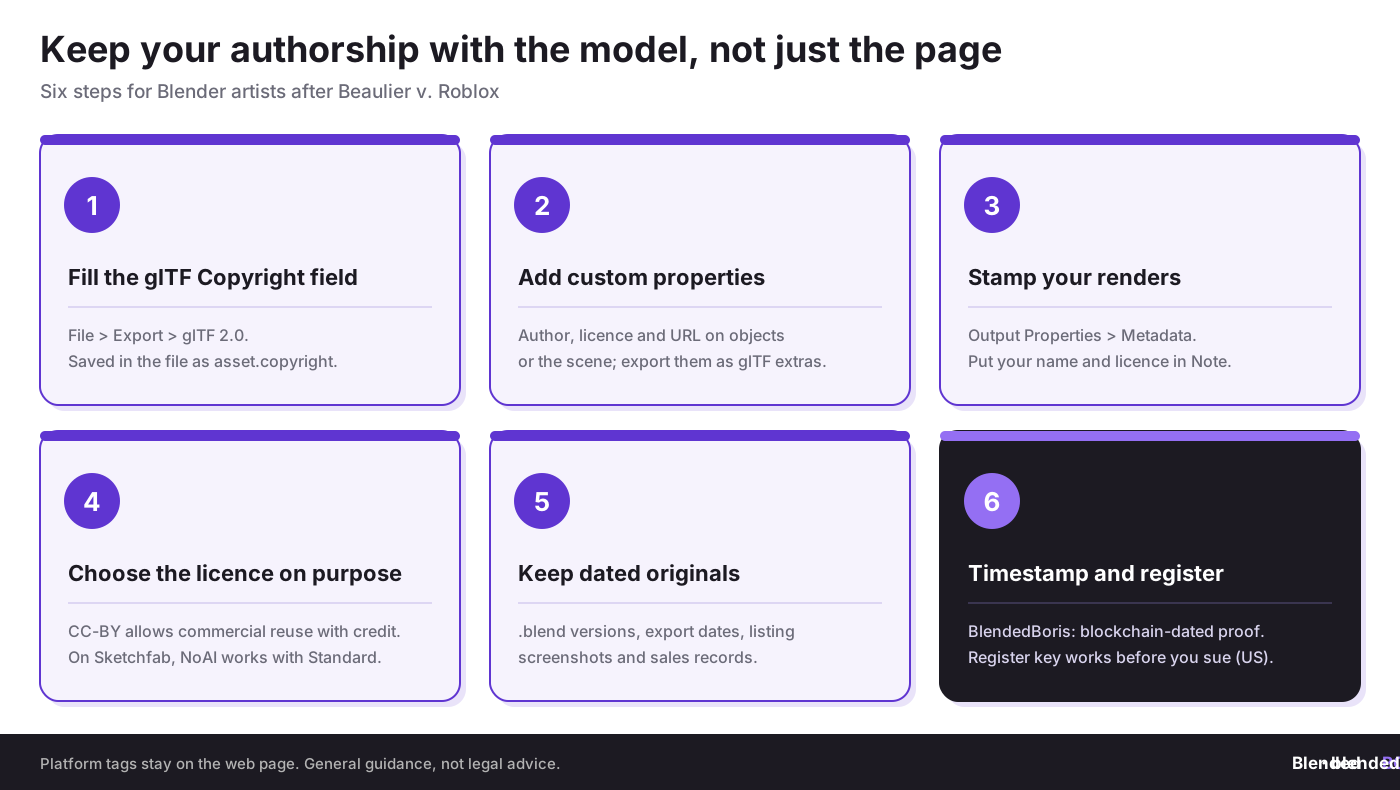
When you export with File > Export > glTF 2.0, fill in the Copyright field with your name, the year and your licence. Blender writes it into the file as asset.copyright, so it sits in every .glb or .gltf you upload.
2. Custom properties exported as glTF extras
Add custom properties such as author, licence and a link to your listing on the scene or on key objects. With custom properties enabled in the exporter, they are written into the file as glTF extras. A short, consistent notice works best: our copyright notice templates for 3D artists give you wording to copy.
3. The render metadata stamp
For renders, open Output Properties > Metadata, enable the fields you want and type your name and licence into the Note field. More options, including visible and invisible marks, are in our guide to Blender metadata and watermarking.
Which licence should you choose: CC-BY or Standard?
Beaulier's claim rests partly on use beyond the scope of his licence, so the licence is a real decision, not a default. CC-BY allows anyone to reuse a model commercially as long as they give credit. On Sketchfab, if you want the NoAI protection to apply after a free download, the platform says to use its Standard licence rather than CC.
CC-BY can grow your audience; a more restrictive licence keeps more control. Compare the options in Creative Commons vs copyright for Blender assets and check each store's rules in our guide to Blender marketplace copyright policies.
Why do dated originals and registration matter?
In the parallel Microsoft case, a joint status report filed on 25 September 2026 lists Microsoft's planned discovery topics, including the artist's ownership of the models, the location and form of CMI on his works, and his licensing history and revenue. In any dispute, you will need the same evidence.
- Keep originals and versions. Save .blend files with version history, export dates, listing screenshots and sales records. See auto-save and version control in Blender and how to save and back up Blender projects.
- Register important works in the US. For US works, registration is generally required before you can file an infringement suit (17 U.S.C. §411), and timely registration is needed for statutory damages and attorney's fees (§412). Our step-by-step guide shows how to register copyright, and art registration and provenance covers registries.
- Add an independent timestamp. A hash of the file recorded on a blockchain gives a tamper-evident record that a specific file existed at a specific time. It complements registration; it does not replace it. We explain the idea in immutable proof of art creation and weigh it up in blockchain copyright registration benefits and drawbacks.
A DMCA §1202 claim is a separate route from an infringement claim and, as this order shows, a hard one to plead. Good records help with both.
What should Blender artists do now?
- Turn on NoAI wherever it exists. On Sketchfab, use the account-wide setting to add NoAI meta tags to all uploads. On ArtStation, check that your existing projects show NoAI.
- Embed your authorship: the glTF Copyright field, custom properties exported as extras, and the render metadata Note field.
- Choose your licence deliberately for each upload, knowing what CC-BY allows.
- Keep dated originals: .blend versions, export files, screenshots and sales records.
- Register or timestamp the work that matters, so you have dated evidence before a dispute starts.
- Know your takedown options if you find a copy: our DMCA takedown guide for Blender artists walks through them, and how to protect Blender models from theft covers prevention.
How does this fit the bigger picture of AI and creative data?
The NoAI cases are one front in a wider question: who controls the data that creators and engineers produce, and on what terms can AI systems use it? The same question is playing out across design software this autumn.
- Engineering data changing hands. Schneider Electric's planned purchase of PTC puts the vendor behind Creo, Windchill and Onshape under new ownership. Our sister site looks at the $22.6 billion PTC deal and who controls design data on cadchain.com.
- CAD vendors and customer data. The SOLIDWORKS 2027 release comes with a statement that its AI is not trained on customer data. Read what is new in SOLIDWORKS 2027 on solidboris.com.
- AI in Autodesk Inventor. Autodesk's AI plans for Inventor, and its answer on training with customer data, are covered in Autodesk Inventor AI after AU 2026 on borisinventor.com.
Whether you sculpt in Blender or design parts in CAD, the lesson is the same: know what you own, keep your terms with the work, and keep proof that does not depend on a platform.
What happens next in the NoAI cases?
- Roblox: Beaulier may file an amended complaint within 30 days of the 2 October order, which points to early November 2026. If he does not, or does not fix the problems, the deficient claims can be dismissed with prejudice.
- Microsoft: the motion to dismiss in the Western District of Washington was fully briefed on 3 August 2026 and is still pending.
- NVIDIA: a motion to dismiss has been briefed in the Northern District of California, with no ruling found as of mid-October.
All four cases rest on allegations. None has reached a finding that any company removed CMI or infringed copyright.
Conclusion
The Roblox order is a partial win for artists on the law and a loss on the facts as pled. A NoAI tag can plausibly be copyright management information, but it did not carry the case past removal, intent and distribution. For Blender artists the takeaway is practical: switch on platform protections, put your name and licence inside your files, choose licences on purpose, and keep dated, independent proof of what you made.
Timestamp your Blender work before you share it.
BlendedBoris records a blockchain timestamp of your Blender files from inside Blender, so you have dated proof of authorship alongside your licence and registration.
👉 Get started with BlendedBoris
FAQ: the NoAI tag ruling and Beaulier v. Roblox
Did a court rule that the NoAI tag is copyright management information?
Not exactly. On 2 October 2026 Judge Beth Labson Freeman found that Austin Beaulier had adequately alleged that a Sketchfab NoAI tag can qualify as CMI. That is a pleading-stage finding, not a final ruling.
Why was the case against Roblox dismissed?
The complaint did not plausibly show that Roblox intentionally removed CMI, as opposed to passively failing to preserve it during pre-processing, and it did not show any distribution of the stripped files. The court said internal use is not distribution.
Is the Roblox case over?
No. The dismissal was with leave to amend, so an amended complaint can be filed by early November 2026. Similar suits against Meta, Microsoft and NVIDIA are at different stages.
Does the Sketchfab NoAI tag protect my model after it is downloaded?
Not on its own. According to Sketchfab, the tag belongs to its platform and does not follow a model that leaves it. Under a Creative Commons licence only the CC licence applies off-platform; the NoAI tag works with Sketchfab's Standard and Editorial licences.
How do I add copyright information to a model in Blender?
Fill in the Copyright field when exporting to glTF 2.0, which is saved as asset.copyright, add custom properties such as author and licence that export as glTF extras, and use the Note field in Output Properties > Metadata for renders.
Should I use CC-BY for my Blender models?
CC-BY lets anyone reuse your model commercially if they credit you. If you want Sketchfab's NoAI protection to apply after a free download, Sketchfab points to its Standard licence instead.
Does a blockchain timestamp replace copyright registration?
No. A blockchain timestamp, like the one BlendedBoris creates, gives independent, tamper-evident proof that a specific file existed at a specific time. For US works, registration is generally still needed before suing and for statutory damages, so use both.


