
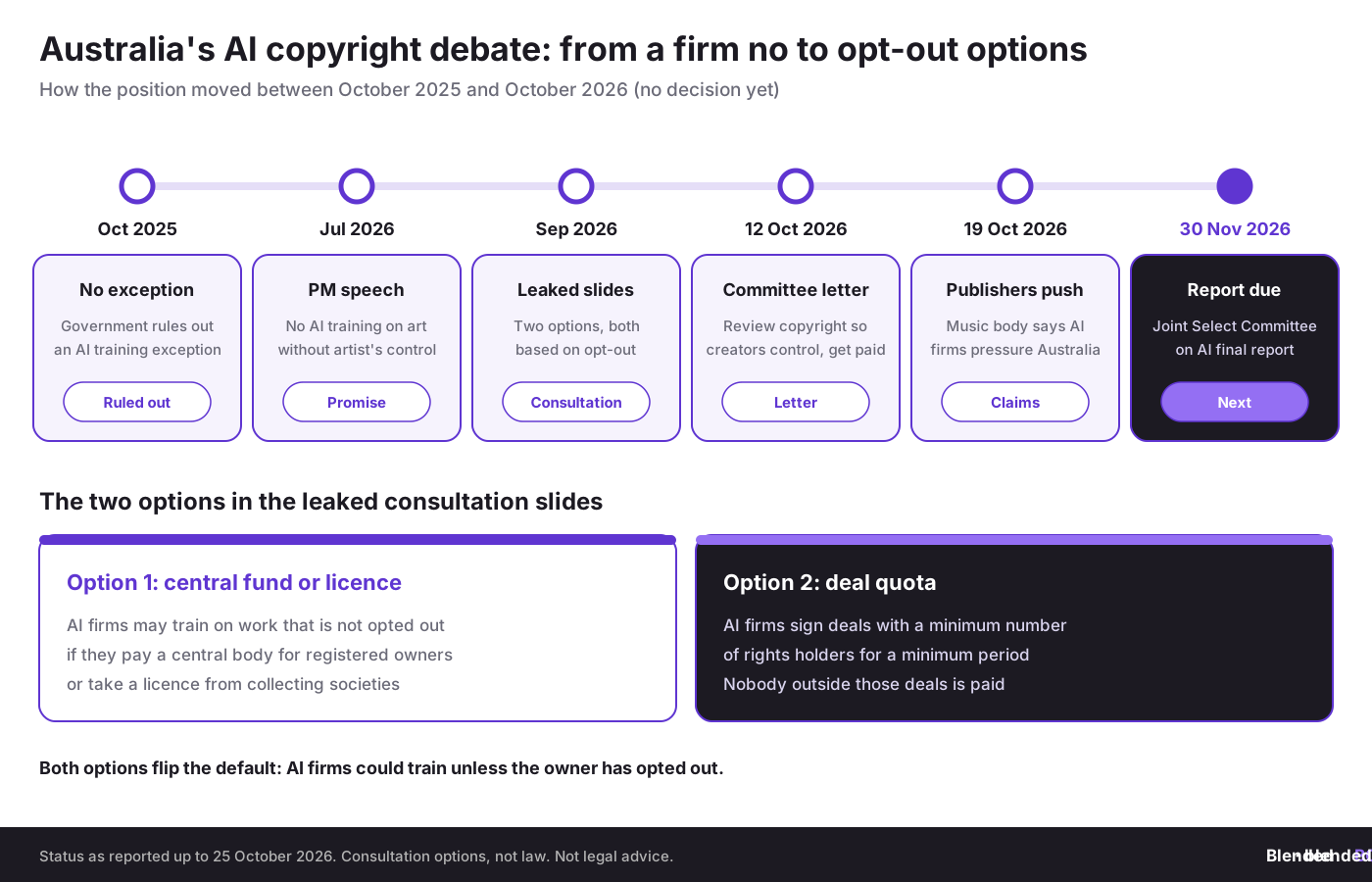
Australia is in the middle of a public fight over whether AI companies should be allowed to train on creative work unless the owner opts out. On 12 October 2026, the leaders of the federal parliament's Joint Select Committee on Artificial Intelligence wrote to Prime Minister Anthony Albanese urging a review of the country's copyright settings, and in the week that followed, music publishers accused AI firms of pressuring the government. No decision has been made, and the committee's full report is due by 30 November 2026.
The trigger was a set of confidential consultation slides, titled "AI on Australian Terms", that the Attorney-General's Department showed to rights-holder groups in September. As the ABC reported on 15 September, both options in those slides would let AI companies train on Australian work that has not been opted out, under conditions. That is a sharp turn for a government that, in October 2025, publicly ruled out a text and data mining exception for AI training.
Why should Blender artists elsewhere care? Because AI training rules are being written country by country, and they all come down to one choice: does an AI company need your permission first, or do you have to say no? If Australia picks opt-out, it joins the EU in putting the burden on creators.
TL;DR: the Australia AI copyright opt-out debate in one paragraph
Leaked government slides in September 2026 showed two options that would let AI firms train on Australian creative work unless owners opt out, either by paying into a central fund or by signing a minimum number of licence deals. Parliament's AI committee asked the Prime Minister on 12 October to review copyright settings so creators keep control and get paid. Nothing is decided; the committee reports by 30 November. For 3D artists the lesson is practical: opt-out only works if you use it, so mark your work, read platform terms and keep dated proof of authorship for your .blend files.
What is Australia actually proposing on AI training?
There is no bill yet, only a consultation by the Attorney-General's Department. Both of its options start from the same idea: owners could opt out of AI training, and AI companies could train on material that has not been opted out if they meet certain conditions.
Under the first option, an AI company could train on unprotected material by paying a central body that would pass the money on to registered copyright owners, or by taking a training licence from Australian collecting societies. According to the ABC, that licence could cover work by creators who are not members of those societies. Under the second option, an AI company would earn the right to train by signing deals with a minimum number of rights holders for a minimum period. The slides were blunt about what that would mean for everyone else:
“No additional $ would be payable to creators or rights holders beyond deals negotiated to achieve quota.”
Attorney-General's Department consultation slides, as reported by the ABC, 15 September 2026
The slides also listed penalties for ignoring opt-outs, protections for Indigenous Cultural and Intellectual Property, transparency and audit requirements, and "best efforts" to avoid training on pirated material. The government said it was still consulting creators, media organisations and AI companies, and OpenAI confirmed it had taken part. Independent senator David Pocock criticised the plans in the Senate, arguing that the burden should not fall on Australians to defend their own rights.
Why is this a reversal of Australia's earlier position?
In October 2025, Attorney-General Michelle Rowland told the ABC that the government would not entertain a text and data mining exception, the legal tool that lets AI companies copy works for training without asking. Creative groups and publishers welcomed the decision.
In July 2026, the Prime Minister went further in a speech at the University of Sydney:
“No company should use Australian books, music, art or news to build or train AI without the artist's control.”
Prime Minister Anthony Albanese, University of Sydney, July 2026
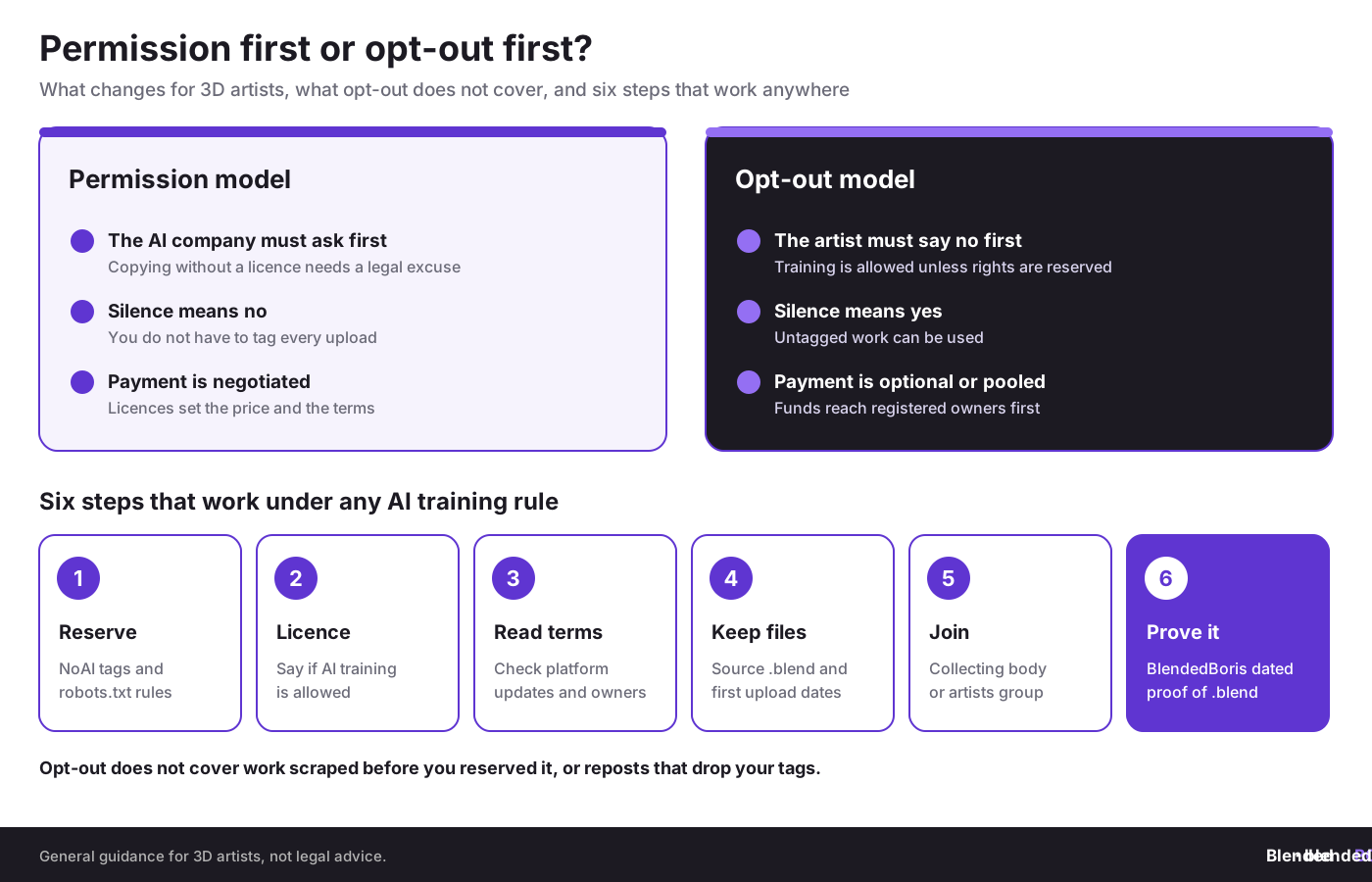
An opt-out model sits awkwardly next to that promise. Opting out is a form of control, but it flips the default: today an AI company is expected to ask; under opt-out it may go ahead unless you have already said no. For a solo 3D artist with work on ArtStation, Sketchfab, Fab, social media and a personal site, that difference is enormous.
What did the parliamentary AI committee say?
On 6 October, the Joint Select Committee on Artificial Intelligence heard from Anthropic's international special envoy Jeff Bleich, OpenAI's Adam Cohen and Annabelle Herd of the music bodies ARIA and PPCA. Music Business Worldwide's account of the hearings reports that Bleich argued it was not practical to license every rights holder, Cohen pointed to US fair use, and Herd accused the AI companies of seeking a free ride.
On Monday 12 October, committee chair Jo Briskey, a Labor MP, and deputy chair Jonathon Duniam, a Liberal senator, wrote to the Prime Minister with early observations. According to AAP's report, the letter said local artists' work was being used without adequate control or payment under current settings, and recommended that the government look again at copyright settings so that creators keep control of their work and are paid for it. The letter also covered AI safeguards, sovereign capability and AI literacy.
On 13 October, Guardian Australia reported that a senior adviser in the Prime Minister's office had edited the letter shortly before it was sent. Pocock, a committee member, said the recommendations had been pre-vetted and overlooked artists' concerns; Briskey said the letter was agreed by consensus. It shows how contested the question has become inside government.
Why are music publishers leading the pushback?
Music has the best-organised rights holders in the debate, so they have been the loudest. On 19 October, Guardian Australia published claims by the International Confederation of Music Publishers (ICMP) that AI companies were pressuring Australian policymakers by tying investment to looser copyright rules. ICMP's director general John Phelan said 62 countries, Australia among them, had looked at changing their laws for AI, and that none of the other 61 had adopted a commercial text and data mining exception or cut back creators' exclusive rights.
ICMP also said Google's Gemini could reproduce lyrics by Kylie Minogue and Nick Cave, and pointed to a public dataset linking to more than 12 million songs on YouTube. These are an industry group's allegations, and appearing in a dataset does not prove a song was used to train a specific model.
Visual artists' position is on record too: in 2025, Australia's National Association for the Visual Arts told the Productivity Commission that artists should not be swept into datasets and then expected to opt out.
Opt-out only protects work you can prove is yours.
BlendedBoris is a Blender add-on that timestamps your Blender work on a blockchain, so you hold dated proof of authorship for every model and render, whatever opt-out or licensing rules end up applying to it.
👉 See how BlendedBoris works
How does Australia compare with the EU, UK, US and Japan?
Australia is not inventing the opt-out idea. The EU already uses it, the UK considered it and backed away, and the US is settling the question in court. The table below sets out where each stands as of 25 October 2026. It is a simplified overview, not legal advice, and you can read more in our guide to international AI art copyright laws.
Either option would move Australia closer to the EU model, with a payment route added. Critics say a fund paying registered owners rarely reaches independent artists, and the second option pays nobody outside the deals. We looked at how US courts are handling training in what the Thomson Reuters v. ROSS ruling means for Blender artists, and at the EU and UK debate in the future of AI art legislation.
Does opting out actually work for 3D artists?
Opt-out is only as strong as the signal you send and the companies that respect it. For 3D artists that signal usually takes three forms: a machine-readable tag on a platform, such as the NoAI tags on ArtStation and Sketchfab; rules in the robots.txt file of your own website; and clear licence terms on every listing. A US court recently found that a Sketchfab NoAI tag can count as copyright management information, as we explained in the NoAI tag ruling in the Roblox case, but that does not stop a crawler that ignores it.
There are also gaps that no opt-out covers. Work that was scraped before you marked it may already sit in training sets. Reposts of your renders on other sites will not carry your tag. And platform terms can quietly widen, as we saw with Meta's new website crawling clause. Our step-by-step guide to opting out of AI training datasets in Blender and the sister blog's AI dataset opt-out strategies show what you can do today, and how to protect your art from AI training covers the technical side.
Opt-out is a negotiating position, not a shield. What decides whether you get paid or win a case is evidence: when you made the work, where you published it and what licence it carried.
What should Blender artists do now?
You do not need to wait for Canberra. These steps work under any of the models above and will matter even more if more countries choose opt-out.
- Mark your work as reserved. Turn on NoAI tags where platforms offer them and add AI crawler rules to your site's robots.txt.
- Put a licence on every listing. Say whether AI training is allowed. See Creative Commons vs copyright for Blender assets.
- Read platform terms when they change. Check whether a new version gives the platform or its partners training rights.
- Keep source files and first-upload dates. A .blend file, a dated render and a first publication link are the core of any claim.
- Register your most valuable works. It is not needed for copyright in Australia or the EU, but in the US it decides what you can claim. See how to register copyright as a 3D artist.
- Join a collecting society or artists' body. Under a fund or collective licence, registered members are the most likely to be paid.
- Respond to consultations. Australian artists can contact the committee and their MPs before the 30 November report.
- Prove authorship from day one. Timestamp your Blender work when you finish it, long before any training set is built.
How does this connect to the rest of the AI copyright fight?
The Australian debate runs in parallel with cases that test the same question from the other end. Studios are suing image generators over characters, as in the Midjourney copyright lawsuit, illustrators are considering action over AI copies, as in the Gruffalo AI copies story, and smaller disputes are being settled quietly, as in the AI meme generator lawsuit. Rules on likeness are moving too, with Denmark's deepfake bill covering digital doubles and 3D scans.
For a wider view of where artists stand, see artist rights in AI training, our list of the 12 most common copyright issues for 3D artists, and the guide to navigating AI art and copyright in Blender.
What are our sister sites covering this week?
Our sister sites looked at the same question of file control this week for engineering teams.
- Side systems leak too. Loxone said attackers entered through a web server and copied CRM and support data: what the Loxone cyberattack teaches on cadchain.com.
- Bulk downloads in under an hour. The Helix extortion group uses phone phishing and SharePoint bulk downloads: how Helix steals SharePoint data on solidboris.com.
- Licences hidden in AI terms. CloudNC's AI quoting agent reads uploaded CAD files under a broad licence to improve the service: what to check before sending CAD files to an AI quoting agent on borisinventor.com.
Conclusion
Australia has not changed its copyright law, and it may not. What has changed is the conversation: a government that ruled out an AI training exception a year ago is now testing options that would let AI firms train unless the owner says no. The committee's full report lands by 30 November. For Blender artists anywhere, the useful response is the same: mark your work, license it, watch platform terms and keep dated proof that the work is yours.
Make your authorship provable before any training set is built.
BlendedBoris records a blockchain timestamp of your Blender files from inside Blender, giving you dated proof that sits alongside your opt-out tags, licences and copyright registrations.
👉 Get started with BlendedBoris
FAQ: Australia's AI copyright opt-out and 3D artists
Has Australia changed its copyright law for AI training?
No. As of 25 October 2026 there is no bill and no decision. The government is consulting on options, and the Joint Select Committee on Artificial Intelligence is due to report by 30 November 2026.
What are the two opt-out options in the leaked slides?
Both let AI firms train on work that has not been opted out. In the first, they pay a central body or take a licence from collecting societies. In the second, they sign a minimum number of deals with rights holders, and nobody outside those deals is paid.
What is a text and data mining exception?
It is a rule that lets someone copy works to analyse them, including for AI training, without asking the copyright owner. Australia ruled one out in October 2025. The EU has one with an opt-out for commercial use.
What did the parliamentary committee recommend?
In a letter of 12 October 2026, the chair and deputy chair asked the Prime Minister to review copyright settings so that creators keep control of their work and are paid when it is used. The full report is still to come.
How can a 3D artist opt out of AI training today?
Use NoAI tags where platforms offer them, add AI crawler rules to your website's robots.txt, state in your licences that AI training is not allowed, and keep records showing when you did each of these.
Does opting out remove work that was already used for training?
Usually not. Opt-outs work for future copying. Work already in a dataset or a trained model is hard to remove, which is why evidence of when you made and published it matters.
How can BlendedBoris help?
BlendedBoris timestamps your Blender files on a blockchain from inside Blender. That gives you dated proof that a file existed at a certain time. It supports opt-outs, licences and copyright registration, but does not replace them.


