
On 29 September 2026, the US Court of Appeals for the Third Circuit ruled in Thomson Reuters v. ROSS Intelligence that copying 2,243 Westlaw headnotes to train an AI legal research tool was not fair use. It is the first time a federal appeals court has decided whether training an AI system on copyrighted material is fair use, and the court also recognised a market for licensing content as AI training data.
The case is about legal summaries, not 3D models or digital art. ROSS, a now-defunct legal AI startup, obtained Westlaw headnotes through a third party after Westlaw refused it access, and used them to build training data for a search tool that competed with Westlaw. Judge Tamika Montgomery-Reeves wrote the opinion for a panel that also included Judges L. Felipe Restrepo and Emil J. Bove III. As reported by Courthouse News, she rejected the framing that the case was about the future of AI:
“But appearances can be deceiving. In truth, this is no more than an ordinary copyright case.”
Judge Tamika Montgomery-Reeves, Third Circuit, 29 September 2026
That is exactly why Blender artists should pay attention. The ruling does not decide whether image or 3D generators may train on your renders and models, and the court said so. But it confirms that "we used it to train AI" is not a defence on its own, that taking whole works counts against the copier, and that losing a training-data licensing deal can be real market harm. Here is what the court decided, what it left open, and what it means for your portfolio.
TL;DR: the Third Circuit AI training ruling in one paragraph
In Thomson Reuters v. ROSS Intelligence (No. 25-2153), the Third Circuit affirmed a 2025 district court ruling: Westlaw's headnotes are original enough for copyright, and ROSS's copying of them to train a competing, non-generative AI tool was not fair use. Three of the four fair use factors went against ROSS, including harm to a market for licensing headnotes as AI training data. The court expressly distinguished generative AI, because ROSS's system could not generate original expression, so the big image and model cases remain open. ROSS says it will seek Supreme Court review. For Blender artists: your licensing terms, your dated records and any AI training permissions you sell now matter more, not less.
What did the Third Circuit decide in Thomson Reuters v. ROSS?
The appeal came up early. Judge Stephanos Bibas, sitting by designation in the District of Delaware, granted Thomson Reuters partial summary judgment on 11 February 2025 and then certified two questions for interlocutory appeal: whether the headnotes are original, and whether ROSS's use was fair. The Third Circuit heard argument on 11 June 2026 and answered both against ROSS in a precedential opinion, according to a summary by Haynes Boone.
- The headnotes are copyrightable. The originality bar is very low, and the editors' choices about which points of law to include and how to phrase them were enough.
- The training was not fair use. ROSS had a third party prepare around 25,000 training memoranda that used the headnotes to frame legal questions, and turned them into machine-readable data.
- Commercial and barely transformative. Training was an intermediate step, but the end product did the same job as Westlaw: legal research.
- A training-data market exists. Thomson Reuters already used its headnotes to train its own AI tools, and the court treated licensing them as AI training data as a market that ROSS's copying harmed.
- Not generative AI. In a footnote the court set the generative AI cases aside because ROSS's system cannot generate original expression; it returned existing court passages.
ROSS's lawyer said the company will ask the US Supreme Court to review the decision. Until then, it is binding law in the Third Circuit, which covers Delaware, New Jersey, Pennsylvania and the US Virgin Islands, and persuasive authority elsewhere.
How did the court weigh the four fair use factors?
US fair use turns on four statutory factors. The table shows how the Third Circuit weighed each one, as summarised by the law firm analyses of the opinion, and what each means for a Blender artist whose work might end up in a training set. The right-hand column is our reading, not legal advice.
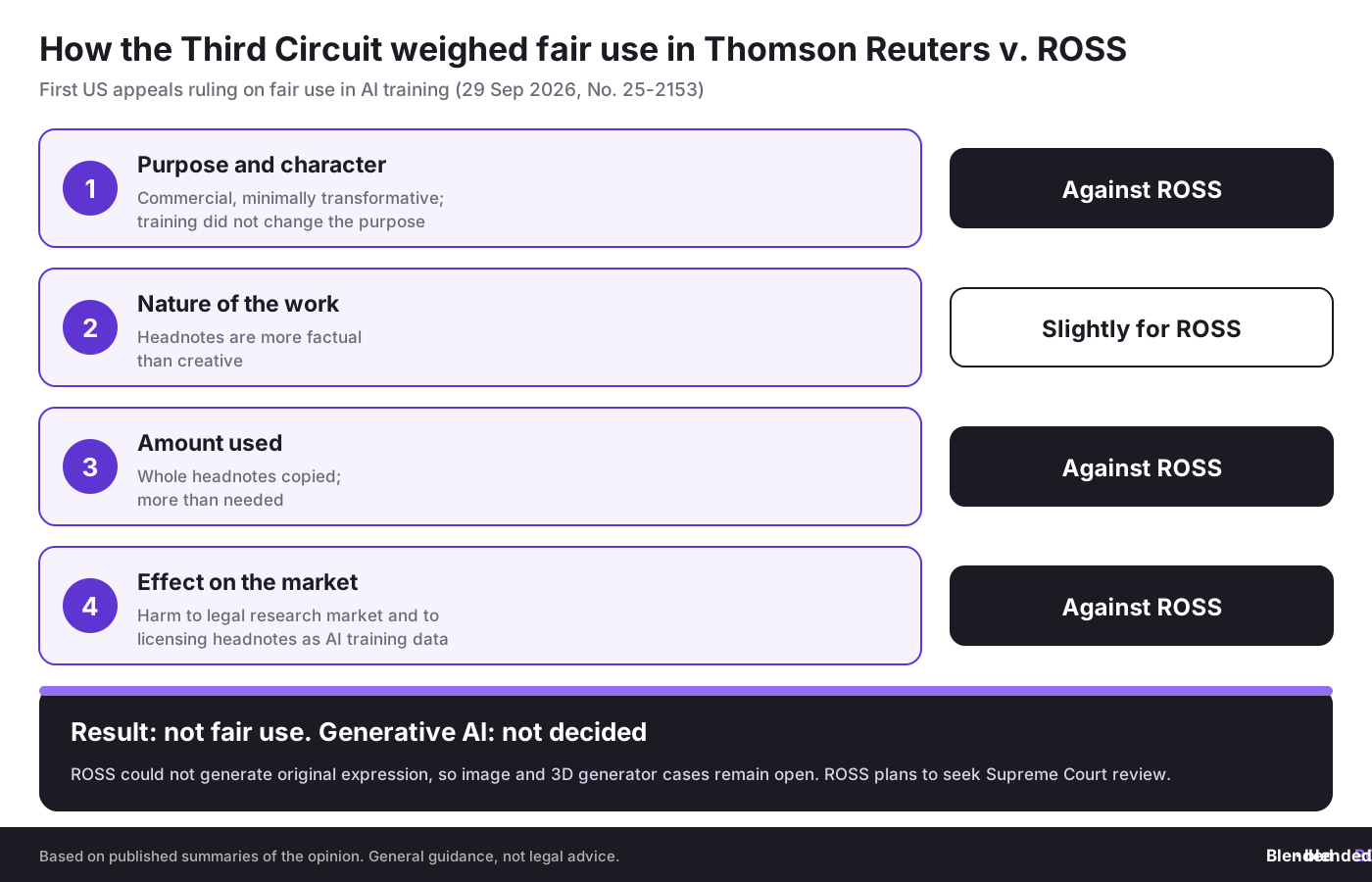
Factor two is where art differs most from legal headnotes. Courts give creative works stronger protection than factual ones, and a hand-sculpted character or a lit, composed Blender scene sits far from a short legal summary. Our guide on whether 3D models automatically have copyright explains what is protected the moment you make it, and our fair use guidelines for digital artists cover the four factors in everyday cases.
Does the ruling cover AI image and 3D model generators?
No, and it is important not to overstate it. The court did not decide whether training a generative model on books, images or other expressive works is fair use. It distinguished the generative cases precisely because ROSS's tool could only return existing text.
District courts are split on that bigger question. In Bartz v. Anthropic, Judge William Alsup compared training on books to teaching schoolchildren to write. In Kadrey v. Meta, Judge Vince Chhabria rejected that analogy and warned that a language model can generate countless competing works. No appeals court has resolved that split. The artists' case against Stability AI, Midjourney and DeviantArt, Andersen v. Stability AI, is still pending in California.
What the Third Circuit did do is reject some arguments that AI companies often make. The opinion said that the ease of copying is no excuse when copying is not necessary:
“Unlike necessity, ease is not a justification for copying.”
Third Circuit opinion in Thomson Reuters v. ROSS Intelligence, as quoted by Haynes Boone
For a wider tour of how courts have treated copying, from photographs to software, see our 30+ landmark copyright cases for 3D artists and the overview of legal precedents for AI art ownership.
Keep dated proof of what you made, and when.
BlendedBoris is a Blender add-on that timestamps your work on a blockchain, so you have a tamper-evident record of each file if you ever need to show that a model or render was yours first.
👉 See how BlendedBoris works
Why does a market for AI training licences matter to 3D artists?
The fourth factor is often the most important in fair use, and here the court counted harm to a market for licensing content as AI training data. Thomson Reuters could show that it used its headnotes to train its own tools, and the court described that licensing market as developing.
Creative markets are building similar deals. Marketplaces and stock sites now set rules on AI use and training, and some artists choose to license datasets while others opt out entirely. The stronger the evidence that your work has licensing value, and that you control who may train on it, the stronger a factor four argument may become. That is one reason to read your marketplace terms closely; our guide to Blender marketplace copyright policies compares them, and artist rights and AI training on our blog sets out the options.
Your licence choice sends a signal too. A model released as CC0 invites any use, while a standard licence or an explicit no-AI clause does not. See Creative Commons vs copyright for Blender assets before you choose.
What does this mean for opt-outs and NoAI tags?
The ruling does not create an opt-out right, and it does not say that a NoAI tag binds anyone. But it fits with a pattern: courts look at whether the copier had permission, how it got the material and whether it took more than it needed. ROSS got the headnotes through a third party after Westlaw refused to license them, a fact the court and the reports stress.
A clear, dated record that you refused AI training, through a tag, a licence term or an opt-out request, can only help if your work is later found in a training set. We covered how one court treated a NoAI label in the NoAI tag ruling in Beaulier v. Roblox. For practical steps, see seven steps to opt out of AI training datasets in Blender and AI dataset opt-out strategies on our blog.
What should Blender artists do now?
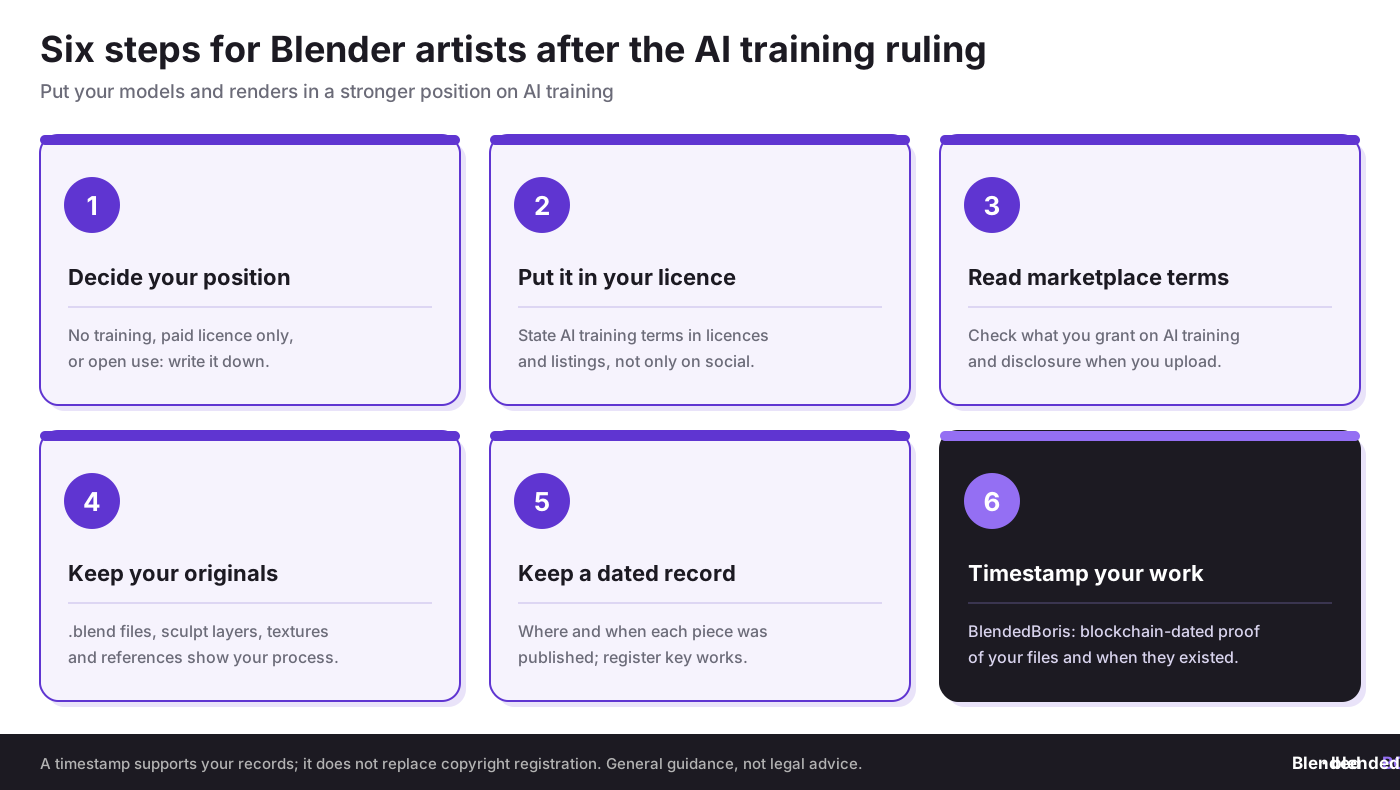
- Decide your AI training position for each portfolio and store: no training, training only under a paid licence, or open use. Write it down.
- Put it in your licence terms and listing text, not only in a social media post. If you license datasets, keep the contracts.
- Read each marketplace's terms on AI training and AI disclosure, and check which permissions you grant by uploading. Our guide to fair use for digital art explains where platform terms override fair use arguments.
- Keep your originals: .blend files, sculpt layers, textures and source references, so you can show what is yours and how you made it.
- Keep a dated record of where and when you published each piece. Our guide to registering copyright in 2026 explains why registration before infringement matters in the US.
- Timestamp your work so that you have independent proof of what existed and when. The round-up of common copyright problems for 3D artists shows where that proof helps.
How does this fit the bigger picture of data, AI and control?
The ROSS case is about who controls valuable data once someone else wants to use it. Our sister sites covered the same question from three security angles this week.
- State-linked hackers for hire. Seven countries issued a joint advisory on Integrity Tech, a China-linked hacking-for-hire company, with critical manufacturing among the targets. Read what the Integrity Tech advisory means for CAD and PLM data on cadchain.com.
- AI agents inside CAD tools. The open-source SolidCraft CAD tool ships with a built-in MCP server for AI agents, while community MCP servers for SOLIDWORKS remain unofficial. See how to use CAD MCP servers without losing control of your designs on solidboris.com.
- Stolen PLM data published. Data from the Clop campaign against PTC Windchill and FlexPLM, including Philips MRI scanner drawings, appeared on the dark web. Read what the Clop PLM data leak means for Inventor and Vault users on borisinventor.com.
Whether it is a legal summary, a CAD drawing or a Blender model, the same lesson keeps coming back: the people who can show what they own, what they allowed and when, are in the strongest position. Our earlier news on Meshy Edit and AI part-editing and AI copies flooding Etsy showed the same thing from the marketplace side.
Conclusion
The Third Circuit's ROSS decision is the first appellate ruling on fair use in AI training, and it went against the AI developer: whole works copied, a competing commercial product, and harm to a market for training-data licences. It is not a ruling on image or 3D generators, it may yet reach the Supreme Court, and the generative AI cases are still open. For Blender artists, the practical message does not depend on how those cases end: decide your AI training terms, write them into your licences, keep your originals and keep dated proof of what you made and published.
Timestamp your Blender work and the records that go with it.
BlendedBoris records a blockchain timestamp of your Blender files from inside Blender, giving you dated proof of authorship to sit alongside your licences, opt-outs and copyright registration.
👉 Get started with BlendedBoris
FAQ: the Third Circuit AI training ruling and 3D artists
What is Thomson Reuters v. ROSS Intelligence?
It is a US copyright case in which Thomson Reuters, owner of Westlaw, sued AI legal research startup ROSS Intelligence in 2020 for copying Westlaw headnotes to train a competing AI tool. On 29 September 2026 the Third Circuit ruled that the headnotes are copyrightable and that ROSS's use was not fair use.
Is this the first appeals court ruling on AI training and fair use?
Yes. It is the first time a US federal court of appeals has decided whether using copyrighted material to train an AI system is fair use.
Does the ruling mean AI image generators cannot train on my art?
No. The court expressly did not decide the generative AI question, because ROSS's tool could not generate original expression. Cases about image generators, such as Andersen v. Stability AI, are still pending.
Why does the market for AI training licences matter?
The court found that ROSS's copying harmed a market for licensing headnotes as AI training data. If creative work is licensed for AI training, unlicensed copying may harm a real market, which weighs against fair use.
Is the ruling final?
It affirmed the district court on two certified questions. ROSS's lawyer said the company intends to seek Supreme Court review. It binds courts in the Third Circuit and can be cited elsewhere as persuasive.
Does a NoAI tag protect my Blender models?
No ruling makes a NoAI tag binding on its own. A tag, licence term or opt-out request does create a dated record of your terms, which can help if your work is later used without permission.
Can a blockchain timestamp replace copyright registration?
No. A timestamp, for example with BlendedBoris, gives dated proof that a file existed at a certain time. It supports your records, but in the US you still need registration before you can sue for infringement of a US work.


