
On 14 October 2026, Deadline reported an exclusive report from VN.ai, a start-up that stress-tests generative AI tools for copyright infringement, which named Midjourney v8.1 the worst offender among 15 popular AI models for reproducing copyrighted characters. The report lands while Disney, Universal and Warner Bros. Discovery are still suing Midjourney in federal court in Los Angeles, and a week after Midjourney agreed to hand its video training datasets to the studios.
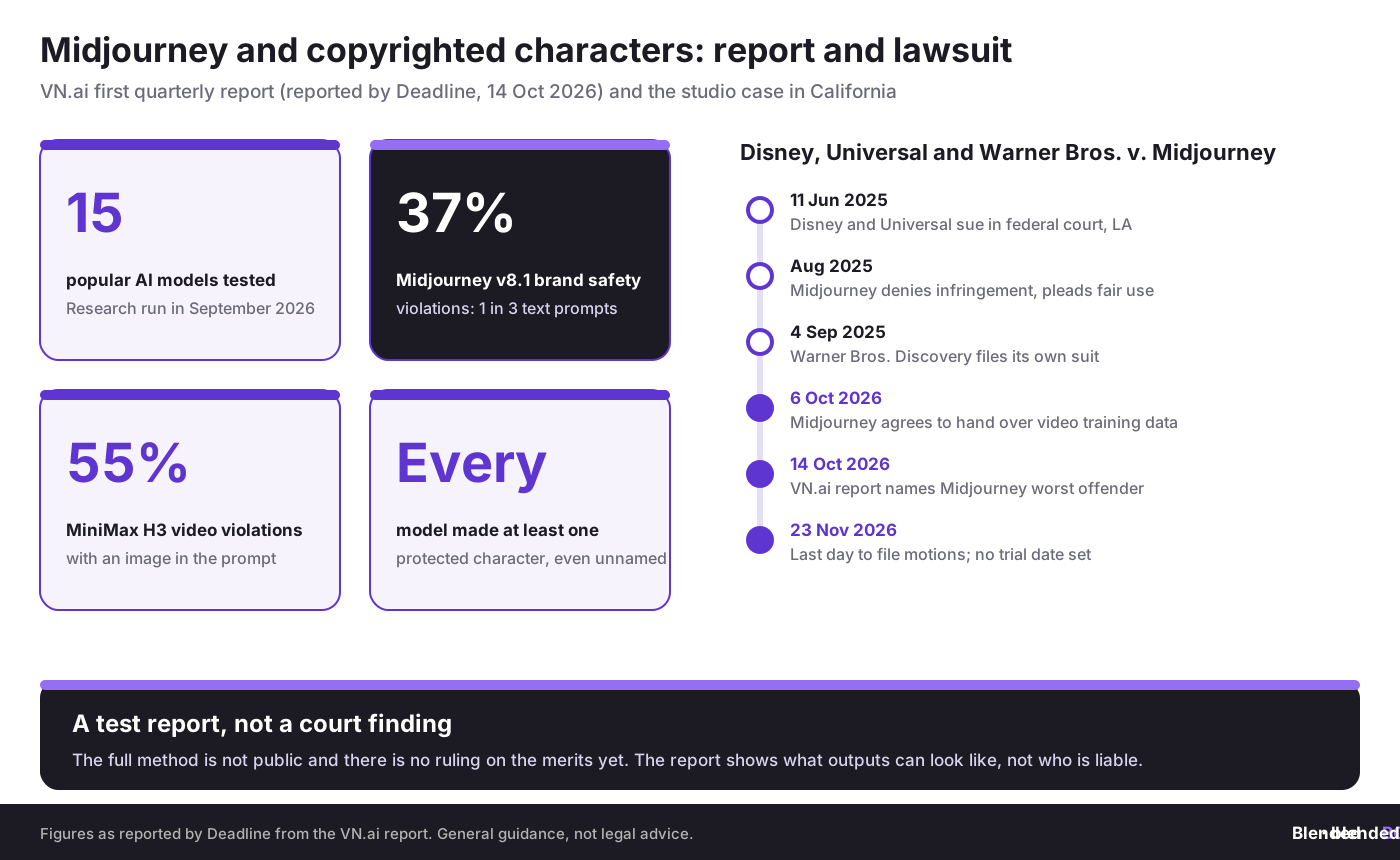
VN.ai says Midjourney v8.1 produced brand safety violations, meaning copyrighted characters placed in harmful contexts such as violence or drug use, in roughly one in three text prompts, or 37% of the time. Every one of the 15 models tested produced at least one copyright-protected character, even when the prompt did not name the character. The research was run in September 2026 and shared with Deadline, which said Midjourney did not respond to a request for comment.
This is a private test report, not a court finding, and VN.ai has not published its full method. But it matters to Blender artists for a practical reason: many 3D workflows now start with an AI concept image, an AI texture or an AI reference sheet. If image generators regularly put someone else's character into their outputs, that character can end up in your model, your render or your marketplace listing without you asking for it. Here is what the report found, where the studio lawsuit stands, and how to keep your own work clean and provable.
TL;DR: the Midjourney copyright report in one paragraph
VN.ai's first quarterly report, covered by Deadline on 14 October 2026, tested 15 popular AI image and video models on studio IP. Midjourney v8.1 came out worst, with brand safety violations in 37% of text prompts, and every model produced at least one protected character. Separately, Disney and Universal (since June 2025) and Warner Bros. Discovery (since September 2025) are suing Midjourney for copyright infringement; Midjourney denies the claims and argues fair use. There is no ruling on the merits and no trial date. For Blender artists: check AI outputs before they enter your work, never prompt by IP name, read the tool terms, and keep dated proof of your own originals.
What did the VN.ai report find about Midjourney and other AI models?
According to Deadline's report by Jake Kanter, VN.ai tested 15 popular AI models on how often they reproduced characters owned by Hollywood studios. The start-up looked at two things: whether a model produced a recognisable copyrighted character at all, and whether it put that character in a context that breaks studio brand safety standards. One Midjourney v8.1 example described in the report showed the Joker smoking cannabis while wearing a dress that resembled Elsa's from Frozen.
- Midjourney v8.1 was the worst offender for reproducing copyrighted characters and for brand safety violations, at 37% of text prompts.
- MiniMax H3 produced videos that broke studio brand safety standards 55% of the time when an image was used in the prompt.
- ByteDance Seedance 2.5 still produced protected characters, though the report says it improved significantly after Hollywood studios sent cease-and-desist letters.
- Google's Nano Banana also generated at least one copyright-protected character.
- All 15 models produced at least one protected character, including when the character's name was not in the prompt.
VN.ai founder Nelson Chu was blunt about why this keeps happening. Asked why AI models keep reproducing studio characters, he told Deadline it was "good for business", adding that it works as marketing and gets people to use and pay for a model. He also said he expects that at some point this will no longer be acceptable.
Two limits are worth keeping in mind. First, the article does not list all 15 models, the number of prompts or the list of characters, so the percentages cannot be checked independently. Second, VN.ai sells stress-testing services, so it has a commercial interest in showing that AI tools leak IP. Treat the figures as a useful signal about how image generators behave, not as proof that any specific output infringes.
Where does the Disney and Universal lawsuit against Midjourney stand?
Disney and Universal sued Midjourney in the US District Court for the Central District of California in June 2025, together with other studio companies in their groups, including Marvel, Lucasfilm and DreamWorks Animation. Their complaint accused Midjourney of direct and secondary copyright infringement, both for training on their films and characters and for generating images of characters such as Darth Vader and the Minions. It called the service a "bottomless pit of plagiarism". Warner Bros. Discovery filed its own suit in September 2025, and the court is handling the two cases together.
Midjourney has denied infringement and argues that training its models on copyrighted images is fair use. The case is now in the late pretrial stage. The public docket sets 23 November 2026 as the last day to file motions, and no trial date has been set. On 6 October 2026 the parties filed a stipulation under which Midjourney will hand over the video datasets used to train its models to the studios, which shows how much of the case now turns on training data and not only on outputs.
So there is no ruling on whether Midjourney infringes, and nothing in the VN.ai report changes the legal position by itself. What it does is add public evidence on the output side of the argument at the exact moment the case moves towards dispositive motions. For context on how US courts have treated AI training so far, see our news on the Third Circuit's AI training fair use ruling in Thomson Reuters v. ROSS, which expressly left generative AI open.
Why should Blender artists care about AI character copies?
Most Blender artists will never be sued by Disney. The risk is smaller and more ordinary: a character, costume, logo or silhouette that belongs to someone else slips into your work through an AI step you did not think twice about. That can happen in several places in a normal 3D pipeline.
- Concept images. A client sends an AI mood board, or you generate one to block out a character. If it echoes a studio design, a model built from it can carry the same problem.
- Textures and decals. AI-generated image textures can include logos, mascots or recognisable artwork from other sources.
- Reference sheets for sculpting. Front and side views from an image generator are easy to sculpt over, and just as easy to copy from without noticing.
- Marketplace thumbnails and promo renders. A listing image that shows a protected character can trigger a takedown, even when the model itself is original.
Copyright protects expression, and characters with distinctive visual traits are often protected on their own. Many are also registered trademarks, which adds a second layer of risk for merchandise and 3D prints. Our guide to copyright vs trademark vs patent for digital artists explains the difference, and the round-up of landmark copyright cases for 3D artists shows how courts have treated characters and derivative works over time.
There is a second, quieter issue. If an AI tool can reproduce studio characters this easily, it can also reproduce the distinctive style and designs of independent artists, including Blender artists who post their work publicly. We covered that from the marketplace side in AI copies flooding Etsy and from the signature side in AI tools adding real artists' signatures. The same evidence problem runs through all of them: the artist who can show what they made, and when, is in the strongest position.
What did each AI model do in the VN.ai test?
The table below only includes figures and findings that Deadline reported from the VN.ai report. Where no number was published, the table says so.
Does using an AI image in your Blender work make you liable?
It can. In copyright law, the person who copies and distributes an infringing work is usually the first one exposed, whatever tool they used. The Disney case asks whether Midjourney itself is liable for what users generate, but a ruling for or against Midjourney will not automatically protect someone who sells a model or print that copies a studio character. Tool terms often put responsibility for outputs on the user, so check what yours say about ownership, permitted use and indemnity before you rely on them.
Ownership is a separate problem. Under current US Copyright Office guidance, material generated by AI without enough human control is not protected, which is why our explainer on whether 3D models automatically have copyright stresses your own modelling, sculpting and texturing work. If you build on an AI image, the parts you created yourself are the parts you can protect. Our news on Meshy Edit and AI part-editing looked at the same question for AI 3D tools.
Keep dated proof of what you made yourself.
BlendedBoris records a blockchain timestamp of your Blender files from inside Blender, so you can show what existed and when, separate from any AI step in your workflow.
👉 See how BlendedBoris works
What should Blender artists do now?
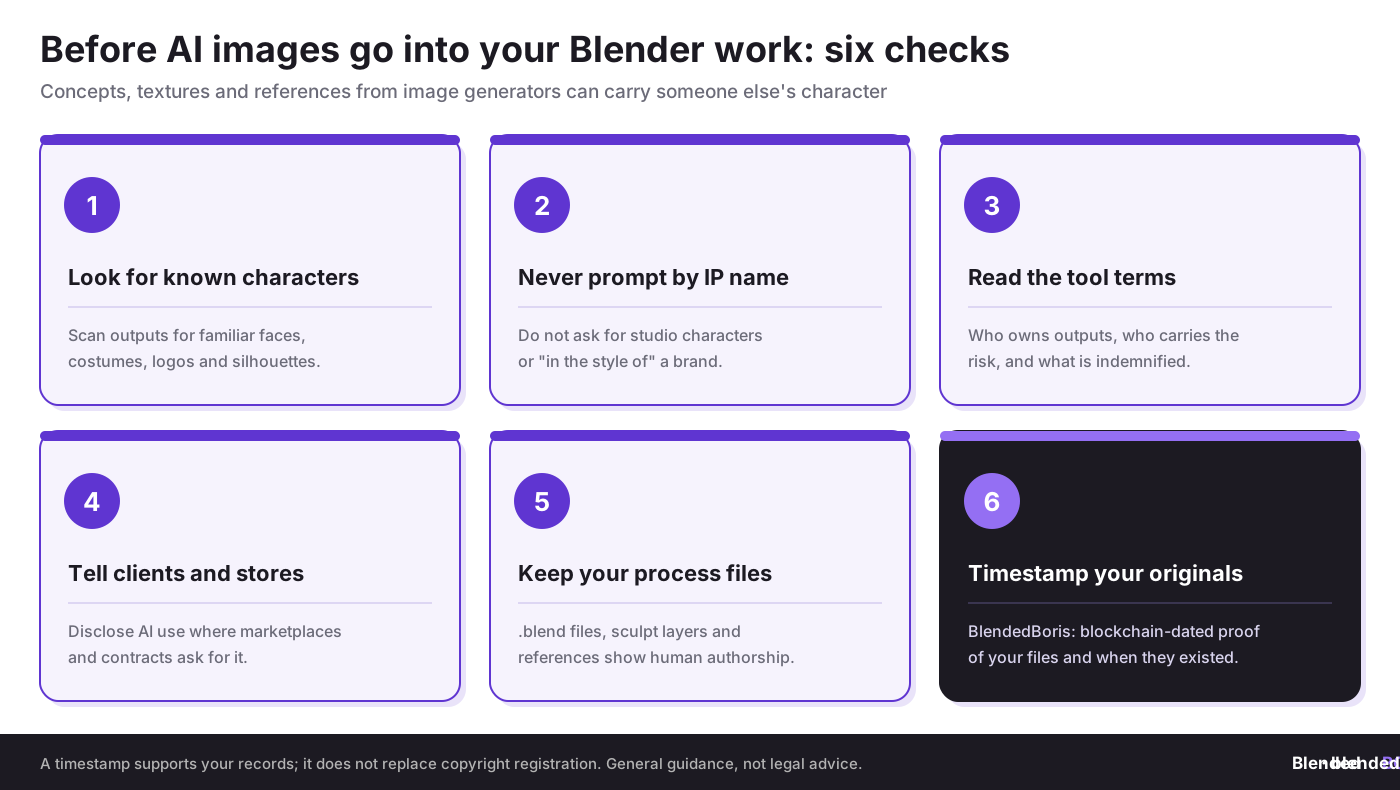
- Check every AI output before it enters your scene. Look for familiar faces, costumes, logos, colour schemes and silhouettes. If you would recognise it from a film or game, do not use it.
- Never prompt by IP name. Do not ask for studio characters, franchise names or "in the style of" a brand. The report suggests models can drift towards known characters anyway, so a clean prompt is the minimum, not a guarantee.
- Read the terms of every AI tool you use. Note who owns outputs, what use is allowed and whether the provider offers any indemnity. Save a dated copy of the terms you accepted.
- Disclose AI use where it is required. Marketplaces and clients increasingly ask about AI. Our guide to marketplace copyright policies for Blender creators is a starting point, and artist rights and AI training covers the training side.
- Keep your process files. Blend files, sculpt layers, reference boards and texture sources show the human authorship that copyright protects. The checklist of common copyright problems for 3D artists shows where these records help.
- Register and timestamp key work. In the US you need registration before suing over a US work; see how to register copyright in 2026. Add a dated record of each version so you can prove your work came first.
- Know how to respond to copies of your own work. If an AI tool or a seller reproduces your model or style, start with DMCA takedown procedures, AI art theft recourses and our guide to writing an effective cease and desist letter.
How does this fit the bigger picture of data, AI and control?
The Midjourney report is about what AI tools do with other people's work. Our sister sites covered the same theme of control over people, agents and machines this week.
- Fake remote workers. The US Department of Justice announced coordinated actions against North Korean remote IT worker schemes, and the FBI issued a new warning on facilitators and extortion. Read what the North Korean IT worker schemes mean for CAD data on cadchain.com.
- AI agents inside CAD. Dassault Systèmes is presenting long-running agentic Virtual Companions at NVIDIA GTC Berlin, while LEO is already available in SOLIDWORKS. See what SOLIDWORKS LEO and agentic AI mean for designers on solidboris.com.
- Unpatched workstations. Year 1 of Windows 10 commercial Extended Security Updates ended on 13 October 2026, and Inventor 2027 runs only on Windows 11. Read what the end of Windows 10 ESU Year 1 means for Inventor teams on borisinventor.com.
Whether it is a studio character, a CAD file or a workstation, the same lesson keeps coming back: know what you hold, control what touches it, and keep a dated record. On the policy side, the NoAI tag ruling and Denmark's deepfake bill show lawmakers and courts slowly catching up.
Conclusion
VN.ai's report says what many artists suspected: popular AI image and video models still reproduce copyrighted characters, and Midjourney v8.1 did so most often in its test. The report is not a court ruling, its method is not public, and the studio case against Midjourney has not been decided. For Blender artists the practical message does not depend on how that case ends: treat every AI output as unverified until you have checked it, keep AI steps out of the parts of your work you want to own, and keep dated proof of your originals.
Prove your Blender work is yours.
BlendedBoris adds a blockchain timestamp to your Blender files from inside Blender, giving you dated proof of authorship to sit alongside your licences and copyright registration.
👉 Get started with BlendedBoris
FAQ: the Midjourney copyright report and 3D artists
What is the VN.ai report on Midjourney?
It is the first quarterly report from VN.ai, a start-up that stress-tests generative AI tools for copyright infringement. Reported by Deadline on 14 October 2026, it tested 15 popular AI models on studio IP and named Midjourney v8.1 the worst offender for reproducing copyrighted characters.
What does the 37% figure mean?
VN.ai says Midjourney v8.1 produced brand safety violations, copyrighted characters placed in harmful contexts such as violence or drug use, in about one in three text prompts, or 37% of the time. The full method has not been published.
Has a court ruled that Midjourney infringes copyright?
No. Disney, Universal and Warner Bros. Discovery are suing Midjourney in federal court in Los Angeles, and Midjourney denies the claims and argues fair use. As of October 2026 there is no ruling on the merits and no trial date.
What happened in the case on 6 October 2026?
The parties filed a stipulation under which Midjourney will hand over the video datasets used to train its models to the studio plaintiffs. The last day to file motions is 23 November 2026.
Can I use Midjourney images as concept art for Blender models?
You can, but check every output for known characters, logos and designs before you build on it, read the tool's terms, and disclose AI use where clients or marketplaces require it. Copying a protected character into a model can infringe whatever tool produced it.
Who owns a 3D model built from an AI concept image?
Under current US Copyright Office guidance, purely AI-generated material is not protected, but your own modelling, sculpting and texturing can be. Keep your process files to show which parts you created.
How can BlendedBoris help?
BlendedBoris records a blockchain timestamp of your Blender files from inside Blender. That gives you dated proof that a file existed at a certain time. It supports your records but does not replace copyright registration.


