
TL;DR: what happened with Big Walk and AI?
On 9 November 2026, 19 jurors of the Independent Games Festival (IGF) said they won't vote for any game that uses generative AI in any capacity, code included. Within hours, social media tied the statement to Big Walk, the 2026 hit by Untitled Goose Game studio House House. On 10 November House House confirmed that LLM chatbots helped with bugs in the final stretch, touching well under 0.1% of the code, and that no generative AI went into anything else. Steam never asked about it, because Valve's survey covers only AI content players see or hear. For Blender artists and small studios the lesson is practical: write a one-page AI policy now, log what each tool did, and keep dated proof of your human work.
The Big Walk AI story started at an awards jury. Aftermath reported on 10 November 2026 that a group of IGF jurors had taken a hard line on generative AI the day before, and that the game behind most of the jury's argument was Big Walk, House House's cooperative walking game. The studio answered the same day with an unusually detailed disclosure. People are searching for it because it puts a number on something most teams never measure: how much AI is too much when a jury, a store or a court asks.
Here is what the studio said, where juries, Steam and copyright law each draw the line, and what a Blender artist or small game team should put in writing this week.
What happened with Big Walk and AI?
- Monday 9 November 2026: 19 IGF jury members publish a co-signed statement. After what they call "fairly intense discussion and disagreement across the judge and jury pools", they decline to vote for any game that uses generative AI in any capacity. Kotaku reports that the statement was approved by IGF leadership.
- Later that day: posts on Bluesky link the debate to Big Walk. Seven-time IGF judge SlyDante writes that the most-discussed game of the year in voting was discussed almost entirely for its AI use, and juror Bruno Diaz says judges knew about the LLM use because IGF rules required the studio to disclose it.
- Tuesday 10 November: House House sends Aftermath a statement and adds it to the game's FAQ under "Was AI used to make Big Walk?". VGC and Kotaku follow the same day.
- As of 13 November: no IGF document says Big Walk was disqualified, and the IGF has published no new rule. The 19 jurors spoke for themselves.
What exactly did House House disclose?
The statement is short and specific, which is why it spread. House House says that in the final stretch of development it used LLMs "sparingly" to work through hard technical problems and bugs. Some snippets from chatbot answers were copied as a starting point and then rewritten into game code. The studio estimates that well under 0.1% of Big Walk's code had anything to do with that, and that generative AI was used nowhere else in the game, so none of its art, audio or text came from AI.
It even gives an example. Unity's Universal Render Pipeline (URP) culled shadow casters only along the camera's forward direction, so shadows behind the player rendered at an infinite distance and the game ran 50% slower for about 20 seconds at every sunrise and sunset. The team read the URP code, asked an engineer at Unity, who concluded it couldn't be done, and then asked a chatbot. After a few dead ends it suggested a fix, which the team changed heavily. The result was about 10 lines of code inside URP.
Three more lines from the statement matter for anyone who sells creative work:
- The disclosure was first written for the IGF submission, where it was a suggested part of the entry.
- There is no Steam disclosure, because the platform does not ask about code or chatbot use.
- Big Walk was made without an internal AI usage policy, and House House calls that missing policy "a failure". The studio promises a fuller policy for future games, and it apologises that its LLM use may not meet the jurors' standards.
Why do IGF jurors count AI-assisted code as AI use?
The jurors' answer is in their statement, as quoted by VGC: "Programming is a creative discipline whose labour deserves the same respect we extend to any part of making a game." They add that this respect extends to the past work used to train these models without the creators' consent. So for this group, a chatbot fix in a render pipeline sits in the same category as an AI-generated texture.
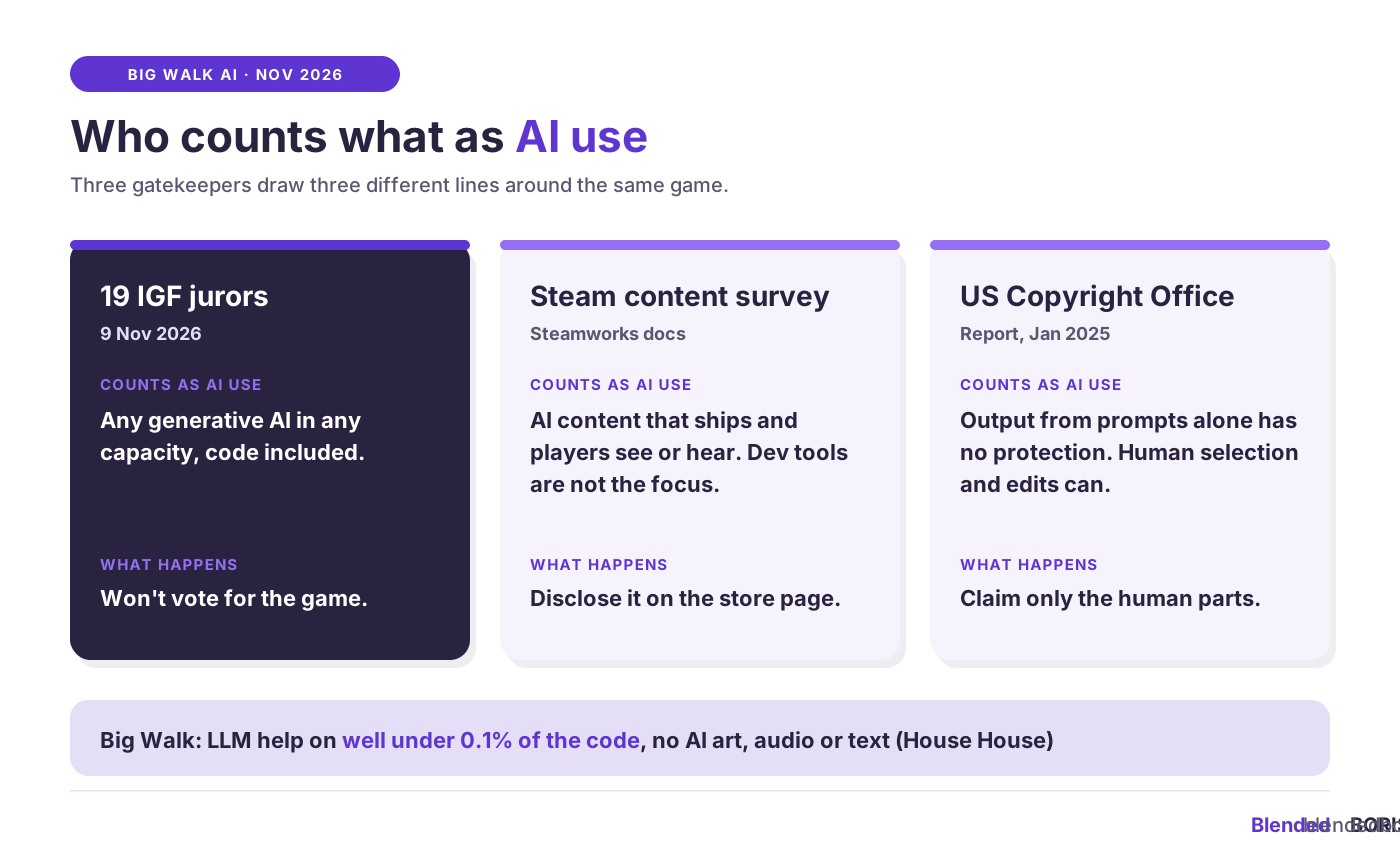
That is a much stricter line than any store uses, and it is the line artists should plan for. Awards, grants, festivals and some clients judge the process behind a work, while stores mostly judge what ships. A game that is clean under Steam's rules can still lose votes, a commission or a festival slot once someone learns how it was made.
Where do juries, Steam and copyright law draw the AI line?
We covered the Steam side in detail, including the January 2026 change that took coding tools out of the survey, in our guide to Steam AI disclosure. The short version for asset sellers: a studio that buys your models answers Steam's survey with your answer, so they will ask you.
What does Big Walk AI mean for Blender artists?
Most Blender artists don't enter the IGF, but plenty sell models, textures and animations to the small studios that do. Expect three changes in the next months.
- Clients will ask about your process as well as your files. A studio that wants to stay eligible for a festival with a strict jury needs to know whether any asset in its game involved AI, even as a reference or an upscale.
- "AI-free" will become a selling point for some buyers and a contract clause for others. If you promise it, you need records that back it up.
- Small, honest numbers beat silence. House House's "well under 0.1%" and its 10-line example calmed part of the debate because they were specific. A vague "we used some AI" invites the worst reading.
The same pattern showed up on the stores this autumn. Steam's AI labels drew fire from Tim Sweeney, itch.io deleted AI-generated uploads and added disclosure filters, and ArtStation started hiding AI art by default. Big Walk adds juries to that list, and juries ask about the whole process.
How do you write an AI usage policy for a small studio or solo artist?
One page is enough. House House's own words make the case: the studio had no policy, called that a failure, and had to write its disclosure under public pressure. Write yours while nobody is asking. Fe/male Switch has a business-wide version, with the EU AI literacy rule that every company using AI now has to follow, in its AI usage policy template for small business.
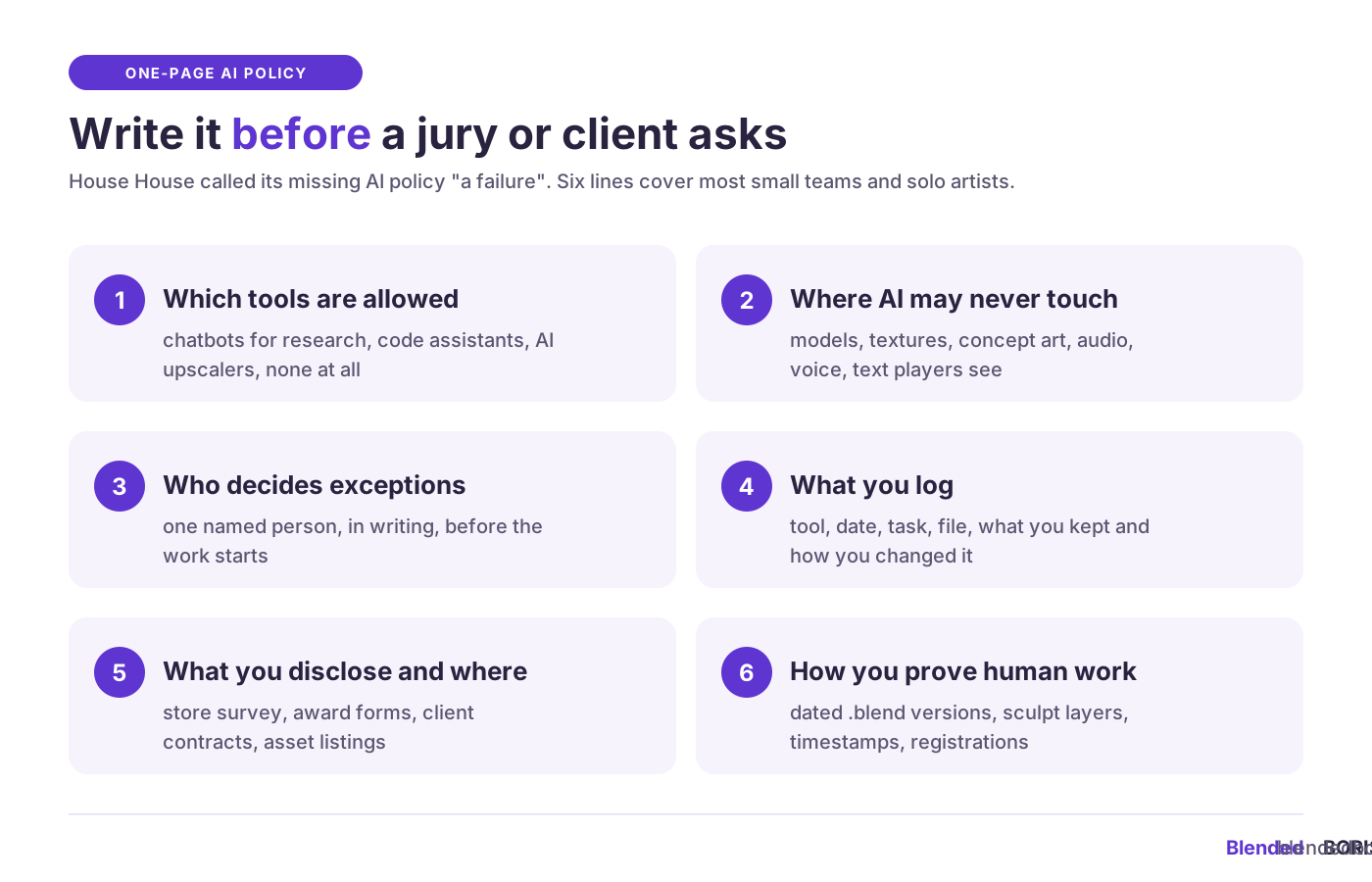
- List the allowed tools. Name them: a chatbot for research, a code assistant, an AI upscaler, or none at all.
- Name the no-AI zones. Models, textures, concept art, audio, voice and any text players read are the usual ones for artists who sell to games.
- Pick who approves exceptions. One person, in writing, before the work starts.
- Keep a short log. Tool, date, task, file, what you kept and how you changed it. House House could only give its 0.1% estimate because it knew roughly what it had used.
- Decide what you disclose, and where. Store surveys, award entry forms, client contracts and asset listings each ask different questions, so keep one honest answer that fits all of them.
- Keep proof of human work. Dated .blend versions, sculpt layers, bake files and reference boards show who made what and when.
How do you prove which parts of your work a human made?
A policy says what you intend; proof shows what you did. For Blender work, the strongest proof is a dated chain of your own files: early blockouts, sculpt passes, retopology, UVs and texture layers, each saved with a timestamp. Our article on C2PA content credentials explains why a timestamp needs to be one that can't be edited later, and the Frankfurt 'it was AI' ruling shows what happens when an artist can't prove the human part.
If a buyer, a jury or a court ever asks, you want to answer with records instead of a statement written in a hurry. For registration in the US, see how to register copyright as a 3D artist, and for the legal line on AI output, our lessons on AI-generated art and copyright.
Register your Blender work with BlendedBoris. BlendedBoris records your .blend files and versions as you work, with a timestamp nobody can change, so you can show which parts a human made. Start protecting your Blender art
What we don't know yet
- Whether the IGF will turn the jurors' position into a written rule for future entries.
- How many other entries this year disclosed AI use, and how the full jury voted.
- What House House's promised AI policy will say.
- Whether Valve will widen its survey again; for now coding tools stay outside it.
What should you do this week?
Big Walk shows that a tiny, honest use of AI can still cost a game votes when the people judging it care about the process. You can't control where a jury draws its line, but you can control what you can show. Write the one-page policy, start the log today, answer AI questions from clients with specifics, and keep dated proof of every model you make.
FAQ: Big Walk AI
Did Big Walk use AI?
Yes, in a small way. House House says LLM chatbots helped with technical problems and bugs in the final stretch of development, that well under 0.1% of the code had anything to do with it, and that no generative AI was used for anything else in the game.
Was Big Walk disqualified from the IGF?
As of 13 November 2026, no IGF document says so. 19 jurors said they personally won't vote for games that used generative AI in any capacity. The statement didn't name a game.
Why didn't Big Walk disclose AI on Steam?
House House says Steam doesn't ask about code or chatbot use. Valve's content survey covers AI content that ships with a game and that players see or hear.
Does using a chatbot for code count as AI use?
It depends on who asks. For the 19 IGF jurors it does. For Steam's survey it doesn't. For copyright, only the parts a human wrote or meaningfully changed can be protected.
Do Blender artists need an AI usage policy?
If you sell assets or freelance for game studios, yes. A one-page policy plus a simple log lets you answer a client, a store or a jury in minutes and with specifics.
How can I prove my 3D model was made by a human?
Keep dated versions of your .blend files, sculpt layers and textures, and add a timestamp that can't be edited later, such as a BlendedBoris registration.
- Steam AI Disclosure: what Tim Sweeney's attack on AI labels means for Blender artists
- itch.io AI policy: deleted AI uploads and new disclosure filters
- ArtStation AI filter: AI declarations and hidden-by-default AI art
- Nexus Mods AI policy: mandatory AI disclosure and AI training permissions
- AI usage policy for small business: a one-page template and the EU AI literacy rule (Fe/male Switch)


