
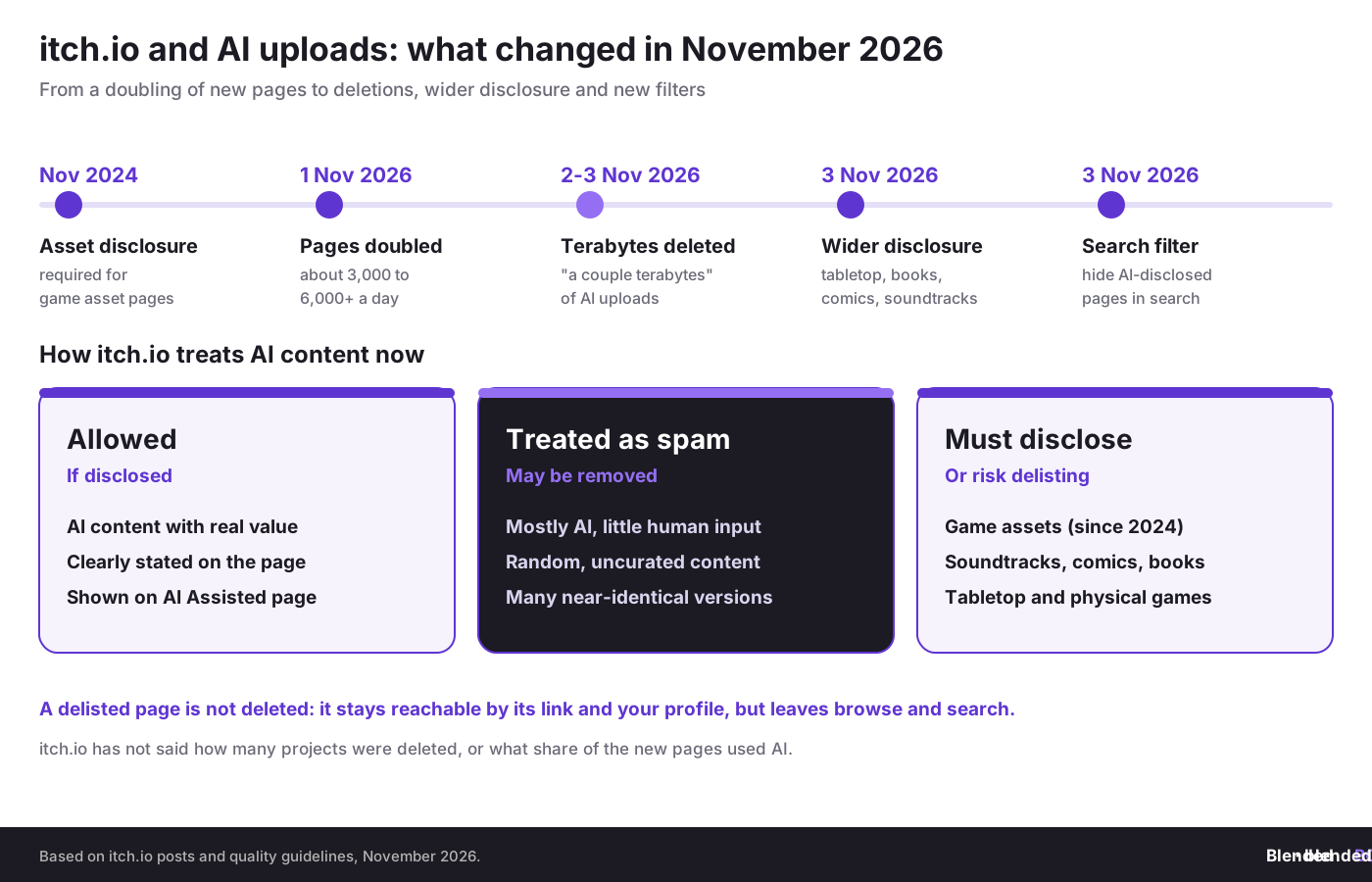
On 2 and 3 November 2026, the indie store itch.io said it had "just deleted a couple terabytes of ai slop" and warned uploaders that being able to upload "10 terabytes of poorly optimized ai generated models" does not mean they should. The same week it made an AI disclosure mandatory for tabletop games, books, comics and soundtracks, and added generative AI filtering to more of the site, including search results. Game asset pages have needed a disclosure for two years already.
The cleanup followed a post on 1 November in which itch.io said the number of game pages created per day had doubled in the past two months, while downloads and purchases had not. Reports of the chart show daily new pages climbing from about 3,000 in early August to more than 6,000 by the end of October. Asked what was behind it, the company replied "take a guess".
For Blender artists who sell low-poly packs, props, characters or environment kits on itch.io, this is not abstract. The store's main rule for assets is a disclosure, and its main punishment is invisibility: pages that are spammy or wrongly tagged can be removed from browse and search. If your asset pack sits next to a flood of generated models, the question is how buyers and moderators will tell your work apart. This article explains what itch.io changed, what its rules actually say and what Blender artists can do now. A few days later the same question reached awards juries, when House House disclosed how it used LLMs on its game: read what the Big Walk AI disclosure means for Blender artists.
TL;DR: itch.io's AI cleanup for Blender artists
itch.io deleted terabytes of bulk AI uploads in early November 2026, extended mandatory AI disclosure from game assets to tabletop, books, comics and soundtracks, and added AI filtering to search. AI content is still allowed if it is disclosed and adds real value. For 3D asset sellers, the practical points are: answer the AI disclosure honestly on every page, keep packs curated rather than bulk-generated, and keep dated records that show how you made your models in case your work is ever reported as AI.
What did itch.io actually do?
Three things happened within a few days, all announced in short social media posts rather than a formal policy update:
- A mass deletion. itch.io said it had deleted "a couple terabytes" of AI-generated uploads. It did not say how many projects, games or asset pages were removed, or who uploaded them.
- Wider disclosure. Creators of tabletop and physical games, books, comics and soundtracks must now complete an AI disclosure before they can create or edit a page. itch.io said these categories "join the game assets section which has required disclosure for the past 2 years".
- More filtering. itch.io said it was adding generative AI disclosure filtering "to few more places on the site", including the search results page, so buyers who do not want AI content can hide it.
As Video Games Chronicle reported, only bulk-released AI spam is banned outright. AI content as such is still allowed. Some users asked for a full ban, and itch.io did not give one. Instead, it pointed people to an AI spam clause that it says has been in its quality guidelines for more than two years.
The volume figure needs care. itch.io said later that the rise in new pages was driven mainly by first-time uploaders, not by bulk uploaders like the account behind the terabytes. A page created is not a page published, and the company has not said what share of the new pages used AI.
What do itch.io's rules say about AI-generated assets?
The rules sit in itch.io's quality guidelines for creators, which the company says are continually updated. Two sections matter for 3D artists.
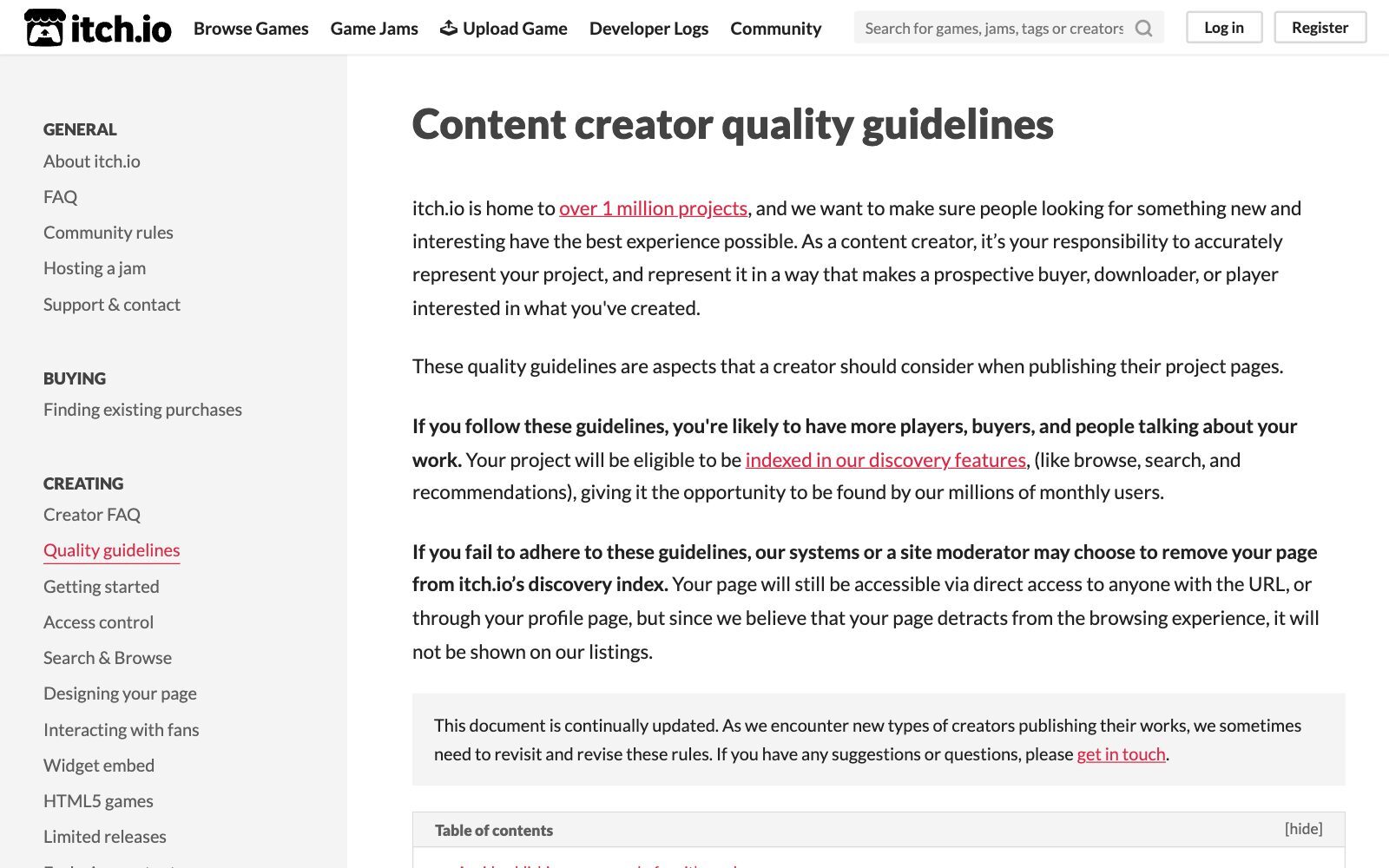
The first is about spam. itch.io asks creators not to "use automated systems to mass produce product pages" and lists three examples it treats as spam: projects predominantly created by algorithms or AI with minimal human intervention, randomly generated content with no or minimal curated design, and multiple iterations of essentially the same content generated by AI or algorithms. Pages like these may be removed from browse and search. Repeat problems can cost an account its place in discovery features altogether.
The second is about disclosure. Every project that contains material produced by generative AI should say so in the AI Disclosure section of its edit page. The guidelines define generative AI as systems that create new content, such as text, images or music, by learning from large datasets. They say itch.io is strictly enforcing disclosure for game asset, soundtrack, physical game, comic and book pages "due to legal ambiguity around rights associated with Generative AI content". Failing to tag these pages may lead to delisting.
Two details are useful for Blender users. Self-contained algorithms that do not rely on external large datasets do not need a disclosure, and itch.io gives procedural level generation as an example of traditional techniques that are not generative AI. So a Geometry Nodes scatter setup or a procedural material you built yourself is not what this rule targets. And a delisted page is not deleted: it stays reachable by its direct link and from your profile, but it no longer appears in listings.
How does the AI disclosure work for asset packs?
The asset disclosure dates from November 2024. In a forum announcement at the time, itch.io administrator leafo explained that the edit page asks whether a project contains results of generative AI. A yes answer adds an "AI Generated" tag, with sub-tags for Graphics, Sound, Text and Dialog, and Code. A no answer adds a "No AI" tag. Creators are told not to add those tags by hand but to use the form, because the tags are generated from the answer.
The announcement also said that assets made with generative AI must be tagged "even if modified afterwards", and that untagged AI assets would not be indexed on browse pages. Asset creators saw a blocking dialog on their dashboard until they classified their public pages, and a bulk tool was added for sellers with many listings. After a grace period, itch.io said it would likely rely on user reports.
For a Blender artist, the most common grey areas look like this:
- AI concept art. If you used an image generator for a reference sheet and then modelled everything yourself, the shipped files contain no generated material. If the generated image is included in the pack or used as a texture, it is part of the product.
- AI textures and HDRIs. Generated textures, decals or skies inside a pack are generated graphics, even after you edit them in Blender or an image editor.
- Image-to-3D and text-to-3D meshes. A mesh from a generator stays an AI-generated asset after retopology and cleanup, under the "even if modified afterwards" wording.
- AI-written descriptions or scripts. Generated text and add-on code fall under the Text and Code sub-tags.
None of these is banned. They need to be disclosed, and the pack needs to add real value for buyers. We saw the same disclosure-first approach in the fight over Steam's AI labels and in the Nexus Mods AI disclosure rules for modders.
Your models. Your process. Your dates.
BlendedBoris adds a blockchain timestamp to your Blender work from inside Blender, so you hold dated proof of how and when you built each model, sculpt and scene, which helps if a buyer or moderator ever questions whether your asset pack was made by hand.
👉 Protect your Blender work with BlendedBoris
Why does "poorly optimized" matter for 3D artists?
The phrase that drew attention from 3D artists was "poorly optimized ai generated models". Raw text-to-3D and image-to-3D output often has dense, messy triangle meshes, baked lighting in the textures, no clean UVs and no sensible scale or pivot. A model like that is heavy to download and hard to use in a game engine, which is part of why bulk uploads of them can reach terabytes.
This is where hand-made Blender assets can stand out. Clean topology, efficient polycounts, tidy UVs and sensible naming are visible in previews and in the files. Our guides to low-poly modelling in Blender, retopology from sculpts and performance limits for mobile game assets cover the craft. Showing wireframes, polycounts and texture sizes on the store page tells buyers the asset was built to be used, not just generated to fill a listing.
Curation matters too. itch.io's spam examples include many near-identical iterations of the same content. A pack of 300 slightly different generated rocks looks like that. A smaller, well-organised pack with consistent style, documented contents and clear licence terms does not. Our guide to file organisation for multi-asset product packs shows how to structure one.
Could your hand-made work be mistaken for AI?
Filtering only works as well as the answers behind it. A buyer who hides AI content on itch.io sees pages that declared no generative AI. If you never completed the disclosure on an older page, it may not carry the No AI tag at all, even if everything in it is hand-made. Checking every listing is the simplest fix.
The harder problem is accusation. Moderation on itch.io relies partly on user reports, and AI detection for 3D models is unreliable. If someone reports your pack as undisclosed AI, the best answer is evidence of process: dated .blend files, sculpt stages, wireframes and work-in-progress renders. Courts are moving the same way. In the Frankfurt "it was AI" decision, the question of who made a work and how turned on what each side could prove, and our report on the Content Credentials timestamp flaw explains why a label inside a file is not the same as independent dated proof.
There is also a copyright reason to keep records. In the United States, the Copyright Office said in January 2025 that prompts alone do not give enough human control for the output to be protected, while human selection, arrangement and changes can be. That is part of the "legal ambiguity" itch.io cites. If your pack mixes hand-made models with AI-generated parts, records of what you made yourself define what you can actually license and defend. Our guide to registering artwork, 3D models and renders covers the next step for key works.
How does itch.io compare with other stores?
Most stores where Blender artists sell have now picked an approach. They differ mainly in whether AI is labelled, filtered or restricted:
The details for each are in our reports on Etsy's AI photo and listing rules and Megascans going free on Fab with new AI terms. The common thread is that platforms are not banning AI. They are asking creators to label it and letting buyers decide, which puts the weight on honest disclosure and on proof when a label is disputed.
What should Blender artists do now?
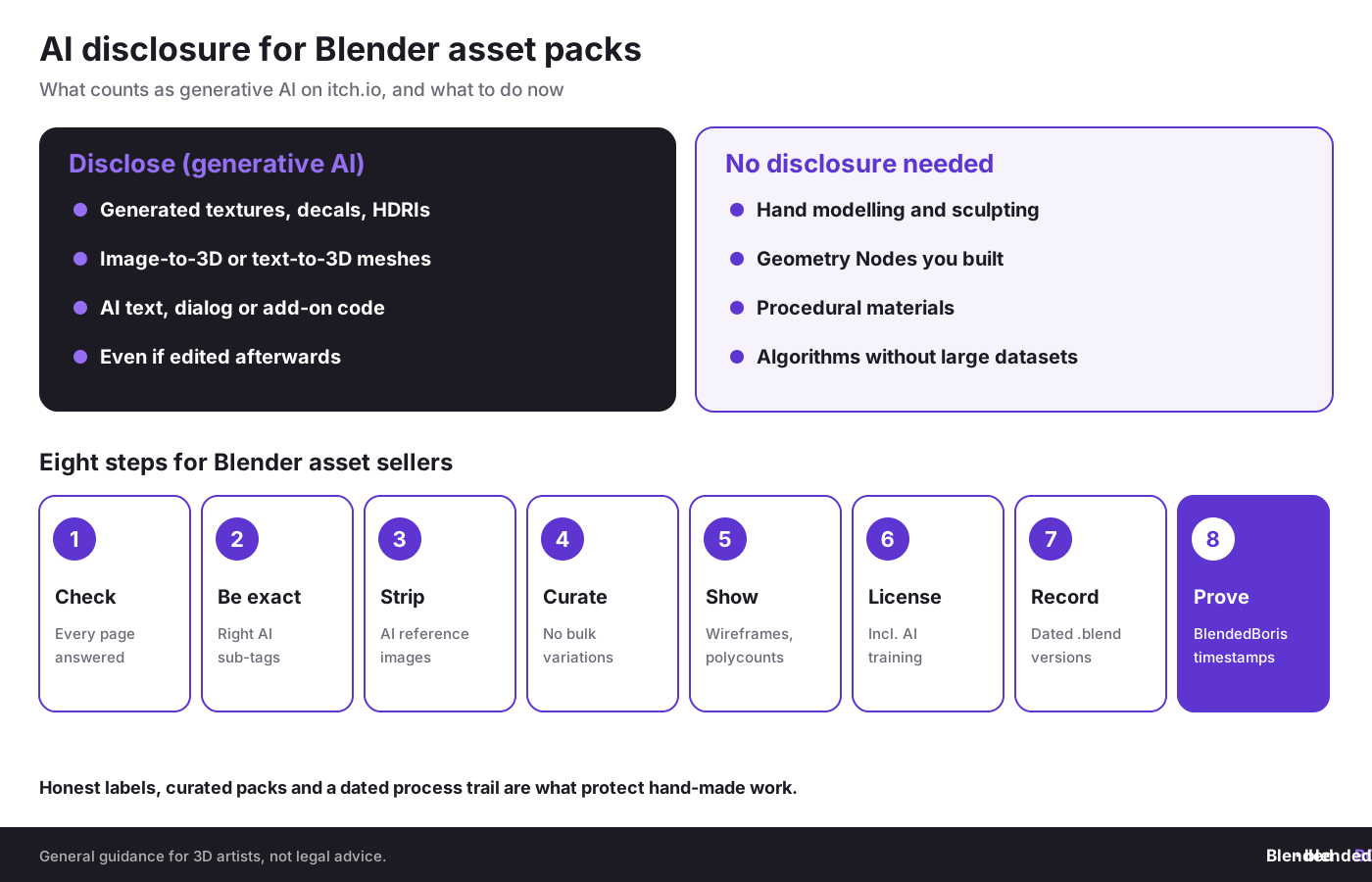
- Check every itch.io page. Open the AI Disclosure section on each asset pack and make sure it is answered. An unanswered page will not show up for buyers who filter for No AI.
- Answer honestly and specifically. If any shipped texture, mesh, sound, text or code came from a generator, say yes and pick the right sub-tags, even if you edited it afterwards.
- Keep generated references out of the files. If you only used AI for private reference, do not ship those images in the pack.
- Curate instead of multiplying. Avoid dozens of near-identical variations. One coherent pack is better for buyers and safer under the spam rules.
- Show your topology. Add wireframes, polycounts, texture sizes and a contents list to the page so buyers can see the asset is production-ready.
- Write a clear licence. State what buyers may do with the assets, including whether they may use them for AI training.
- Keep a process trail. Save dated .blend versions, sculpt stages and work-in-progress renders for every pack.
- Timestamp releases. Dated proof of authorship helps if a pack is reported as AI or copied by someone else.
For more context, read how AI game clones copy art and assets and what the NoAI tag ruling means for 3D artists. The sister blog has guides to selling 3D models, copyright for AI-generated art and immutable proof of art creation.
Where does this fit in the bigger picture?
Today our sister sites looked at other cases where control over files and proof of what happened decided the outcome:
- A trade secret leak through photos. Korea's Supreme Court ruled that payments made before a leak of LG Chem process data can be confiscated: what the LG Chem trade secret ruling means for companies that protect designs on cadchain.com.
- An AI add-in that collects CAD files. MecAgent's terms allow automatic collection of open SOLIDWORKS files on its free tier: what the MecAgent controversy means for SOLIDWORKS users on solidboris.com.
- An editor left open on the network. Attackers are probing Node-RED instances that run without a login: what the Node-RED vulnerability means for Inventor machine builders on borisinventor.com.
Conclusion
itch.io's cleanup is not a ban on AI. The store deleted bulk uploads it saw as spam, widened its disclosure rule and gave buyers better filters. For Blender artists who sell assets there, the rules reward the same things good asset work always needed: honest labels, curated packs, clean topology and clear licences. The new risk is being lost in the flood or wrongly reported as AI. Answer every disclosure, show your process on the page and keep dated records of how you made your work.
Make your process provable.
BlendedBoris records a blockchain timestamp of your Blender work from inside Blender, giving you dated proof of authorship for your models, sculpts and asset packs, so you can show they were made by you, and when.
👉 Get started with BlendedBoris
FAQ: itch.io's AI cleanup and Blender artists
What did itch.io delete in November 2026?
itch.io said on 2 and 3 November 2026 that it had deleted "a couple terabytes" of AI-generated uploads it called slop, and warned against uploading terabytes of poorly optimized AI-generated models. It did not say how many projects were removed.
Does itch.io ban AI-generated assets?
No. AI content is allowed if it is clearly disclosed and adds substantial value. What itch.io treats as spam is mass-produced content with minimal human involvement, random content with little curated design and many near-identical generated versions.
Do Blender asset packs need an AI disclosure on itch.io?
Yes. Game asset pages have required a generative AI disclosure since November 2024. In November 2026 the rule was extended to tabletop games, books, comics and soundtracks.
Do I have to disclose an AI texture I edited afterwards?
Yes. itch.io's 2024 announcement said assets made with generative AI must be tagged even if modified afterwards.
Do Geometry Nodes or procedural materials count as generative AI?
No. itch.io says self-contained algorithms that do not rely on external large datasets do not need an AI disclosure, and lists procedural generation among traditional techniques.
What happens if I do not tag a page?
The page may be delisted. It stays reachable by its direct link and from your profile but no longer appears in browse and search. Repeated problems can affect the whole account.
How can I prove my asset pack is hand-made?
Keep dated .blend versions, sculpt stages, wireframes and work-in-progress renders, and show topology details on the store page. Independent timestamps make those records harder to dispute.
How can BlendedBoris help?
BlendedBoris adds a blockchain timestamp to your Blender work from inside Blender, giving you dated proof of what you made and when.


