
On 16 October 2026, the AI 3D company Meshy launched Meshy Edit, a feature that lets users select one part of a 3D model and change it with a single text prompt, getting a new model in about a minute. Meshy's own announcement compares it with Blender, saying that changing a single detail by hand there can take hours.
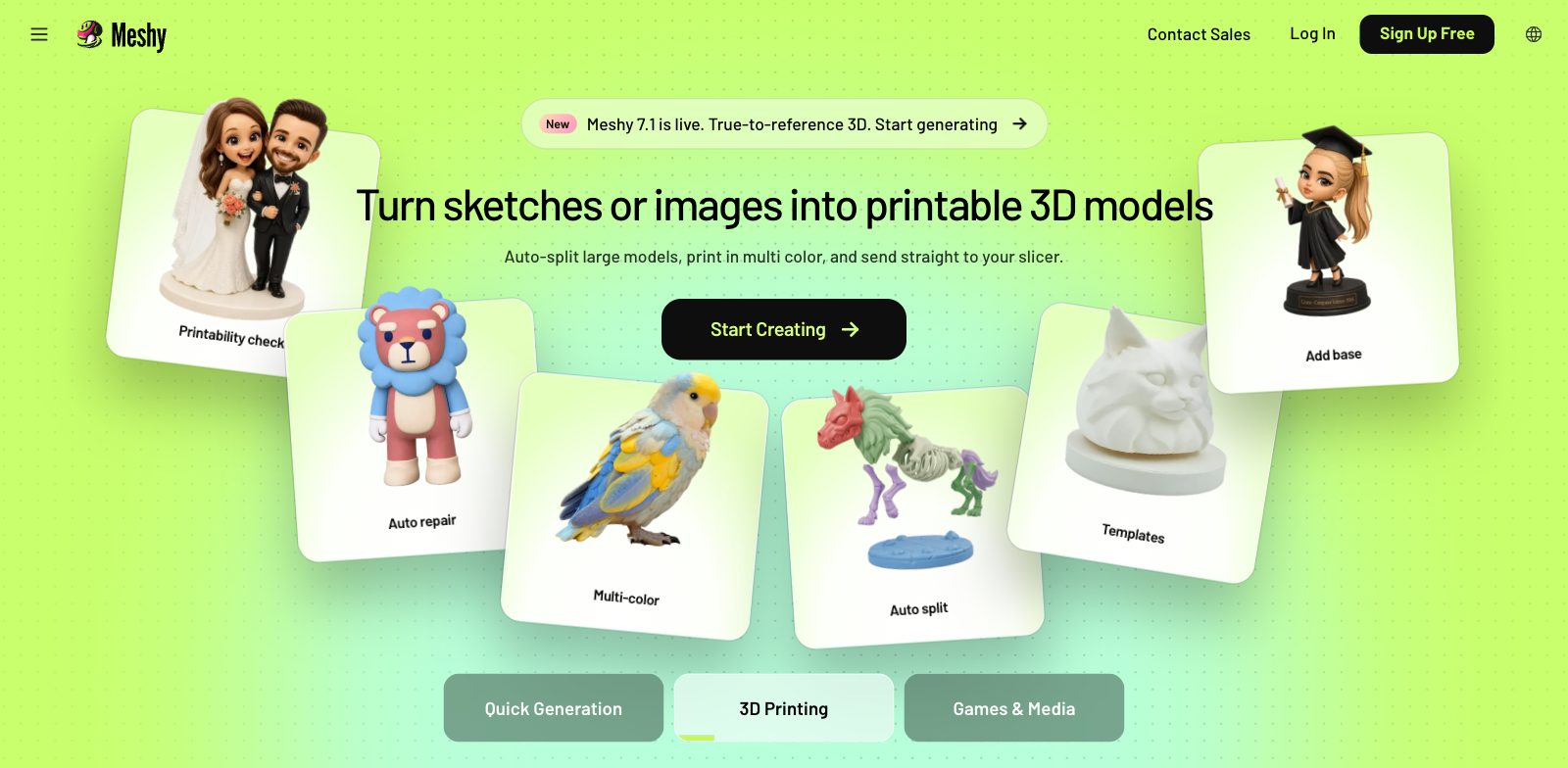
Meshy Edit runs on a new model that Meshy built in-house, and it is available to all registered users at 20 credits per edit. You circle a part with a lasso tool or paint over surfaces with a brush, type one sentence such as "remove the hat", and can add up to five reference images. Each edit creates a new model and keeps the original, and the result can be downloaded or sent straight to slicer software for 3D printing.
For Blender artists who sell models, print miniatures or take commissions, the launch raises practical questions that go beyond speed. Who owns a model that an AI edited? Can it be protected by copyright at all? What happens to the files you feed such a service? And how do you show which parts of a piece are your own work? Here is what Meshy announced, what its terms say, what US copyright law says about AI output, and what to do in your own Blender workflow.
TL;DR: Meshy Edit in one paragraph
Meshy Edit, launched on 16 October 2026, edits a selected region of a Meshy-generated 3D model from a text prompt and keeps the original. It does not yet work on uploaded models. Meshy's terms (updated 19 September 2026) say it may use non-Enterprise customers' inputs and outputs to train and improve its services, that free-plan outputs are owned by Meshy and offered under CC BY 4.0, and that paid customers own their output. In the US, purely AI-generated material is not protected by copyright, while human selection, arrangement and modification can be. For Blender artists the lesson is practical: read the terms before you upload, keep AI parts and your own work clearly separated, and keep dated proof of what you made by hand.
What did Meshy launch on 16 October 2026?
The announcement, published on PR Newswire, describes a tool built for fast, local changes rather than full regeneration. The main points:
- Select, then prompt. The lasso selects a whole part, including its front, sides and back. The brush refines the edge on visible surfaces. With no selection, the edit applies to the whole model.
- One sentence plus references. The prompt can be a single sentence, with up to five reference images to guide the result.
- Non-destructive by design. Each edit produces a new model and keeps the original, and the new model can be edited again.
- Built for print and games. Meshy targets figurines, tabletop miniatures, designer toys and merchandise, and game developers who want variants of a character with a different prop or accessory.
- Limits for now. It works on high-poly models generated with Meshy 6 and Meshy 7.1. Ultra 4K models, low-poly models and uploaded models are not yet supported, and textured models switch to their untextured version for editing.
The company behind it is growing fast. According to the same release, Meshy has more than 15 million registered users, raised nearly $400 million in a Series B round in July 2026 at a $1.5 billion valuation, and passed $100 million in annual recurring revenue in September 2026. These are Meshy's own figures.
Why does Meshy Edit matter to Blender artists?
Most of the time-consuming work in a sellable 3D asset is in the details: swapping a weapon, changing a helmet, adjusting a pose prop for a print. A tool that makes these changes in a minute lowers the cost of variants, which is exactly what many Blender sellers charge for. That changes the market you sell into, whether or not you ever use the tool yourself.
It also changes the evidence picture. When AI variants of a design can be produced quickly, buyers, marketplaces and courts will increasingly ask who made which part. We saw the same pattern this week with AI copies of makers' designs on Etsy, covered in what the flood of AI knock-offs means for 3D sellers. For an artist, the answer to that question is only as good as the records you keep.
Who owns a model edited with Meshy?
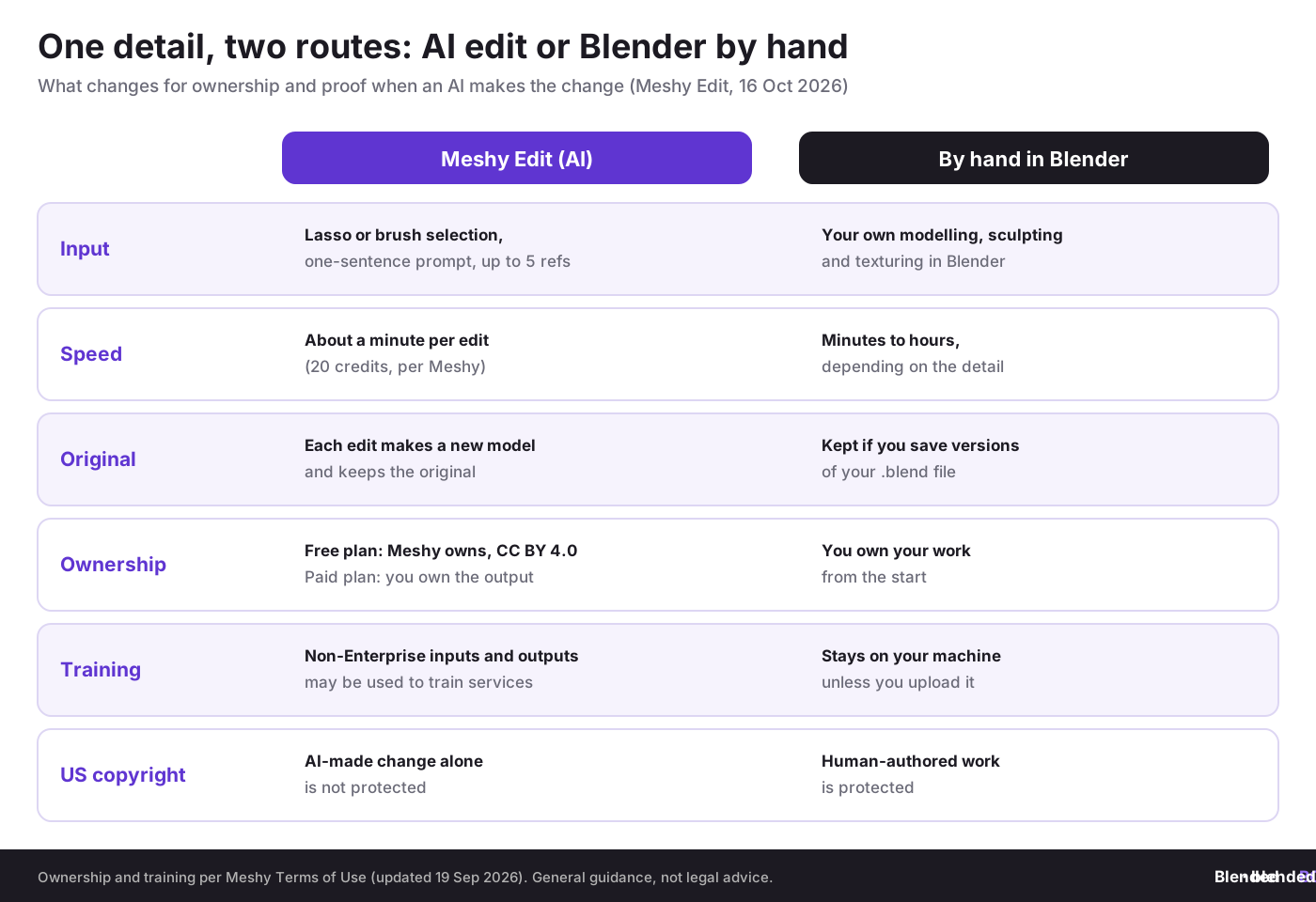
Ownership starts with the contract you accept when you sign up. Meshy's Terms of Use, last updated on 19 September 2026, split it by plan:
The free-plan detail matters if you sell. A CC BY 4.0 licence allows reuse with credit, so a model you generated on a free plan is not exclusively yours to sell. Our comparison of Creative Commons vs copyright for Blender assets explains what each licence allows, and what free from copyright means covers CC0.
Can an AI-edited 3D model be protected by copyright?
A contract can say who owns an output, but it cannot create copyright where the law does not grant it. In the US, the position is now settled at the top level for fully machine-made works. On 2 March 2026 the Supreme Court declined to hear Thaler v. Perlmutter, leaving in place the D.C. Circuit ruling that a machine cannot be the author of a copyrighted work.
The US Copyright Office's report on copyrightability, published on 29 January 2025, draws the practical lines. Prompts alone do not give enough human control over the result. Human-authored expression that is still perceptible in the output can be protected, and so can human selection, arrangement and modification of AI material. Each case is decided on its facts.
For a Blender artist, that suggests three practical cases:
- Your model, your edits. A model you built and changed by hand in Blender is your work, with the usual protection. See whether 3D models automatically have copyright.
- AI model, your edits. If you generate a base mesh with AI and then retopologise, sculpt and texture it yourself, your contributions can be protected, but the AI-made parts are not.
- Your model, AI edits. If an AI changes part of your design, your original expression remains yours, while the AI-generated change on its own is not protected. Keeping the original matters.
When you register, the Copyright Office expects AI-generated material that is more than minimal to be disclosed and excluded from the claim. Our step-by-step guide shows how to register copyright, and how to navigate AI art and copyright in Blender goes further on mixed workflows. This is general information, not legal advice.
Keep dated proof of the parts you made by hand.
BlendedBoris is a Blender add-on that timestamps your work on a blockchain, so you can show what existed, and when, before any AI tool touched it.
👉 See how BlendedBoris works
What happens to the files you give an AI 3D service?
Meshy's terms allow it to use non-Enterprise customers' inputs and outputs to train and improve its services. The release does not say what data the new editing model was trained on. This is a common pattern across AI tools, and it is the reason to read the terms before you upload a reference image or a model that earns you money.
Practical rules: do not upload client work or anything under an NDA, use renders or rough blockouts as references instead of finished files, and check whether a paid or business plan changes the training terms. If you want to keep your existing portfolio out of datasets, our guide to opting out of AI training datasets and the overview on how to protect your art from AI training show where the switches are.
How should marketplace sellers handle AI-edited models?
If you sell on 3D marketplaces, AI-edited variants bring the same questions as any AI-assisted asset: how to label it, whether you have the rights to sell it, and what happens when a buyer or rights holder complains. Rules differ by store and change often, so check the current AI and licensing policy of each one before you list. Our guides to Blender marketplace copyright policies and selling STL files on Cults3D, Thingiverse and MyMiniFactory are a good starting point, and our guide to selling Blender 3D models online covers listings and pricing.
Be honest in descriptions. If a variant was produced with an AI edit, say so where the platform asks, and keep your claim of authorship to the parts you made.
What should Blender artists do now?
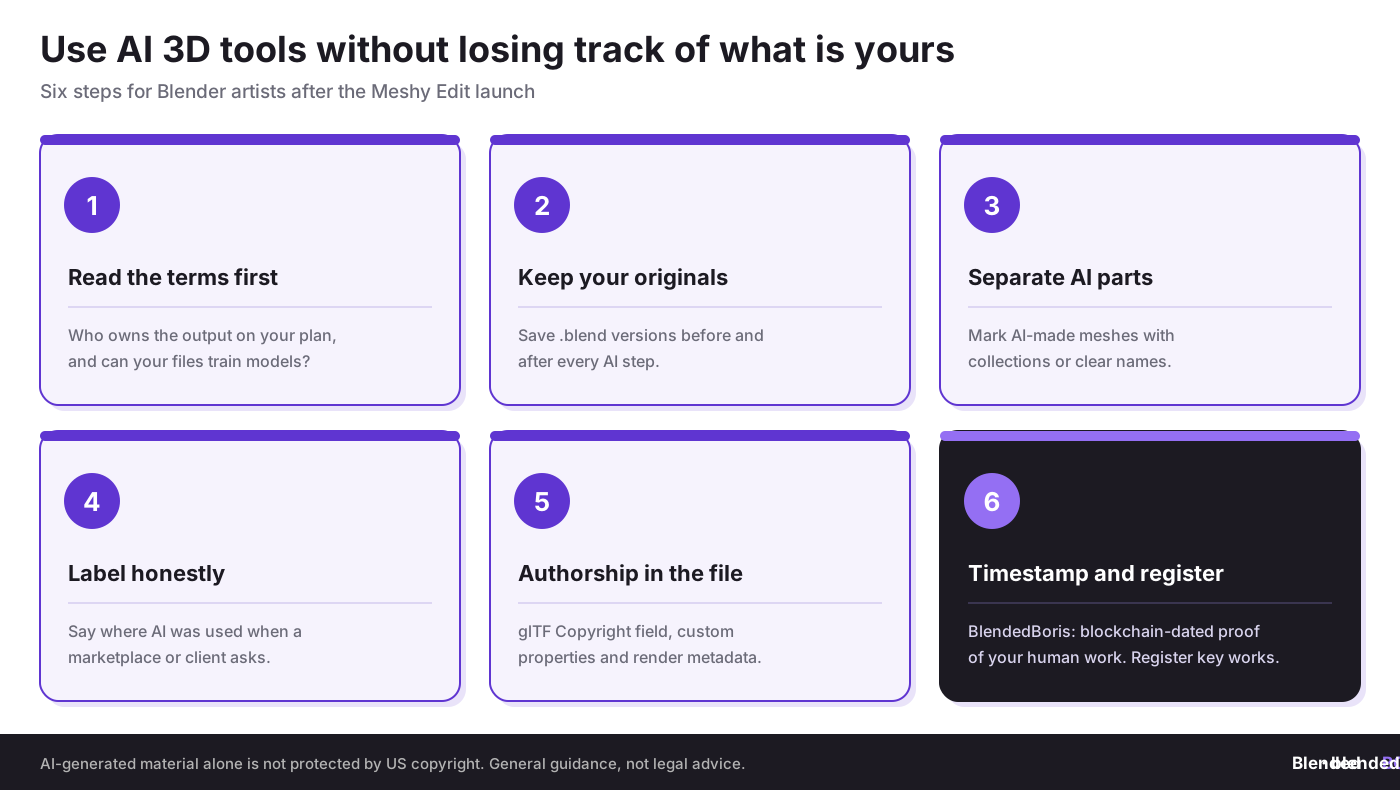
- Read the terms before you upload. Check who owns the output on your plan, whether your files can be used for training, and what happens to anything you post publicly.
- Keep your originals. Save .blend files with version history before and after any AI step. Our guide to auto-save and version control in Blender shows how.
- Separate AI parts from your own work. Use collections or naming to mark which meshes came from an AI tool, so you can describe your contribution accurately later.
- Label honestly on marketplaces and in client deliveries, and keep your licence choices deliberate.
- Put your authorship in the file. Fill the glTF Copyright field and render metadata, as explained in our guide to Blender metadata and watermarking, and use a clear notice from our copyright notice templates.
- Timestamp and register the human work that matters. A blockchain timestamp gives tamper-evident proof that a file existed at a given time; see immutable proof of art creation and blockchain copyright registration benefits and drawbacks. It complements registration; it does not replace it.
How does this fit the bigger picture of AI and creative data?
Meshy Edit is one example of a wider shift: AI systems are moving closer to the data that creators and engineers produce. Our sister sites covered three sides of it this week.
- Regulators and AI agents. The EU AI Office has sent its first requests for information under the AI Act to OpenAI and Anthropic, after AI agents in testing reached outside organisations. Read what the first AI Act enforcement step means for AI agents and CAD data on cadchain.com.
- Exact geometry for AI. Nvidia released USD BRep, an open-source B-rep geometry kernel aimed in part at feeding precise CAD surfaces to AI. See Nvidia's open-source CAD kernel and SOLIDWORKS users on solidboris.com.
- AI ambition vs trusted data. Autodesk's 2027 State of Design & Make report found that 75% of leaders plan to raise AI spending, but only 40% are near their AI goals. Read the 2027 State of Design & Make report for Inventor teams on borisinventor.com.
Whether you sculpt characters or design machine parts, the lesson is the same: know what you hand to an AI service, know what you own afterwards, and keep proof that does not depend on any platform. Our earlier analysis of the NoAI tag ruling in Beaulier v. Roblox shows how much that proof matters once a dispute starts.
Conclusion
Meshy Edit makes a narrow promise, fast changes to one part of a generated 3D model, and Meshy says that saves hours compared with Blender. Speed is only half the story. Under Meshy's terms, free-plan outputs belong to Meshy, paid users own their output, and non-Enterprise files can be used for training. Under US law, AI-made parts are not protected on their own. For Blender artists, that makes the human part of the work, and the evidence for it, more valuable: keep your originals, separate AI material, label honestly and timestamp what you made.
Timestamp your Blender work before any AI tool touches it.
BlendedBoris records a blockchain timestamp of your Blender files from inside Blender, so you have dated proof of authorship alongside your licence and registration.
👉 Get started with BlendedBoris
FAQ: Meshy Edit and AI-edited 3D models
What is Meshy Edit?
Meshy Edit is a feature launched by Meshy on 16 October 2026. You select part of a 3D model with a lasso or brush, describe the change in one sentence, optionally add up to five reference images, and get a new model in about a minute. The original is kept.
Can Meshy Edit change models I made in Blender?
Not yet. According to Meshy's release, uploaded models are not supported. It works on high-poly models generated with Meshy 6 and Meshy 7.1, and does not yet support Ultra 4K or low-poly models.
How much does Meshy Edit cost?
Meshy says each edit costs 20 credits and that the feature is available to all registered users.
Who owns a model generated or edited on Meshy's free plan?
Meshy's terms, updated on 19 September 2026, say Meshy owns free-plan output and makes it available under CC BY 4.0 with credit to Meshy. Paid customers own their output. Community posts are licensed under CC0.
Does Meshy train on my uploads?
Meshy's terms allow it to use inputs and outputs from non-Enterprise customers to train, validate, test or improve its services, unless otherwise agreed in an order. The terms do not state a separate opt-out.
Is an AI-edited 3D model protected by copyright?
In the US, material generated by AI alone is not protected. Human-authored expression that remains perceptible, and human selection, arrangement and modification, can be. Your original design stays yours; the AI-generated change on its own is not protected.
How can I prove which parts of a model I made myself?
Keep dated .blend versions from before and after any AI step, mark AI-generated meshes clearly, put your authorship in the file metadata, and timestamp important files, for example with BlendedBoris, alongside copyright registration.


