
On 30 October 2026, Google, Microsoft and OpenAI said they plan to honour one shared line in robots.txt that tells AI companies not to use a website's content for AI training. Anthropic, whose engineer wrote the proposal, says it has already started building support. For the first time, a Blender artist with a portfolio site could opt out of training by several major AI developers with one group of rules instead of a separate block for every crawler.
The signal is a new robots.txt "policy token" called __usage_ai-training. It comes from an Internet-Draft submitted the same day to the AI Preferences (AIPREF) working group of the Internet Engineering Task Force, the body that maintains many core web standards. Google announced its plans in a post by John Mueller on the Google Search Central Blog, and Microsoft published a longer post by Krishna Madhavan on the Bing blog. According to Search Engine Journal and The Next Web, OpenAI said it aims to implement the signal in the coming months.
None of the four companies reads the new line yet, and the dates range from "coming months" to February 2027. The draft is an individual proposal, not an adopted standard. Still, this is the clearest move so far towards a single opt-out that creators can control themselves. Here is how it works, what it covers for renders, .blend files and 3D models, and what it leaves out.
TL;DR: the shared AI training opt-out for Blender artists
Adding a group for User-Agent: __usage_ai-training with Disallow: / to the robots.txt of your own website will state that you do not want your content used to train generative AI. Google, Microsoft, OpenAI and Anthropic have said they will honour it, with support arriving between now and 2027. It only covers content on sites whose robots.txt you control, it does not reach data already collected, and it is a preference, not a lock. Meta, Amazon and Apple have not committed. Keep your existing crawler rules and your own dated proof of authorship.
What happened on 30 October 2026?
Kevin Kelley of Anthropic published the Internet-Draft for a machine-readable training preference signal and announced it on the working group's mailing list. In that message he wrote that Anthropic has already started implementing support, that it will take time to add it across Anthropic's services, and that publishers should be able to use it over the coming months. Anthropic's existing crawler controls stay in place.
Google said in its Search Central post on a shared AI training control that when a website uses the new token to opt out of training and does not mention Google-Extended separately, Google plans to treat it "as if the publisher had disallowed Google-Extended". Google-Extended is the training control Google has offered since 2023. Google aims to support the shared control in 2027 and says the approach is consistent with the EU Code of Practice for general-purpose AI models, which treats robots.txt as a main way for publishers to express machine-readable preferences.
Microsoft went furthest on detail. From 1 February 2027, Bing will start applying the new training preference as it crawls pages, and it adds a separate page-level setting for grounding, meaning the use of a page to inform AI answers in Bing, Copilot and Microsoft 365. Microsoft says these preferences do not change eligibility for normal Bing search results, and that "Neither choice guarantees inclusion, traffic, or payment."
How does the new robots.txt line work?
Robots.txt is a plain text file at the root of a website, such as yoursite.com/robots.txt. Until now, an artist who wanted to keep work out of AI training had to name each company's crawler or training token one by one, for example GPTBot for OpenAI, ClaudeBot for Anthropic and Google-Extended for Google. Our older guide on how to opt out of AI training datasets walks through that approach. The new draft adds one shared name that any AI developer can choose to read.
Example: a robots.txt group for a Blender portfolio site
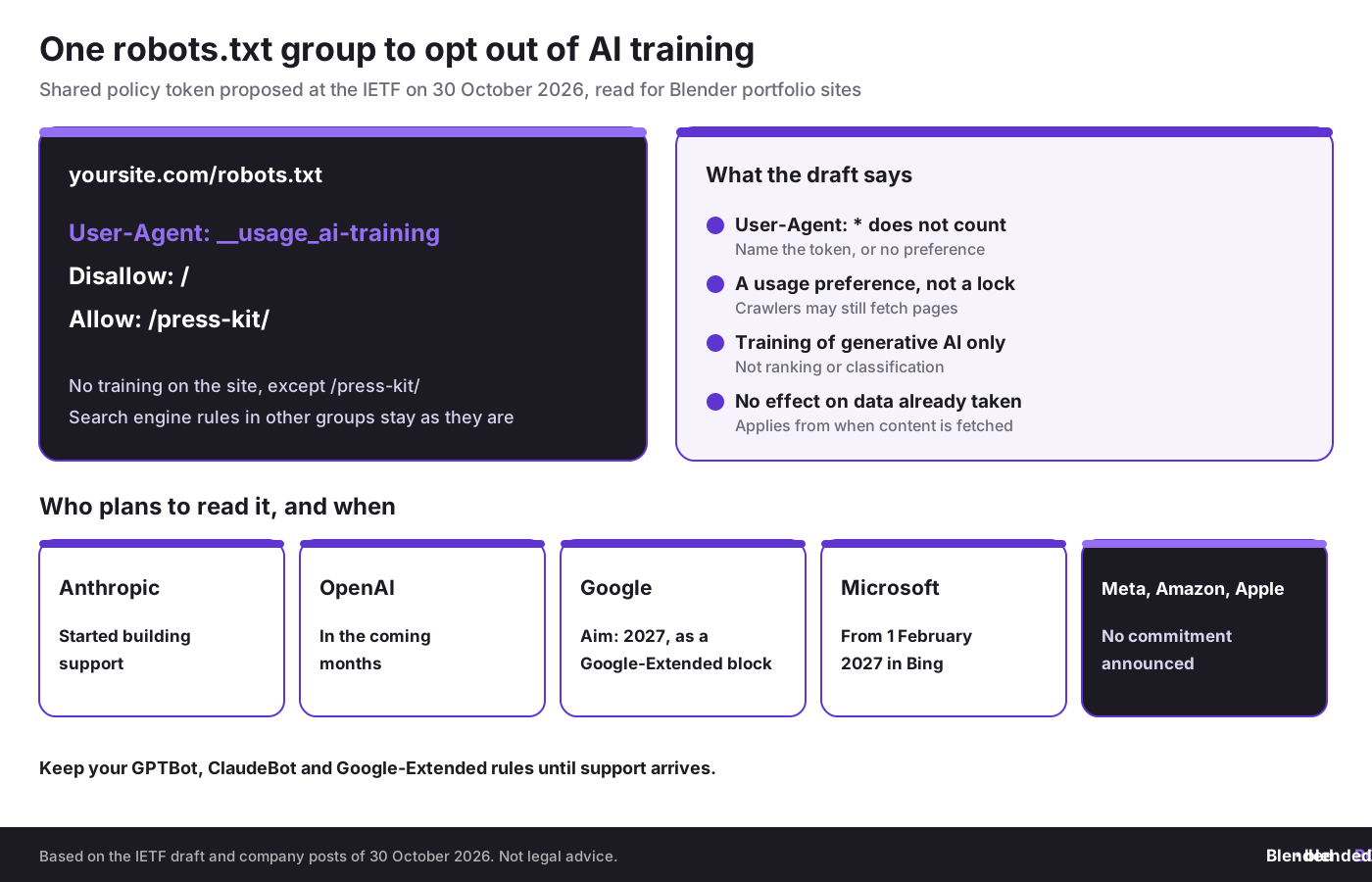
User-Agent: __usage_ai-training
Disallow: /
Allow: /press-kit/
This states a preference against AI training for every path on the site except /press-kit/, where it states a preference in favour. Your existing groups for search engines stay as they are.
The details matter. Under the draft, a wildcard group, User-Agent: *, does not count as a training preference. If your robots.txt has no group naming __usage_ai-training, you have expressed no preference at all under this scheme, even if you already block a list of AI crawlers. The token is also not a crawling rule: it says how content may be used, not whether a bot may fetch it. Crawlers may use it to skip pages, but they do not have to.
The definition of training is borrowed from the working group's vocabulary draft: "Using an asset to modify the learned parameters of a generative AI model." Training of models used only for tasks such as classification, ranking or scoring is not included. So the line is aimed at image, 3D, video and text generators, not at every kind of machine learning.
What do Google, Microsoft, OpenAI and Anthropic each promise?
The four companies agree on the token but not on the timing or on what an opt-out means for their other AI products. The table sums up what each said on 30 October 2026.
The Google detail is easy to miss. If you use the shared opt-out and say nothing about Google-Extended, Google will treat you as having blocked Google-Extended. Google's post adds that websites that specifically allow Google-Extended are eligible to appear in responses and receive clicks through grounding in Gemini Apps. In our reading, an artist who wants to stay out of training but still be cited in Gemini Apps has to make that choice explicitly. Google has said since 2023 that Google-Extended does not affect inclusion in Google Search.
Microsoft separates the two uses. Training is set per site or path in robots.txt and can be overridden per page with a meta tag such as name="Bingbot" content="ai-training:disallow". Grounding can only be set per page, with three values: Allow, DisallowExtended, which keeps your page in Microsoft's own products such as Copilot but out of third-party grounding services, and Disallow. Sites that rely on the older NoArchive and NoCache tags get a temporary grounding setting in Bing Webmaster Tools from 15 December 2026.
An opt-out is a request. Proof is a record.
BlendedBoris records a blockchain timestamp of your Blender work from inside Blender, so you hold dated proof of authorship whatever any crawler does with your portfolio.
👉 Protect your Blender work with BlendedBoris
Does it protect renders, .blend files and 3D models?
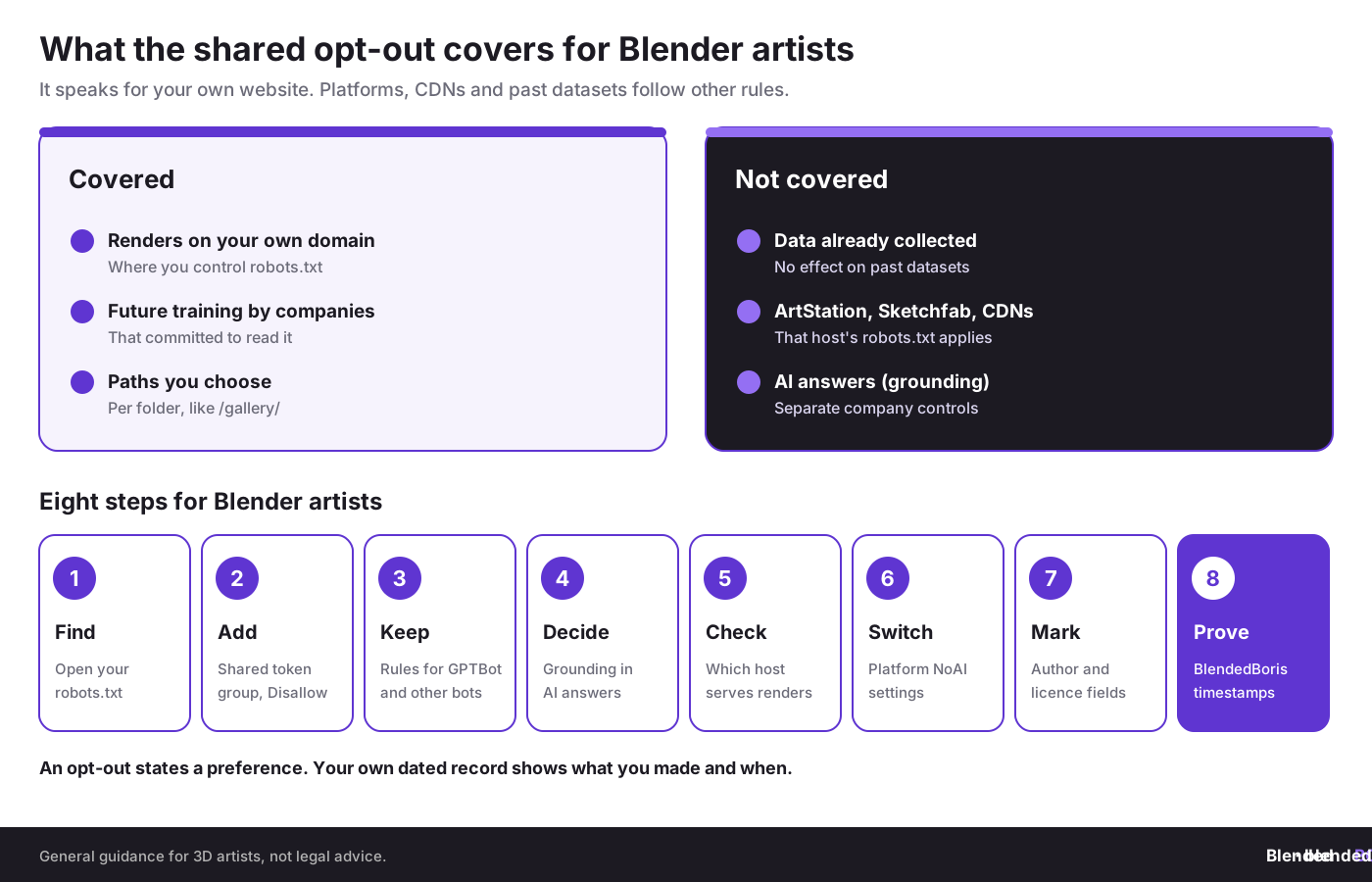
Only where they are served from a website whose robots.txt you control. Robots.txt works per host, and the draft says the preferences that apply to a file are the ones in the robots.txt in effect when that file was retrieved. A render on your own domain falls under your file. A render served from a content delivery network, an image host or a platform such as ArtStation, Sketchfab or a marketplace falls under that host's robots.txt, which you cannot edit. If your site builder stores images on a separate CDN domain, check which robots.txt applies to those image URLs.
Most 3D work reaches AI datasets through platforms and licences rather than through personal websites. Our report on the Hi3D open-source 3D generator described how the Objaverse dataset was built from hundreds of thousands of Creative Commons models on Sketchfab. For those uploads, the platform's settings and your licence choice matter more than your robots.txt. ArtStation now applies its NoAI setting by default, while Sketchfab's NoAI tag is opt-in, as we explained in our article on Sketchfab's new terms of use. Our guide to Creative Commons versus copyright for Blender assets covers what a CC licence allows.
The 3D model lawsuits show why platform tags are a weak shield on their own. In the Roblox NoAI tag ruling, a judge accepted at the pleading stage that a Sketchfab NoAI tag can count as copyright management information, but the claims were still dismissed with leave to amend. A robots.txt preference is a different kind of signal again: it sits on your site, not in the model file.
What does the shared opt-out not do?
- It does not reach the past. The draft ties preferences to the robots.txt in effect when content was retrieved. Work that was already collected stays where it is.
- It is not enforced. It is a voluntary preference. Private agreements between a site and an AI company can override it, and scrapers that ignore robots.txt will ignore this too.
- It does not cover everyone. Meta, Amazon and Apple have not committed, and we found no announcement from Common Crawl, whose web archives feed many training datasets.
- It does not pay anyone. Microsoft states that the preferences do not create licensing or payment arrangements.
- It is not yet a standard. The Internet-Draft expires on 3 May 2027 unless it is renewed, and the working group can still change it.
Grounding is the other gap. Training changes a model's parameters. Grounding fetches your page when someone asks a question and uses it in the answer. The shared token covers only training. For grounding you still depend on each company's own controls, which is how Google and Microsoft handle it differently.
Does an AI training opt-out have legal weight?
In the European Union, yes, potentially. The text and data mining exception in Article 4 of the 2019 Copyright Directive lets anyone mine lawfully accessible online content unless the rightsholder has reserved that use in an appropriate way, such as by machine-readable means. The AI Act requires providers of general-purpose AI models to have a policy to respect those reservations. A shared, widely read robots.txt line makes it easier to show that you reserved your rights and when. Our guide to international AI art copyright laws compares the main regions.
In the United States there is no statutory opt-out. Whether training on your work is lawful is decided case by case under fair use, as in the Thomson Reuters v. ROSS appeal ruling. A clear opt-out may still help as evidence of what you told AI companies. In the United Kingdom, the government's March 2026 report on copyright and AI did not adopt a new training exception and promised more evidence gathering. Australia is still debating its own model, as we reported in our article on the Australian opt-out fight.
Whatever the law, the opt-out does not prove that you made a work. If an AI output looks like your character, you still need dated originals, registrations where available, and a record of when you published. Our guide on how to register copyright in 2026 and our copyright notice templates for 3D artists cover those basics.
What should Blender artists do now?
- Find your robots.txt. Open yoursite.com/robots.txt and check whether your site builder lets you edit it.
- Add the shared group. Add User-Agent: __usage_ai-training with Disallow: / for the paths you want kept out of training. It costs nothing to add it before the companies start reading it.
- Keep your crawler rules. Do not delete existing groups for GPTBot, ClaudeBot or Google-Extended. They still work and cover the gap until 2027.
- Decide on grounding. Choose whether you want to be cited in AI answers. Allow Google-Extended if Gemini Apps grounding matters to you, and plan Bing page-level settings before 1 March 2027.
- Check your image hosts. Find out which domain serves your renders and whose robots.txt applies there.
- Set platform switches. Review NoAI settings on ArtStation, Sketchfab and the marketplaces you use. Our portfolio guide for Blender artists helps you decide what to show where.
- Mark your files. Add author and licence fields to renders and exports, as explained on the sister blog's guide to Blender metadata and watermarking.
- Keep dated proof. Timestamp your .blend files and final renders, so you can show what you made and when if a copy turns up.
The sister blog has more on AI dataset opt-out strategies and on protecting art from AI training, including tools that work on the image itself. If you also run business pages on Instagram or Facebook, see our article on Meta's website crawling clause, because Meta has not joined this commitment.
Where does this fit in the bigger picture?
Since 2023, creators who wanted to stay out of AI training have had to opt out crawler by crawler, one company at a time. A shared token backed by four major developers changes that, even if it covers only one kind of use. It also fits a wider trend towards provenance and disclosure, from Etsy's new AI photo rules to the Content Credentials timestamp flaw, where a record is only as strong as what it covers. Our sister sites looked at other questions of control this week:
- Patent work as a trade secret. A Seoul appeals court upheld a jail sentence for Samsung's former IP chief over an internal patent analysis passed to an outside firm: what the Samsung patent trade secrets ruling means on cadchain.com.
- Meshes back to CAD. New AI tools can rebuild editable CAD models from scanned or exported meshes, so an STL file is no longer a safe way to share a shape: what AI mesh-to-CAD means for SOLIDWORKS users on solidboris.com.
- Fake extensions. A trojanized copy of the Claude Code extension appeared on Cursor's marketplace for about eleven hours on 29 October: what the Claude Code extension backdoor means for Inventor teams on borisinventor.com.
Conclusion
The shared AI training opt-out is a small line of text with a long way to go. It is a draft, it is voluntary, it arrives in stages until 2027 and it says nothing about work already collected or about companies that have not signed up. For Blender artists with their own website, it is still worth adding now, next to your existing crawler rules, because it states your choice once in a way four major AI developers have promised to read. Pair it with sensible platform settings, honest licences and your own dated proof of what you made.
Your work, your date, your proof.
BlendedBoris adds a blockchain timestamp to your Blender work from inside Blender, giving you dated proof of authorship to stand next to your opt-outs, licences and copyright registrations.
👉 Get started with BlendedBoris
FAQ: the shared AI training opt-out and Blender artists
What is __usage_ai-training?
It is a robots.txt policy token proposed in an IETF Internet-Draft on 30 October 2026. A group with User-Agent: __usage_ai-training and Disallow rules states that the listed paths should not be used to train generative AI models.
Which companies will honour it?
Google, Microsoft and OpenAI announced plans to honour it, and Anthropic says it has started implementing it. Meta, Amazon and Apple have not committed.
When does it start working?
Not yet. Anthropic and OpenAI speak of the coming months, Google aims for 2027 and Microsoft starts on 1 February 2027.
Does User-Agent: * with Disallow: / count as an opt-out?
Not under this draft. Wildcard groups do not count as a training preference. You need a group that names __usage_ai-training.
Will it remove my work from existing AI datasets?
No. The preference applies to content retrieved while the rule is in place. It does not address data collected earlier.
Will opting out hurt my search ranking?
Google says Google-Extended does not affect Google Search, and Microsoft says the new preferences do not change eligibility for Bing search results. Opting out of grounding can reduce visibility in AI answers.
Does it protect my models on Sketchfab or ArtStation?
No. Those pages fall under the platform's robots.txt and settings. Use each platform's NoAI options and choose your licence carefully.
How can BlendedBoris help?
BlendedBoris records a blockchain timestamp of your Blender work from inside Blender, giving you dated proof of authorship that does not depend on whether a crawler respects your opt-out.


