
Blender 5.3 brings native support for 3D Gaussian splats. In a post on the Blender developers' blog on 30 October 2026, developers Mark van de Ruit and Sergey Sharybin explained how Blender now imports, edits and renders splats in Workbench, EEVEE and Cycles. Blender 5.3 is in its release candidate phase until 10 November 2026. For Blender artists, this means photo-based captures of real objects, rooms and places become a normal part of a scene. It also raises a question that rarely came up before: who owns a capture, and what are you allowed to capture?
A Gaussian splat is a 3D scene made from a set of photos. As the developers put it, splatting "doesn't produce a mesh, but a radiance field made of many tiny Gaussian blobs." Each blob has a position, a size in three directions, a rotation and colour information that changes with the viewing angle. The result can look almost like a photograph from any angle. Until now, Blender artists needed add-ons to work with splats. In Blender 5.3 they are a built-in data type.
This is a big practical change for anyone who already uses photogrammetry, scans props for games or builds environments from real locations. It is also a reminder that a splat is mostly made of other people's things: the objects, buildings, artworks and people in the photos. This article explains what Blender 5.3 actually supports, what it does not do yet and how to keep your captures on the right side of copyright, privacy and licence rules.
TL;DR: Blender Gaussian splatting and your rights
Blender 5.3 imports Gaussian splats from PLY and SPZ files, and from USD and glTF, stores them as a new type of point cloud and renders them in Workbench, EEVEE and Cycles. It cannot export splats yet, and the developers call the support initial. A splat copies whatever was in front of the camera. Your own sculpture or prop is yours, but a capture of someone else's artwork, product or face can need permission, and a splat downloaded from the web comes with its creator's licence. A faithful capture may also carry less copyright of its own than a model you built by hand. Keep your photos, the original splat file and dated records of what you captured and when.
What does Blender 5.3 support for Gaussian splats?
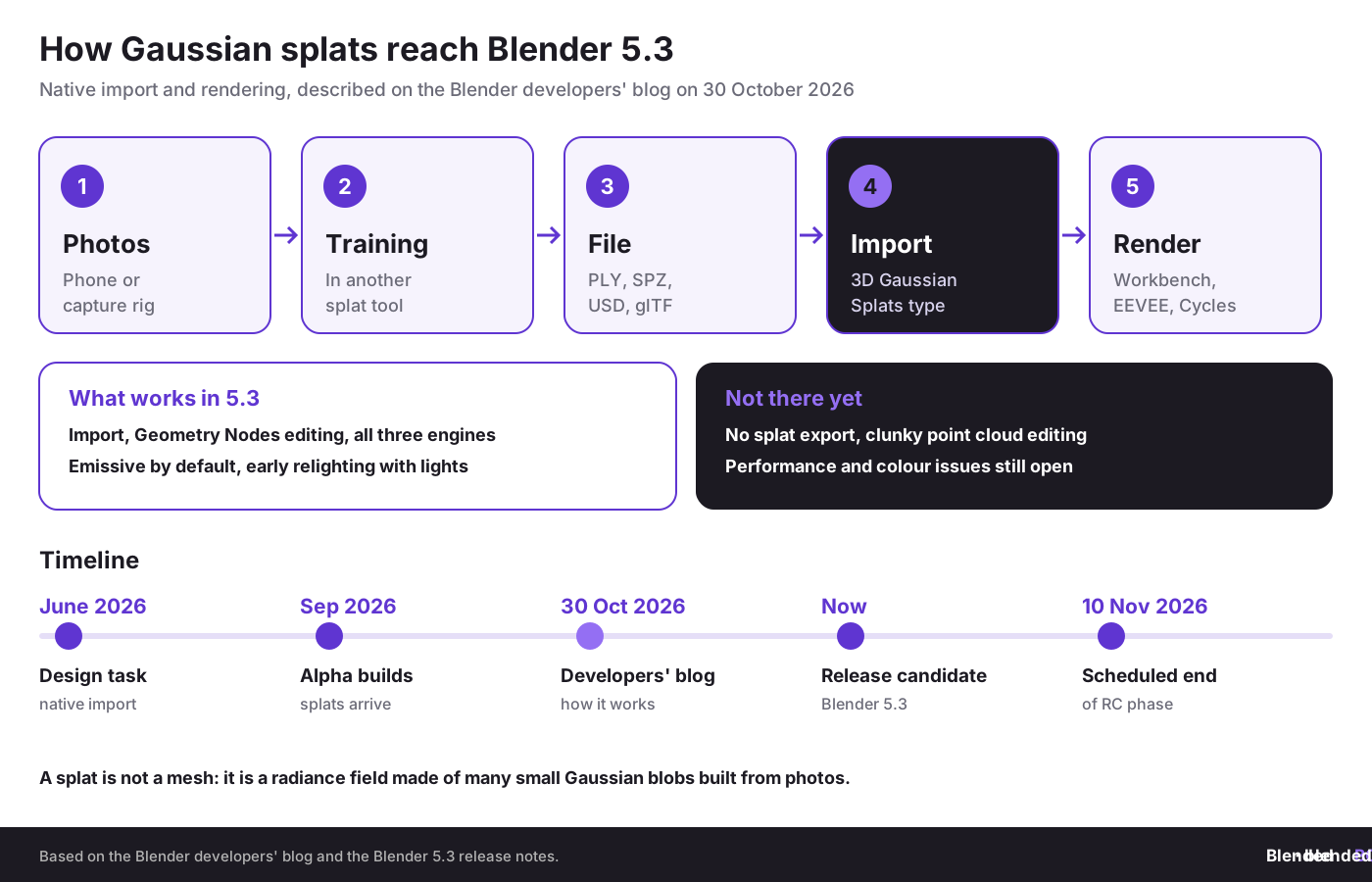
According to the Blender developers' blog post, Blender 5.3 adds initial support for importing, editing and rendering 3D Gaussian splats. You can drag a .PLY or .SPZ file into the viewport and confirm the import. The Blender 5.3 pipeline release notes add that splats can also come in through the glTF importer and through USD, which now reads the USD schema for Gaussian splats.
Inside Blender, splats are a type of point cloud. A new geometry node switches a point cloud between ordinary points and 3D Gaussian splats, so Geometry Nodes can read and change the splat data. Each splat stores its position, a 3D scale, a rotation and radiance, the view-dependent colour data. By default, splats use an emissive material driven by that radiance. You can change the shader to light splats with scene lights, but the developers describe this relighting as early-stage.
All three built-in render engines draw splats. Workbench and EEVEE draw them as small transparent cards that face the camera, sorted back to front. EEVEE's transparency is noisy, so you need more samples, and Workbench needs flat lighting for an accurate preview. Cycles traces rays through the splats and supports reflections and indirect light. The developers note that EEVEE and Cycles can give different results, because most splat data is made with a camera-facing method like EEVEE's in mind.
There are clear limits. Blender 5.3 cannot export splats. Coverage of the alpha builds by Radiancefields listed known issues with performance, colour handling for very transparent but bright splats, and Apply Transform. The developers say point cloud editing tools are still clunky and that EEVEE draws splats hidden behind other splats, which slows down weaker hardware. Further work is a roadmap project funded through the Blender Development Fund.
Where do Gaussian splats come from?
Blender does not make splats from photos. You take a set of photos or a video of an object or place, and another tool trains the splat from those images. The developers say this can be done with professional capture tools or with a phone. Blender's own demo file is a capture of real DOGWALK game assets, photographed as physical objects at Blender HQ.
If you already work with photogrammetry, the input is the same: many overlapping photos. The output is different. Photogrammetry gives you a mesh and textures that you then clean up, as our guide to photogrammetry cleanup and integration in Blender shows. A splat keeps the look of the photos, including reflections and fine detail, but it is not a mesh you can easily edit or 3D print. Camera data matters for both, which is why camera tracking and matchmoving skills carry over.
Splats also come from other people. There are public galleries and capture apps where people share splat files, and the developers' post links to several example scenes online. The post does not state licence terms for those examples. That is normal for a technical blog post, but it is the first thing to check before you put a downloaded splat into commercial work.
Who owns a Gaussian splat?
No court we know of has ruled on copyright in a Gaussian splat as such. But splats are built from photos and from real objects, and copyright law already has a lot to say about both. Three layers usually matter: the thing you captured, the photos you took and the splat file you made.
The thing you captured. If you capture your own sculpture, prop or set, you are copying your own work. If you capture someone else's artwork, toy, statue or designed product, the splat may be a copy of their protected work. A splat of a copyrighted figure is still a copy of that figure, in the same way a photo or a 3D scan would be. Our guide to whether 3D models automatically have copyright explains how protection arises for the original.
The photos. In many countries, photos are protected if they reflect the photographer's own creative choices. Some countries, such as Germany, also give simple photographs a separate, shorter right. If you used someone else's photos or video to train a splat, their rights come along.
The splat itself. A faithful capture may carry less copyright of its own than a model you built by hand. In the US, the Tenth Circuit held in Meshwerks v. Toyota (2008) that digital wireframe models that faithfully reproduced Toyota cars were not original enough for copyright. A splat that only records what a camera saw may face the same argument. Your creative choices, such as lighting, composition, set design, cleanup, editing and how you use the splat in a scene, are where your own protection is strongest. The landmark copyright cases for 3D artists show how courts weigh copying against creativity.
A capture is only as safe as your records.
BlendedBoris records a blockchain timestamp of your Blender work from inside Blender, so you hold dated proof of what your scene, edits and renders looked like and when.
👉 Protect your Blender work with BlendedBoris
Can you capture buildings, statues and public art?
This depends on the country, and it trips up a lot of 3D artists. Many countries have a freedom of panorama rule that lets you photograph or depict works permanently placed in public places. The scope varies widely:
- European Union. The 2001 copyright directive lets each member state decide whether to allow it and how far. Some countries allow broad use. France allows only reproductions made by individuals and excludes commercial use.
- United Kingdom. The exception covers buildings, and sculptures and works of artistic craftsmanship permanently situated in a public place.
- United States. The exception covers buildings only. Sculptures and memorials are not covered. In Gaylord v. United States (2010), the Federal Circuit found that a postage stamp showing the Korean War Veterans Memorial was not fair use.
So a splat of a city street may be fine in one country and need permission for a statue in another. Works inside museums and galleries are not "permanently situated in a public place" in the usual sense, and venues often set their own photography rules. There is one useful rule for old art in the EU: since the 2019 copyright directive, a faithful reproduction of a public domain artwork is not protected unless it is itself original. Our guide to works that are free from copyright explains when old works become free to use.
Brands are a separate issue. A splat of a branded product or a shop front can raise trademark questions when you use it commercially, even where copyright does not stop you. Our list of the most common copyright problems for 3D artists covers this overlap.
What about people in your captures?
Splats are made to look real, and that makes people in them easy to recognise. In the EU, an identifiable person in a capture is personal data under the GDPR, and many countries protect a person's image or likeness. Capturing a person on purpose, for a digital double or a character, needs their clear permission. Our report on Denmark's deepfake bill and 3D scans explains why realistic digital copies of people are getting their own rules.
For street and interior captures, the practical rule is simple: avoid capturing people you do not need, and remove or blur them before you share or sell the result. That also keeps your scene cleaner.
What should Blender artists do now?
Native splats will make captures part of everyday Blender work. The best time to set good habits is before your first client project, not after a takedown notice.
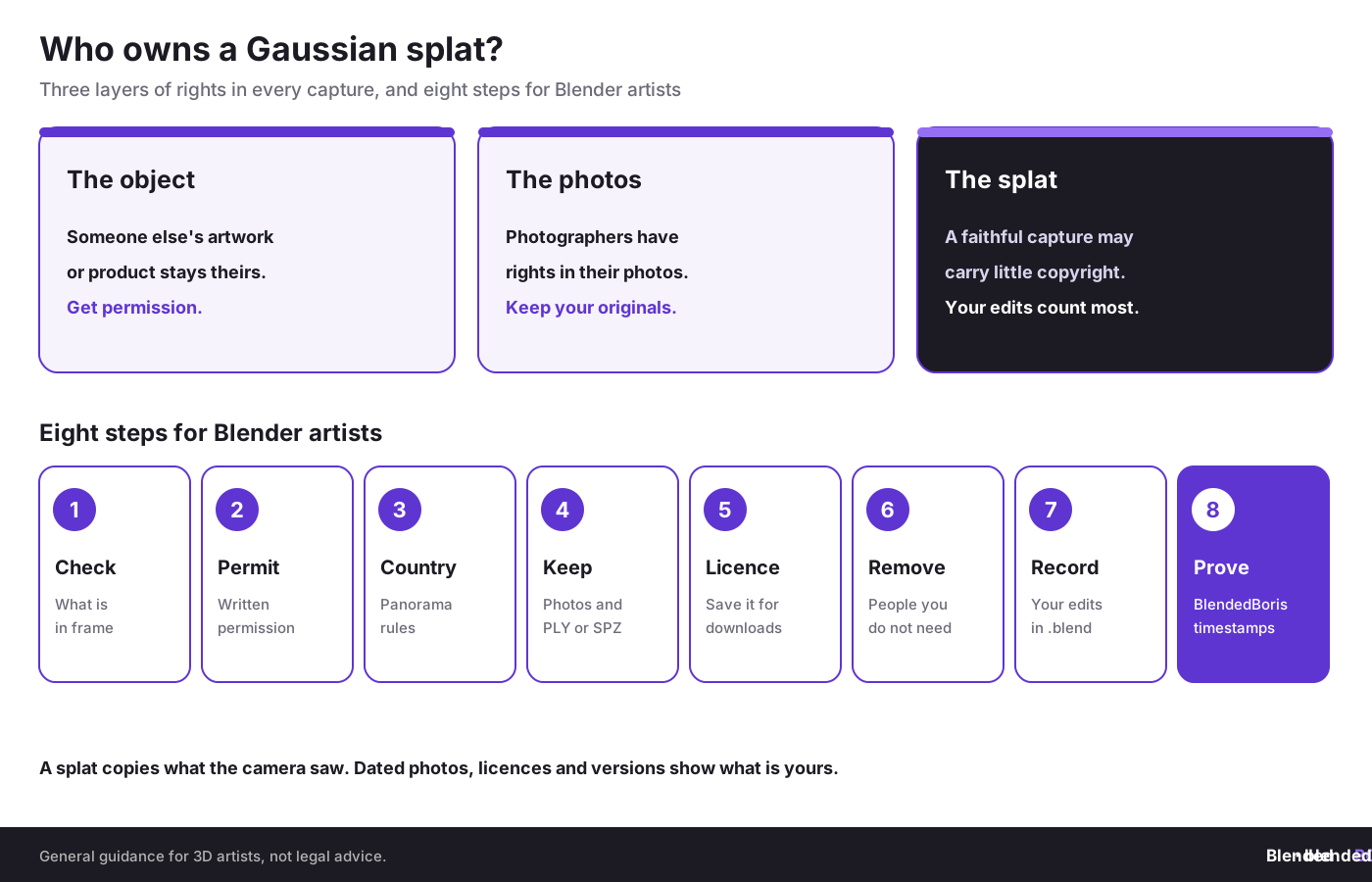
- Check what is in frame. Before you capture, decide whether the object, artwork, building or brand is yours, free to use or needs permission.
- Get permission in writing. For other people's artworks, products, homes and private spaces, a short email or signed note is far better than a verbal yes.
- Check the country. For public art and buildings, check the freedom of panorama rules where the work stands and where you sell.
- Keep the source photos. The photos are your best evidence of when and how you captured something. Blender 5.3 cannot export splats, so the original PLY or SPZ file is your master copy too.
- Save licences for downloaded splats. Keep a copy of the licence text and the page you downloaded from, with the date. If there is no licence, assume you may not use it commercially.
- Remove people you do not need. Crop, mask or delete identifiable people before you share or sell a capture.
- Record your own creative work. Save .blend versions that show your lighting, edits, scene design and cleanup. That is where your own copyright is strongest.
- Timestamp each important version. Dated proof helps when a client, platform or other artist asks who made a scene first.
If you plan to share splat scenes through Blender's new online libraries, read our report on Blender 5.3 online asset libraries and access tokens. For uploads to model platforms, see what Sketchfab's new terms of use say and how 3D uploads ended up in datasets in our report on the Hi3D image-to-3D generator. If you want an extra layer of formal protection for your original work, see how to register copyright as a 3D artist.
The sister blog covers how to create immutable proof of your art, metadata and watermarking for Blender work and how to protect Blender models from theft. For the limits of embedded provenance data in image files, see our article on the Content Credentials timestamp flaw.
Where does this fit in the bigger picture?
New tools keep changing what counts as a design file and who can copy it. This week our sister sites covered the same shift from the engineering side:
- Espionage against knowledge-heavy firms. The UK's National Cyber Security Centre says cyber espionage is highly likely the most significant cyber threat to the UK's long-term growth: what the NCSC Annual Review 2026 means for design data on cadchain.com.
- AI that builds CAD models. A new benchmark tested AI systems on 100 parametric CAD tasks in FreeCAD, including turning drawings into models: what the Parametric CAD Bench results mean for SOLIDWORKS teams on solidboris.com.
- Old systems near design data. Windows 11 23H2 Enterprise and Education get their last update on 10 November 2026: what the Windows 11 23H2 end of support means for Inventor workstations on borisinventor.com.
The common thread is that it keeps getting easier to turn something real into a digital file, whether that is a drawing turned into a CAD model or a statue turned into a splat. The person who can show what they made, what they had permission to use and when they did it is in the strongest position. Our guide to the Blender Conference and how to protect the work you show applies the same idea to public demos.
Conclusion
Native Gaussian splats in Blender 5.3 are a real step for 3D artists. Photo-real captures can now sit next to meshes, be changed with Geometry Nodes and be rendered in all of Blender's engines. The support is still initial: there is no export, relighting is early and performance needs work. The rights questions are not new, but splats make them more common. A capture copies what was in front of the camera, so permission, location and licences matter, and a faithful capture may give you less protection than work you built yourself. Keep your photos, original splat files, licences and dated versions together, and you will be ready when someone asks where a scene came from.
Your scenes, your date, your proof.
BlendedBoris adds a blockchain timestamp to your Blender work from inside Blender, giving you dated proof of authorship to stand next to your capture records, permissions and licences.
👉 Get started with BlendedBoris
FAQ: Blender Gaussian splatting and your rights
Does Blender support Gaussian splatting?
Yes. Blender 5.3 adds initial native support for importing, editing and rendering 3D Gaussian splats. Blender 5.3 is in its release candidate phase until 10 November 2026.
Which splat file formats can Blender 5.3 import?
PLY and SPZ files, plus splats from USD and glTF. Blender 5.3 cannot export splats yet.
Can Cycles render Gaussian splats?
Yes. Workbench, EEVEE and Cycles all render splats. Cycles traces rays through them and supports reflections and indirect light, while EEVEE and Workbench draw them as camera-facing transparent cards.
Can Blender make a splat from my photos?
No. You train the splat from photos or video in another tool, then import the file into Blender.
Do I own a Gaussian splat I captured?
You own the rights in your own photos and creative choices, but not in the objects you captured. A faithful capture of someone else's work may be a copy of it, and a pure record of reality may carry little copyright of its own.
Can I capture a public statue and sell the result?
It depends on the country. The UK allows depictions of sculptures permanently in public places, the US exception covers buildings only, and EU countries each set their own rules.
Can I use splats I downloaded from the web?
Only within the licence the creator gave. Save the licence and source page with the date. Without a clear licence, do not use the splat commercially.
How can BlendedBoris help?
BlendedBoris records a blockchain timestamp of your Blender work from inside Blender, giving you dated proof of when you made each version of a scene or render.


