

On 3 November 2026, an adviser to the Court of Justice of the European Union gave the first opinion in a generative AI copyright case to reach that court. Advocate General Maciej Szpunar said that when an AI chatbot such as Google Gemini fetches an online article in real time and reuses it in an answer, it may infringe the publisher's rights in certain circumstances. He also said, as a side note, that training a large language model on protected works is, as a rule, allowed under the EU's text and data mining exception. For Blender artists who show renders and models online, both halves of that opinion matter.
The case is Like Company v Google Ireland, C-250/25. Like Company runs several Hungarian news portals and sued Google before the Budapest Regional Court. It says Google used its articles to train the Gemini models and repeatedly reproduced them and made them available to users through the Gemini chatbot between 13 June 2023 and 31 May 2024. The Hungarian court paused the case and asked the Court of Justice four questions about EU copyright law.
The case is about news articles and a right that only press publishers have. It is not about 3D art. But it is the first time the EU's top court has been asked how copyright rules apply to AI, and the reasoning covers training, opt-outs and AI answers that copy someone else's expression. This article explains what the Advocate General said, what he did not say, what happens next and what Blender artists can do now.
TL;DR: the EU AI copyright opinion and Blender artists
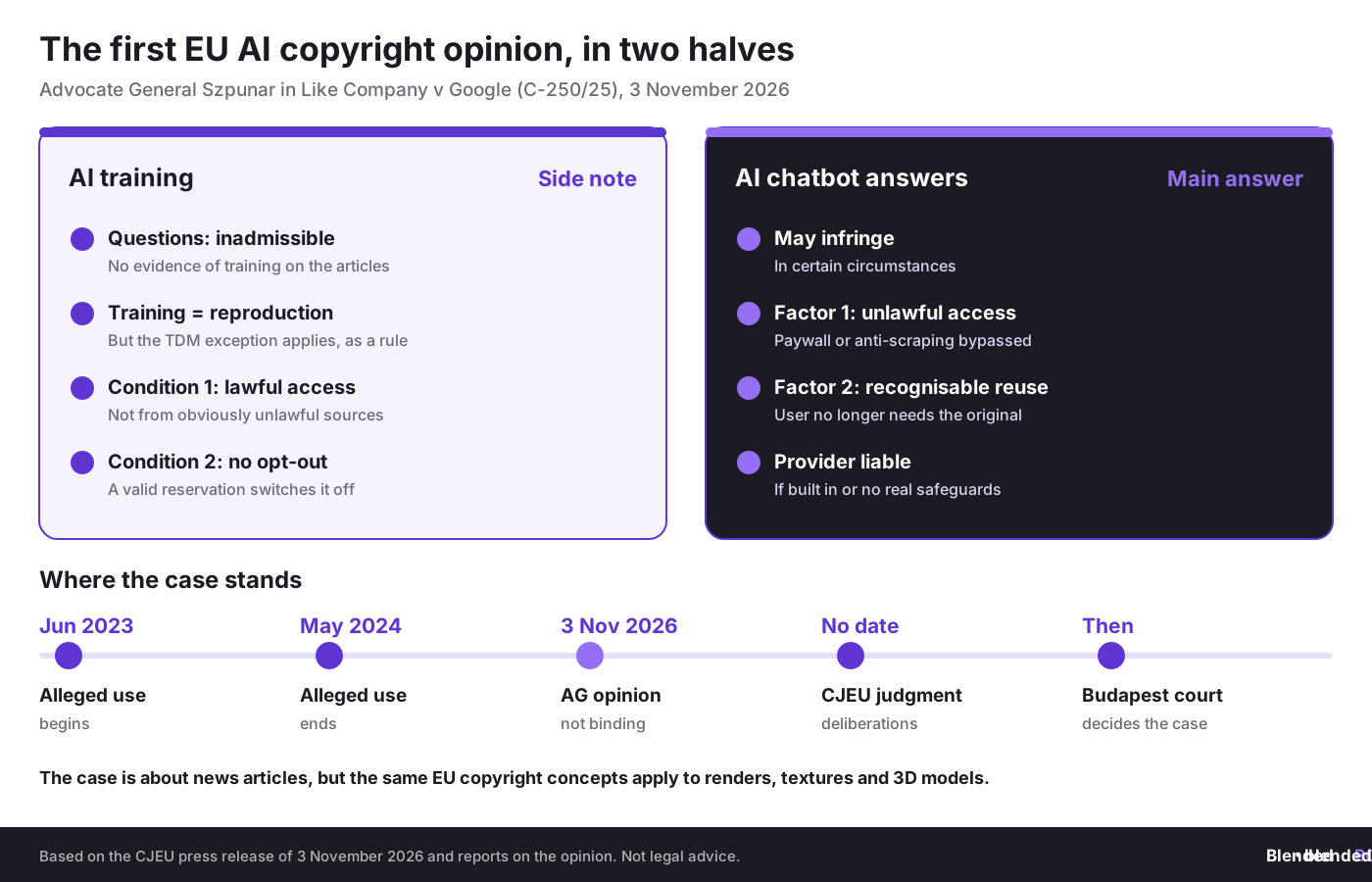
Advocate General Szpunar advised the Court of Justice to treat the two training questions as hypothetical, because there was no evidence Like Company's articles were used to train Gemini. He still said that training an AI model on protected works is, as a rule, allowed under the text and data mining exception, which only works if access is lawful and the rights holder has not opted out. On chatbot answers, he said they may infringe where the AI got around a paywall or anti-scraping measure, or reused the original expression so closely that users no longer need the source. The opinion is not binding and the Court has not ruled. For artists, it raises the value of a clear, dated opt-out and of evidence that an AI output reuses your work.
What did the Advocate General say about AI training?
Two of the four questions asked whether using press articles to train an AI model needs the publisher's permission, or whether it is covered by the text and data mining exception in Article 4 of the 2019 Copyright in the Digital Single Market Directive. Text and data mining means the automated analysis of large amounts of content to find patterns. Under Article 4, anyone with lawful access may mine content unless the rights holder has reserved its rights in an appropriate way, such as by machine-readable means for content published online.
According to the Court's official press release, Szpunar advised the Court to declare both training questions inadmissible. There was no evidence that Like Company's articles had been used to train the Gemini models, and in his view training is not an "online use" of press publications, which is what the press publishers' right covers. So the questions were hypothetical.
He then added a view "for the sake of completeness": using works and other content protected by copyright and related rights to train a large language model is, as a rule, freely permitted under the text and data mining exception. That is not a ruling and the Court may decline to address it. But it is the clearest statement yet from inside the Court on how EU law treats AI training.
The detail matters more than the headline. As Eleonora Rosati explains on the IPKat blog, the opinion treats training as an act of reproduction, so the exception is what makes it lawful. The exception needs two things: lawful access to the content and no reservation of rights by the rights holder. The opinion discusses how a reservation must be made to be enforceable. Reports on the full text say Szpunar accepted robots.txt rules, crawler-specific controls such as Google-Extended and metadata embedded in files, and did not rule out a plain-language reservation in website terms if machines can reliably understand it at the moment of access. Reports also say content taken from obviously unlawful sources, such as pirate sites, falls outside the exception.
In other words, in the EU your opt-out is not a polite request. If the Court follows this reasoning, a valid reservation is what turns lawful mining into infringement. That is why the new shared AI training signal we covered in our article on the robots.txt opt-out from Google, Microsoft, OpenAI and Anthropic matters so much for European artists.
When can an AI chatbot's answer infringe?
The other two questions were about what Gemini shows users. Gemini uses retrieval-augmented generation, also called grounding: it fetches web pages in real time and uses them to build an answer. The Advocate General said that when a chatbot retrieves a press article, reuses it to generate an answer and gives that answer to the user, "the press publisher's right may be infringed in certain circumstances".
He stressed that the right protects only the specific form of expression, not the facts reported. Whether an answer is a reproduction depends on two factors. First, did the chatbot access the article unlawfully, in particular by getting around an effective technical measure such as a paywall or a measure designed to stop web scraping? Second, does the answer merely report facts, or does it reuse the article's form of expression in a recognisable way, to the point where the user no longer needs to read the original?
Making content available to the public is, as a rule, infringed where the original's form of expression is systematically recognisable in the chatbot's answers to related questions. The chatbot provider is liable where such use is built into its business model, or where it has not put in place appropriate measures to stop it credibly and effectively. Reports on the full opinion add that the specific Gemini answer Like Company complained about probably did not infringe, because it seemed to be a hallucination with invented facts rather than a summary of one of its articles. The Budapest court will decide that.
Why does a case about news articles matter for 3D artists?
The press publishers' right is a special right, but the opinion's building blocks are general EU copyright concepts: reproduction, making available to the public, the text and data mining exception and opt-outs. Your renders, textures, sculpts and models are protected by copyright as soon as you make them, as our guide to whether 3D models automatically have copyright explains. If the Court adopts this approach, courts are likely to ask similar questions when an AI tool reuses an artist's work: was access lawful, was there a valid opt-out, and is the artist's expression recognisable in the output? That is our reading of where the reasoning leads, not something the opinion decides for images or 3D work.
AI tools that answer with images are moving the same way as text chatbots. They search the web, pull in pictures and describe or remix them. Portfolio sites and marketplaces where Blender artists post work are exactly where these tools look. Our reports on Sketchfab's new terms of use and on the open-source Hi3D image-to-3D generator show how 3D uploads already end up in AI datasets and how platforms describe that use.
The opinion also helps on a question artists ask often: does posting work online mean you agreed to AI use? IPKat reports that Szpunar said publishers do not implicitly consent to chatbot use just by putting content online. That fits the argument made by artists' groups in the US, which we covered in our report on the OpenAI copyright lawsuit.
An opt-out works best with a date on it.
BlendedBoris records a blockchain timestamp of your Blender work from inside Blender, so you hold dated proof of what you made and when, next to your opt-outs and licences.
👉 Protect your Blender work with BlendedBoris
What did the Advocate General not decide?
Several points are still open, and it is worth being precise about them:
- Nothing is binding yet. An Advocate General's opinion is advice. The judges have now started their deliberations and will give judgment later. No date has been set.
- The training view is a side note. Because he proposed that the training questions be declared inadmissible, the Court may never answer them in this case. Rosati notes the issue may come back in this or another referral.
- Where training happens. Google argued that the law of the place where its main computing infrastructure sits should apply. According to IPKat, Szpunar said that would leave EU rights holders unprotected when training happens abroad, and called on the EU legislature to clarify the point.
- Whether models contain copies. Reports say Szpunar urged caution about treating a trained model as a store of copies. That differs from the Munich Regional Court's November 2025 ruling in GEMA v OpenAI, which found that song lyrics memorised by a model were reproduced in it.
- Payment. Reports say he suggested EU countries could attach remuneration to some uses under the text and data mining exception. No such scheme exists at EU level.
Other courts have reached different answers on related questions. In Germany, the Frankfurt appeal court said in October that a songwriter keeps copyright even if AI was used later in production, as we explained in our article on the 'it was AI' ruling. In the US, the fair use question is still open, as our report on the Thomson Reuters v. ROSS appeal shows.
What should Blender artists do now?
None of this requires waiting for the judgment. The opinion points to three kinds of evidence that decide AI copyright disputes in the EU: proof that you opted out, proof of what your work looked like and when, and proof of what an AI tool did with it.
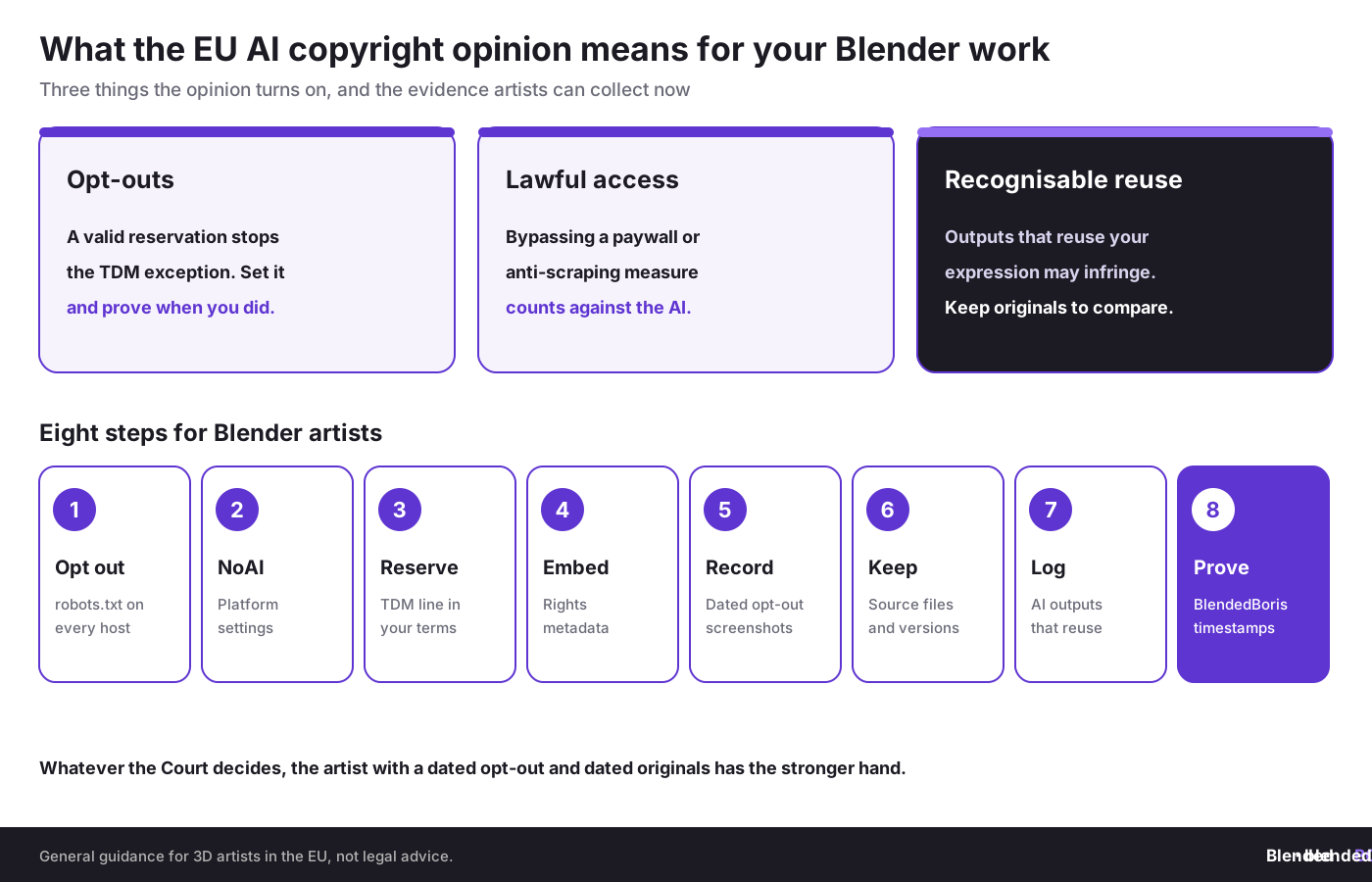
- Set opt-outs on every host you control. Add AI training rules to the robots.txt of your own site and any subdomain or CDN that serves your images. Our steps to opt out of AI training datasets walk through the options.
- Use platform NoAI settings. Turn on NoAI options on portfolio sites and marketplaces where they exist, and read what each one actually promises. See what the Roblox NoAI tag ruling said.
- Add a rights reservation in plain words. Put a short text and data mining reservation in your site terms and in your licence files. The opinion reportedly does not rule out that this counts.
- Embed rights metadata. Add creator and rights fields to exported images and texture files where your tools allow it, so the reservation travels with the file.
- Record your opt-outs with dates. Take dated screenshots of robots.txt, settings and terms. A reservation you cannot prove you made is hard to rely on.
- Keep your source files. Save .blend files, sculpts, texture projects and early versions. They show what your original expression looked like.
- Record AI outputs that reuse your work. Save the prompt, the answer, the date and the tool whenever an AI tool reproduces your characters, models or renders in a recognisable way.
- Keep proof in one place. Store files, timestamps, screenshots and records together so you can use them in a takedown, a complaint to the provider or a licensing talk.
The sister blog explains how AI art laws differ between countries, which AI dataset opt-out strategies work and what rights artists have over AI training. For a wider view of how other countries are handling opt-outs, see our report on Australia's AI training opt-out debate, and for the limits of embedded provenance data, our article on the Content Credentials timestamp flaw.
Where does this fit in the bigger picture?
AI tools are reaching further into other people's data, and the rules are being written as they go. This week our sister sites covered the same shift from the engineering and security side:
- Spying on network gear. Cisco Talos reported on 28 October that a group it tracks as UAT-11473 planted malware on Cisco SD-WAN controllers to steal encryption key material: what the KeyDrift SD-WAN espionage campaign means for design data on cadchain.com.
- Fake job offers. ESET's latest APT activity report describes North Korea-aligned groups using fake job offers and fake interviews against drone makers, their suppliers and developers: what the fake job offer malware campaigns mean for SOLIDWORKS teams on solidboris.com.
- AI agents inside CAD. Inventor 2027.2 adds a local MCP server that lets outside AI agents inspect and change an open model: what the Inventor MCP server means for your design data on borisinventor.com.
The common thread is control over your own work. Whether the question is who may train on a render, who may read a design file or which AI agent may edit a model, the person with clear rules and dated records is in the strongest position. Our list of the most common copyright problems for 3D artists covers what usually goes wrong when that control is missing.
Conclusion
Advocate General Szpunar's opinion in Like Company v Google is not a judgment and it is about news articles, not Blender art. But it sets out a clear EU framework that artists can use now. Training on protected work is, in his view, generally lawful under the text and data mining exception, but only with lawful access and no valid opt-out. AI answers that get around technical barriers or reuse someone's expression so closely that the original is no longer needed may infringe, and the provider may be liable. The Court will rule later. Until then, the practical answer for Blender artists is to make opt-outs clear and dated, keep originals and record what AI tools do with your work.
Your renders, your date, your proof.
BlendedBoris adds a blockchain timestamp to your Blender work from inside Blender, giving you dated proof of authorship to stand next to your opt-outs, licences and copyright records.
👉 Get started with BlendedBoris
FAQ: the EU AI copyright opinion and Blender artists
What is the Like Company v Google case?
It is a reference from the Budapest Regional Court to the Court of Justice of the European Union, case C-250/25. A Hungarian news portal operator says Google used its articles to train Gemini and reproduced them in Gemini's answers between June 2023 and May 2024.
Did the EU court rule that AI training is legal?
No. Advocate General Szpunar gave a non-binding opinion on 3 November 2026. He said, as a side note, that training is as a rule allowed under the text and data mining exception. The Court has not ruled.
Can I still opt out of AI training in the EU?
Yes. The text and data mining exception does not apply where the rights holder has validly reserved its rights. Reports say the opinion accepts robots.txt, crawler controls and metadata as ways to do that.
When can an AI chatbot answer infringe?
According to the opinion, when the chatbot got access by getting around a paywall or anti-scraping measure, or when it reuses the original's form of expression so recognisably that users no longer need the original.
Does the opinion cover images and 3D models?
Not directly. It is about the press publishers' right over news articles. But it uses general EU copyright concepts, so it is likely to influence how courts look at AI use of artwork.
When will the Court of Justice decide?
No date has been set. The judges began deliberating after the opinion was delivered, and the judgment will be given later.
Is an opt-out enough to protect my work?
It is an important part of it in the EU, but you also need evidence: dated proof of the opt-out, your original files and records of any AI output that reuses your work.
How can BlendedBoris help?
BlendedBoris records a blockchain timestamp of your Blender work from inside Blender, giving you dated proof of when you made each version of a model or render.


