
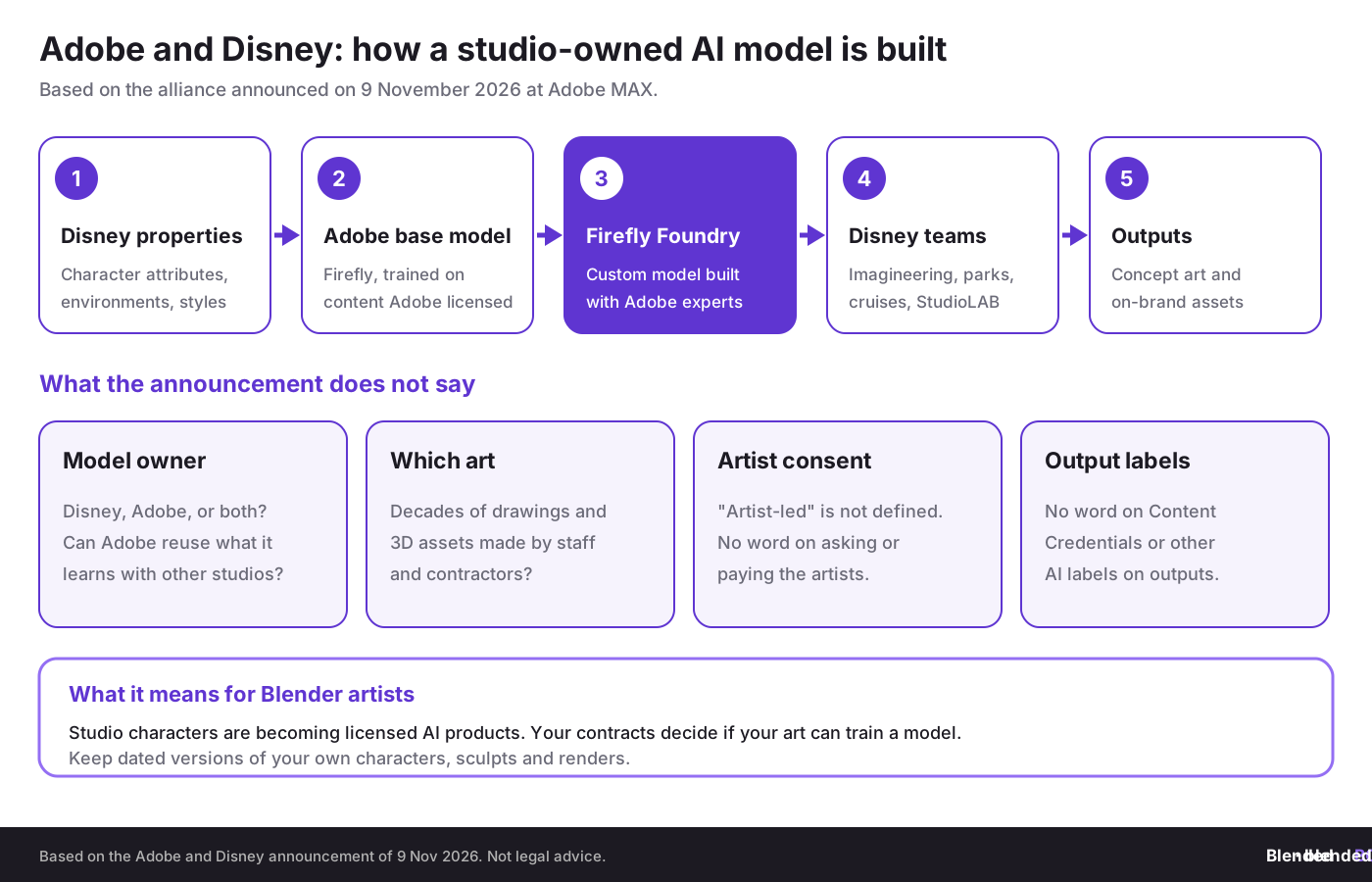
On 9 November 2026, at its MAX conference, Adobe announced a multi-year alliance with The Walt Disney Company. Adobe becomes Disney's "Official AI Innovation Partner", and the two companies will build custom generative AI models with Adobe Firefly Foundry that are trained on Disney's own characters, environments and visual styles.
Walt Disney Imagineering already uses two of these models in theme park development: one turns hand-drawn sketches into rendered 2D concept art, and another generates on-brand, franchise-accurate creative assets. The alliance also covers Disney's parks, Disney Cruise Line, the Walt Disney Studios innovation hub StudioLAB and ESPN Edge.
For Blender artists, this is more than a big-company partnership. It shows the model that large rights holders are choosing: train AI on art they own, call the result commercially safe, and keep going after AI companies that train on art they do not own. That changes what fan art, character work, studio contracts and client briefs look like. This article explains what was announced, what is still unknown, what else Adobe showed for 3D at MAX, and what to do now.
TL;DR: Adobe and Disney, November 2026
Adobe and Disney signed a multi-year AI alliance on 9 November 2026. Disney will get custom Firefly Foundry models trained on Disney properties, including character attributes, environments and visual styles, aimed at "commercially safe and production-ready outputs". The announcement does not say who owns the models, what exactly goes into training beyond Disney's own properties, or whether artists are paid or asked. For Blender artists: Disney characters are becoming licensed AI products, so unlicensed lookalikes carry more risk; studio and client contracts may let your work train a model; and dated records of your own work matter more than ever.
What did Adobe and Disney announce?
The joint announcement was released from Miami Beach and Burbank on 9 November, the day before Adobe MAX opened. It lists these parts of the deal:
- Official AI Innovation Partner. Adobe takes this title for a multi-year term. Disney gets early access to Firefly, Firefly Foundry, Premiere and Photoshop, plus dedicated Adobe engineering and research resources.
- Custom models. Disney will work directly with Adobe to build generative AI models tailored to Disney properties, which the companies describe as "human-centered and artist-led".
- Imagineering tools already in use. A sketch-to-image model that turns hand-drawn concepts into fully rendered 2D concept art, and a custom image model that generates on-brand, franchise-accurate assets.
- Parks, cruises, studios and sport. Concept exploration in Disney's innovation labs and in the development pipelines for Walt Disney World Resort, Disneyland Resort and Disney Cruise Line; Adobe joins StudioLAB as an innovation partner; and ESPN Edge will explore AI for fan engagement and its archive.
- Marketing. Joint activations, industry events and customer stories, with the work to be shown at future Adobe Summit and Adobe MAX events.
The announcement says the custom tools help Disney teams develop ideas faster "while protecting creators and their works". It does not explain how. No price or contract value was published.
What is Firefly Foundry, and what are the Disney models trained on?
Adobe launched Firefly Foundry at Adobe MAX in October 2025 as a service that builds custom generative models on a company's own intellectual property, with outputs that can include images, video, audio, vectors and 3D. Disney Imagineering was already named as an early tester then. At that launch, Adobe said client IP is kept separate and is not fed back into its base Firefly model.
The new announcement says Disney's models are customised on Disney properties and "trained on unique world knowledge (character attributes, environments, visual styles)". In plain terms, the models learn what Disney's characters look like, how its worlds are built and how its art styles work, from material Disney owns. The base Firefly model underneath is the one Adobe says it trained on content it has the rights to use, such as Adobe Stock and public domain material.
Who made that Disney material matters. Much of a studio's art library was drawn, painted, sculpted and modelled by employees and contractors. Under US law, work an employee creates as part of their job is a work made for hire, owned by the employer. For freelancers, it depends on the contract: many studio agreements assign all rights, which can include using the work to train a model. Our comparison of studio employment and freelancing explains how ownership differs between the two.
Why does this matter to Blender artists who never work for Disney?
Because it shows how the largest rights holders now treat their characters in the age of AI. Disney is building three routes at once:
- Its own models. The Adobe alliance trains custom models on Disney's own properties for its own teams.
- Licensing. In December 2025, Disney agreed to invest $1 billion in OpenAI and licensed more than 200 animated, masked and creature characters from Disney, Marvel, Pixar and Star Wars for Sora videos and ChatGPT Images, without talent likenesses or voices.
- Lawsuits. Disney and Universal sued Midjourney in June 2025, alleging the image generator copies their characters; Warner Bros. Discovery filed its own case that September. The case is still pending, with no trial date set. Our report on the AI character copies report covers what testers found.
Put together, Disney characters are becoming licensed AI products with a price and rules. That makes unlicensed lookalikes easier to spot and easier to challenge. If you sculpt, model or render a recognisable Disney character in Blender and sell it as a print, a 3D-printable file, a game asset or a commission, you are working with a protected character, and possibly a trademark. The fact that an AI service can generate the same character does not give you a licence. Our guides to copyright, trademark and patent for Blender artists and fair use for digital artists, and the sister blog's guide to fair use in digital art, explain where the lines are.
Style is different from characters. In most countries, copyright protects specific characters and works, not a general look. That is why the debate about AI copying an artist's "distinctive style" is now moving into new laws, such as the proposal we covered in Indonesia's AI copyright bill. A studio can protect a character it owns; an independent artist usually cannot stop someone imitating their style.
Keep a dated record of your own characters and styles.
If your original characters, sculpts and renders may one day be compared with AI output, you need proof of what you made first. BlendedBoris adds a blockchain timestamp to your Blender work from inside Blender, giving you dated proof of authorship.
👉 Protect your Blender work with BlendedBoris
What if you work for a studio, agency or client?
The Adobe and Disney deal makes one question urgent for every working 3D artist: can the art you deliver be used to train a model? Concept sketches, character turnarounds, environment models and look-development renders are exactly the kind of material that teaches a model "character attributes, environments and visual styles".
- Employees. In most cases the employer owns your work, and can use it for training unless your contract or a collective agreement says otherwise.
- Freelancers. Read the rights clause. "All rights in all media now known or later developed" will usually cover AI training. Some artists now negotiate a separate clause that excludes training, or a higher fee for it.
- Portfolio rights. Check whether you may still show the work. If a client's model can produce images in the style you built for them, your portfolio and dated records are how you show you created it.
- Briefs that include AI. If a client gives you AI-generated concepts to model from, ask who made them and with which tool, and keep that brief. Parts generated by AI may not be protected by copyright at all, as we explained in the Frankfurt 'it was AI' ruling.
The GDC State of the Game Industry survey found that 40% of developers now use generative AI at work, and co-development is common. Our guide to building a Blender freelance career covers contracts and pricing in more detail.
What else did Adobe show at MAX for 3D artists?
The Disney deal was one of many announcements at Adobe MAX, held in Miami Beach from 10 to 12 November. Several touch 3D work directly:
- Firefly Design (beta). One canvas for illustration, image editing, animation, 3D and print.
- Partner models in Firefly. Firefly offers models from Adobe, Topaz Labs and partners including ByteDance, Google, Kling, OpenAI and ElevenLabs. Adobe's terms generally exclude output from models it did not train from its Firefly IP indemnity, apart from limited extra cover for eligible enterprise customers, so "made in Firefly" does not always mean "commercially safe".
- Agents and MCP. Local MCP integrations (preview) let third-party AI agents edit native Photoshop, Illustrator, Premiere and After Effects files.
- Substance 3D Painter (beta) on Arm Windows PCs, and Firefly 3D Digital Twin, which makes 3D replicas of products for marketing images.
- Sneaks. Experimental demos with no release commitment. Cool Hunting reported that Project Sight Span turns a single photo, painting or illustration into a navigable 3D scene, including a demo stepping into Vermeer's The Milkmaid, and Project Hands On lets you pose objects by dragging points, shown on a quick 3D mesh.
Sight Span is the same idea as World Labs Atlas, which opened to everyone last week: one picture in, a 3D world out. If it ships, the same questions apply. Who owns the parts the model invents, and what happens to the paintings and photos people upload?
How do Disney's AI routes compare?
Here is what each route means for an independent Blender artist, based on what has been published:
What is still unknown?
- Who owns the models. The announcement does not say whether Disney or Adobe owns the custom models, or whether Adobe can reuse what it learns with other studios.
- What exactly goes into training. "Disney properties" could include decades of concept art, animation drawings and 3D assets made by artists who never imagined AI training.
- Artist consent and pay. "Artist-led" and "protecting creators" are not defined. Nothing was said about paying or asking the artists whose work is used.
- How outputs are labelled. The announcement does not say whether outputs carry Content Credentials. Our report on the C2PA timestamp flaw shows why such labels are only part of the answer.
- Whether the Sneaks ship. Adobe makes no commitment to release Sight Span or Hands On.
What should Blender artists do now?
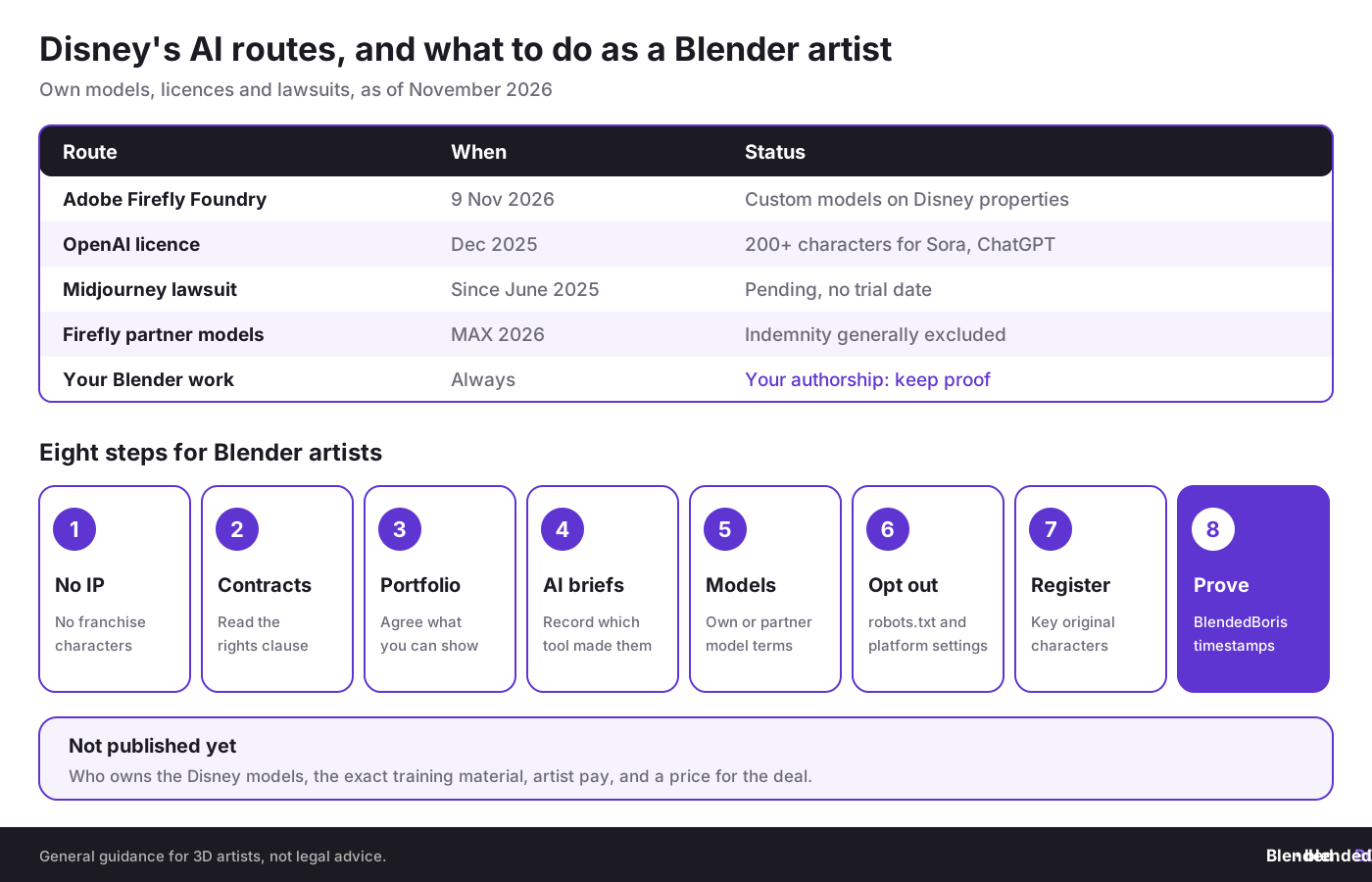
- Keep studio characters out of your store. Do not sell models, prints or files of Disney or other franchise characters without a licence, even if an AI tool made the starting image.
- Read the rights clause in every contract. Look for wording that covers "all media", "machine learning" or "training", and ask for a no-training clause or a separate fee if you want one.
- Keep your portfolio rights. Agree in writing which work you may show, and when.
- Record where AI briefs come from. If a client hands you AI-generated concepts, keep the brief and ask which tool made them.
- Check which model you use. In Firefly, Adobe's own models and partner models come with different terms and different indemnity cover.
- Set your opt-outs. Our guide on opting out of AI training datasets covers robots.txt rules and platform settings.
- Register what matters. For key original characters, registration gives you stronger remedies. See how to register copyright and our copyright basics for 3D artists.
- Timestamp your work. Keep dated versions of sketches, sculpts and renders. The sister blog explains immutable proof of art creation.
Where does this fit in the bigger picture?
Our sister sites covered stories this week about who controls valuable files and know-how:
- Know-how hidden in equipment. Prosecutors say a supplier tried to take LCD process data from equipment control PCs being sold off: what the Samsung Display technology leak case shows about data leaving with equipment on cadchain.com.
- When systems stop. A cyberattack halted three furniture factories for days: what the Kinnarps cyberattack means for SOLIDWORKS teams on solidboris.com.
- AI inside design tools. Anthropic launched a manufacturing plugin with a Fusion connector: what Claude for Manufacturing means for Inventor users on borisinventor.com.
Closer to home, our reports on the OpenAI copyright case, the Getty v Stability AI appeal, the Gruffalo AI copies and ArtStation's AI filters show the same split: rights holders license or sue, and independent artists need their own proof. The sister blog's round-up of court decisions for artists gives more background.
Conclusion
The Adobe and Disney alliance turns Disney's characters, worlds and styles into custom AI models for its own teams, built on Firefly Foundry and described as commercially safe. It sits alongside Disney's character licence with OpenAI and its lawsuit against Midjourney. For Blender artists, the message is clear: studio characters are licensed products, not free reference; contracts decide whether your work can train a model; and the tools on show at Adobe MAX, from partner models to photo-to-3D experiments, come with their own terms. Keep franchise characters out of your shop, read your rights clauses, and keep dated proof of everything you create yourself.
Prove what you made, and when.
BlendedBoris records a blockchain timestamp of your Blender work from inside Blender, giving you dated proof of authorship for your characters, models, scenes and renders.
👉 Get started with BlendedBoris
FAQ: the Adobe and Disney AI alliance
What did Adobe and Disney announce?
On 9 November 2026, Adobe and The Walt Disney Company announced a multi-year alliance. Adobe becomes Disney's Official AI Innovation Partner, and they will build custom Firefly Foundry models trained on Disney properties.
What is Adobe Firefly Foundry?
Firefly Foundry is an Adobe service, launched in October 2025, that builds custom generative AI models on a company's own intellectual property, for outputs such as images, video, audio, vectors and 3D.
What are the Disney models trained on?
According to the announcement, on Disney properties: character attributes, environments and visual styles. The announcement does not list the exact material or say who owns the models.
Does this mean I can use Disney characters with AI?
No. The custom models are for Disney's own teams. Disney's separate licence with OpenAI covers fan videos and images in Sora and ChatGPT, not your own models, prints or files.
Can my client use my art to train AI?
It depends on your contract. If you assigned all rights, training may be covered. Read the rights clause and ask for a no-training clause or separate fee if that matters to you.
Are Firefly partner models commercially safe?
Adobe's own Firefly models come with an IP indemnity for many users, but Adobe's terms generally exclude partner models from it. Read each model's terms before using output commercially.
Can Adobe turn a photo into a 3D scene?
Adobe showed Project Sight Span at MAX 2026, which turns one photo, painting or illustration into a navigable 3D scene. It is an experiment with no release commitment.
How can BlendedBoris help?
BlendedBoris adds a blockchain timestamp to your Blender work from inside Blender, giving you dated proof of what you made and when, which helps when your work is compared with AI output.


