
On 11 November 2026, Google, Meta and TikTok told Indonesian lawmakers at a public hearing that they oppose parts of a planned rewrite of Indonesia's copyright law. According to a draft reviewed by Reuters in July, the bill would ban using AI to imitate a creator's "distinctive style", require people to disclose AI use in content, deny copyright to fully AI-generated works and make AI training on copyrighted works subject to fair-use rules or licences.
The hearing was held by the Legislation Body (Baleg) of Indonesia's House of Representatives, the DPR. Much of the debate was about news: the draft would make digital platforms pay publishers for showing, previewing or summarising news, and for using news to train AI. But the AI rules are the part that reaches far beyond journalism. If the bill passes, Reuters reported, Indonesia would be the first country in Southeast Asia to write AI into its copyright law.
For Blender artists, one provision stands out. Most copyright systems, including those of the US and the EU, protect specific works, not an artist's style. A rule against AI imitation of a creator's distinctive style would be unusual, and it is exactly the kind of protection many illustrators and 3D artists have asked for since image generators arrived. This article explains what the draft says, what the companies objected to, what is still unknown and what you can do now, wherever you live.
TL;DR: Indonesia's AI copyright bill, November 2026
The draft bans AI imitation of a creator's "distinctive style", requires disclosure of AI use, protects AI-assisted works only with enough human involvement and puts AI training under fair-use rules or licences. Platforms that do not comply could lose local business permits. At the 11 November hearing, Google asked for a text and data mining exception with a robots.txt-style opt-out, and TikTok asked that disclosure not apply when AI only assists. The bill is not final, and no date for a vote has been announced. For Blender artists: the style question is now on a legislature's table, and dated records of your own style matter more.
What does Indonesia's draft copyright bill say about AI?
Reuters first reported the draft on 17 July 2026. It would replace Indonesia's current copyright law, Law No. 28 of 2014, and Reuters described it as an initiative of parliament that the government had received for input. A law ministry official overseeing intellectual property, Hermansyah Siregar, confirmed the draft was authentic and said it would be the first explicit recognition of AI in Indonesian copyright law. "If unregulated, it could kill human creation," he told Reuters.
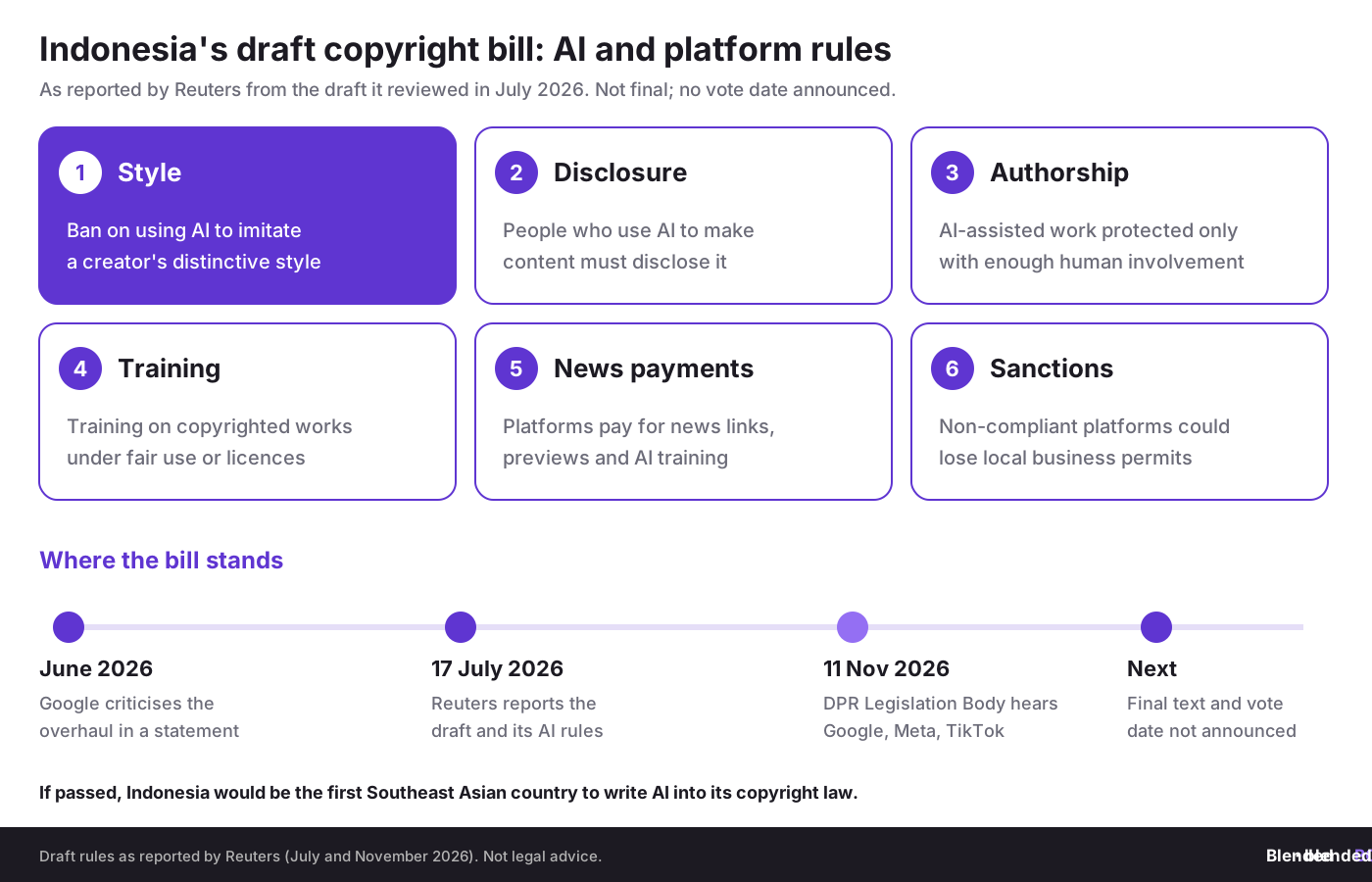
The AI and platform rules in the draft, as reported by Reuters, are:
- Style imitation. Using AI to imitate a creator's "distinctive style" would be banned. The reports do not say how a distinctive style would be defined or proven.
- Disclosure. People who use AI to make content would have to disclose it.
- Authorship. AI-assisted works would get copyright only if they meet human-involvement criteria. Fully AI-generated works would be excluded. The draft does not say how much human input is enough.
- Training. Using copyrighted works to train AI models would be subject to fair-use provisions or licensing agreements.
- News payments. Platforms would compensate publishers for aggregating, republishing or link-previewing news and for training AI on news, paid through state-supervised collective management organisations.
- Sanctions. Platforms that do not comply could lose their local business permits.
The rules would cover video games, photography, computer programs, journalism and film, among other works. Reuters reported that the draft is not final and that it was not clear when it would pass. That was still true after the November hearing: no vote date has been announced.
What did Google, Meta and TikTok tell lawmakers?
Three companies spoke at the hearing on Wednesday 11 November, as Reuters reported via The Star. Their objections show which parts of the bill the platforms see as the biggest risk:
- Google. Agung Pamungkas, Google's government affairs and public policy manager in Indonesia, said paying for links to news would limit Indonesians' access to news. According to Suara's report from the hearing, he named four areas for more discussion: links and snippets, voluntary deals instead of a blanket licence run by one collective body, safe-harbour protection for platforms, and AI. On AI, he argued that a mandatory licence for training data cannot work at the scale of the web and proposed a text and data mining exception with a standard opt-out such as robots.txt.
- Meta. Berni Moestafa, Meta's head of public policy in Indonesia, said publishers "could lose readership traffic as well as potential advertising and subscription revenue" and argued that sending readers to an article is different from republishing it.
- TikTok. Noudhy Valdryno, TikTok's head of public policy in Indonesia, said disclosure rules should not apply where AI only assists a person rather than fully creating the content. He asked lawmakers to keep safe-harbour protection, arguing that platforms cannot reliably tell who owns a copyright or holds a licence.
Google had already criticised the overhaul in June, warning that rigid, overbroad mandates would harm local creators and slow innovation. Meta and TikTok joined that position at the hearing. Notably, none of the reports quote the companies arguing against the style-imitation rule directly. Their AI objections focused on training licences, disclosure and platform liability.
Can a law protect an artist's style?
This is the question that matters most for artists, and the honest answer is that nobody knows yet how Indonesia's rule would work. Copyright traditionally protects expression, such as a specific model, texture or render, not a way of working. Two artists can both make low-poly, hand-painted fantasy props without infringing each other. Our guide to copyright basics for 3D artists explains where that line usually sits.
AI image and 3D generators blurred that line. A user can type an artist's name into a prompt and get new work that looks like theirs without copying any single piece. Artists have fought this in court and in public, as our reports on the Gruffalo illustrator's fight over ChatGPT copies, AI character copies in Midjourney and the Suno lawsuits over names and styles used as prompts show. Most of those cases still rely on copies of specific works, trademarks or personality rights, because style alone is hard to claim.
A statutory ban on AI imitation of a distinctive style would change that, at least in Indonesia. But it raises hard questions the reports do not answer: who decides that a style is distinctive, whether the ban targets the AI provider, the user or both, and how an artist would prove that a generator imitated them. Denmark has taken a related but narrower route, protecting people's faces, voices and bodies from realistic digital imitation, as our article on Denmark's deepfake bill explains. The sister blog's overview of international AI art laws shows how different countries handle AI and art.
Make your style provable.
Any rule that protects a distinctive style will need evidence of who developed it first. BlendedBoris adds a blockchain timestamp to your Blender work from inside Blender, building a dated record of your models, scenes and renders over time.
👉 Protect your Blender work with BlendedBoris
How do the draft's AI rules compare with what platforms want?
Here is each AI rule next to the industry position reported from the hearing and what it would mean for 3D artists:
The opt-out debate will sound familiar. Google's proposal at the hearing resembles the shared robots.txt signal covered in our report on the AI training opt-out signal, and the EU's opt-out model discussed in our article on the Advocate General's Google Gemini opinion. Australia faced a similar choice, as our report on Australia's AI training opt-out fight explains.
Who owns AI-assisted work under the draft?
The draft follows a growing international pattern. AI-assisted works would be protected only if a human was involved enough, and fully AI-generated works would get no copyright. The US Copyright Office takes a similar view, and in March 2026 the US Supreme Court declined to hear Stephen Thaler's challenge to the human-authorship rule. In Germany, the Frankfurt appeal court recently rejected an attempt to strip copyright from lyrics by claiming they were AI-made, as our report on the Frankfurt 'it was AI' ruling explains.
The open question everywhere is how much human input is enough. Indonesia's draft does not say. For Blender artists, the practical answer is the same in every country: the more you can show your own modelling, sculpting, texturing, lighting and composition, step by step and with dates, the stronger your claim. The sister blog explains how copyright applies to AI-generated art.
Disclosure rules point the same way. Platforms already ask for AI declarations, as our reports on Steam's AI labels and itch.io's new disclosure filters show. TikTok's request at the hearing, that AI used only as an assistant should not need disclosure, is the same line many stores are trying to draw.
What should Blender artists do now?
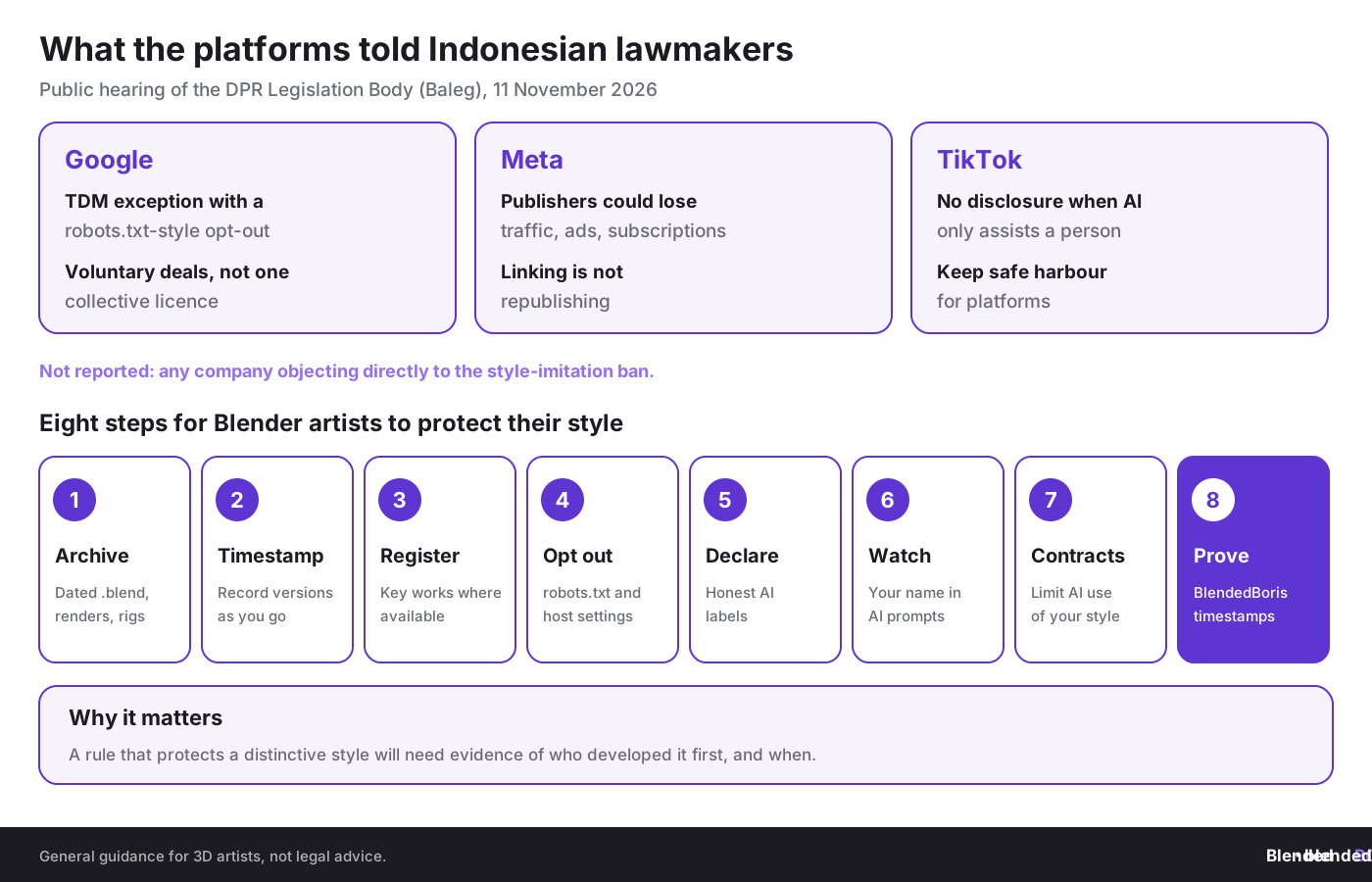
- Document your style. Keep a dated archive of the works that define your look: .blend files, material setups, sculpt brushes, lighting rigs and final renders.
- Timestamp as you go. Record versions of key pieces when you make them, not when a dispute starts. Our guide to art registration and provenance explains the options.
- Register important work. Where registration is available, such as in the US, register the pieces that matter most. Our guide to registering copyright covers fees and timing.
- Set your opt-outs. Add AI training opt-outs to your own site and use the settings on portfolio hosts. Our guide to opting out of AI training datasets has the robots.txt rules.
- Declare honestly. When you post or sell work, use each platform's AI categories and keep notes on where AI helped and where it did not.
- Watch for your name in prompts. Search AI galleries and marketplaces for your name and signature looks, and save dated screenshots of anything that imitates you.
- Check contracts for AI clauses. Clients may ask to train on or generate from your work. Agree in writing what is allowed, and limit use of your style as well as your files.
- Follow the bill. If you sell to Indonesian buyers or work with Indonesian studios, watch for the final text, because definitions will decide whether the style rule helps you.
For more on building a record that holds up, the sister blog's piece on where AI art legislation is heading and our guide to international AI art copyright laws are useful next reads.
Where does this fit in the bigger picture?
Our sister sites covered stories this week about how software, data and accounts reach the wrong hands:
- A poisoned update. Drone maker Quantum Systems said it had contained a cyberattack, and reports say a malicious file disguised as a software update reached customer servers: what the Quantum Systems cyberattack means for software update chains on cadchain.com.
- AI chats exposed. A breach at the AI provider Fireworks AI exposed some Notion AI chat transcripts: what the Notion AI breach means for what engineers type into AI tools on solidboris.com.
- Stolen logins. Police in nine countries took down servers behind the Gootloader, CastleRAT and StealC malware: what Operation Endgame means for logins on CAD workstations on borisinventor.com.
Closer to home, our reports on the GDC survey on generative AI use in game studios and ArtStation's AI filter show the same pressure from the industry and platform side.
Conclusion
Indonesia's draft copyright bill is one of the most artist-friendly AI proposals any legislature has put on the table: a ban on AI imitation of a creator's distinctive style, mandatory disclosure, a human-involvement test for copyright and training only under fair-use rules or licences. Google, Meta and TikTok pushed back at the 11 November hearing, mostly on news payments, training licences, disclosure and platform liability. The bill is not final, and nobody yet knows how a distinctive style would be defined or proven. Whatever happens in Jakarta, the lesson for Blender artists is the same: a style is easier to protect when you can show, with dates, that it is yours.
Build a dated record of your work.
BlendedBoris records a blockchain timestamp of your Blender work from inside Blender, giving you dated proof of authorship for your models, scenes and renders, so you can show what you made, and when.
👉 Get started with BlendedBoris
FAQ: Indonesia's AI copyright bill
What happened at the Indonesian parliament on 11 November 2026?
Google, Meta and TikTok spoke at a public hearing of the DPR's Legislation Body on planned revisions to Indonesia's copyright law. They objected to paying publishers for news links and to parts of the AI rules.
Does the bill ban AI from copying an artist's style?
According to the draft reviewed by Reuters in July 2026, it would ban using AI to imitate a creator's "distinctive style". The reports do not say how a distinctive style would be defined or proven.
Would AI-generated art get copyright in Indonesia?
Not if it is fully AI-generated. AI-assisted works would be protected only if they meet human-involvement criteria, and the draft does not say how much human input is enough.
Would people have to disclose AI use?
The draft requires disclosure of AI use in content. TikTok asked lawmakers not to apply this when AI only assists a person rather than fully creating the content.
What did Google propose for AI training?
Google argued that a mandatory licence for training data cannot work at web scale and proposed a text and data mining exception with a standard opt-out such as robots.txt.
Has the bill been passed?
No. Reuters reported that the draft is not final, and no date for a vote has been announced.
Does this affect Blender artists outside Indonesia?
Not directly. But it is one of the first attempts to protect style in law, and it may influence other countries in the region. Platforms that operate in Indonesia would have to comply.
How can BlendedBoris help?
BlendedBoris adds a blockchain timestamp to your Blender work from inside Blender, giving you dated proof of what you made and when, which supports claims about your work and style.


