
On 12 November 2026, World Labs opened Atlas, its world model that turns photos, images and simple block-outs into explorable 3D scenes, to everyone. Until then, making your own worlds needed test access. Atlas exports 3D Gaussian splats and can convert them into meshes, and World Labs names Blender as one of the tools its developer API connects to.
For Blender artists this is a real shortcut. A few location photos, or a single concept image, can become a navigable set you can render, relight and bring into your own scenes. Blender 5.3 already imports splats natively, so the path from a phone camera to a Blender scene just got much shorter.
But the tool comes with terms that every artist should read before uploading anything. Under World Labs' Terms of Service, the company keeps all rights in what free accounts generate, free users may use those results only for personal, non-commercial purposes, and World Labs takes a licence to use everything you upload and generate to train its AI models. This article explains what Atlas does, what the terms say, what is still unknown and what to do before you feed it your work.
TL;DR: World Labs Atlas, November 2026
Atlas is now open to everyone, with the Viewfinder and Chisel web apps, a Splats to Mesh converter, a Relight tool and a developer API. It outputs video, 3D Gaussian splats and meshes. Under World Labs' terms (last updated 21 January 2026): free accounts do not own their outputs and may not use them commercially; paid and API accounts own their outputs; and World Labs gets a licence to train on your inputs and outputs, irrevocable for free users and revocable only going forward for paid users. For Blender artists: only upload photos and images you have the rights to, use a paid account for anything you want to sell, and keep dated records of the work you add on top.
What is World Labs Atlas, and what changed on 12 November?
World Labs announced Atlas on 1 September 2026 as a new world model for what it calls spatial intelligence. The company said it pretrained Atlas from scratch on a large and diverse body of multimodal data, without naming the sources. Atlas takes text, images, camera positions and depth maps as input, and produces images, video of up to one minute at 1440p, panoramas, depth maps, point clouds and 3D Gaussian splats.
At first only selected partners could build with it. On 12 November, World Labs opened Atlas to everyone with a set of web apps and API endpoints. The tools listed on the Atlas launch page are:
- Viewfinder. Reconstructs a scene from photos or generated images, lets you explore new viewpoints and renders camera paths to video. VP Land reported that it works from a single image or from up to 64 overlapping photos of a real place.
- Chisel. Lets you block out a scene with simple shapes, a graybox, and then generate a styled world that follows that structure.
- Splats to Mesh. Converts splats into meshes with real geometry for games and interactive scenes.
- Relight. Lets you change the lighting of a splat scene.
- Developer API and integrations. Brings Atlas into other apps and existing tools, including Blender, according to the launch page. The API documentation still carries beta labels.
World Labs has not published prices for Atlas, a technical paper or a model card. If you have followed our coverage of the open-source Hi3D image-to-3D model and Meshy's AI part-editing, Atlas is the next step: not a single object from a prompt, but a whole place from a few pictures.
Who owns what you make with Atlas?
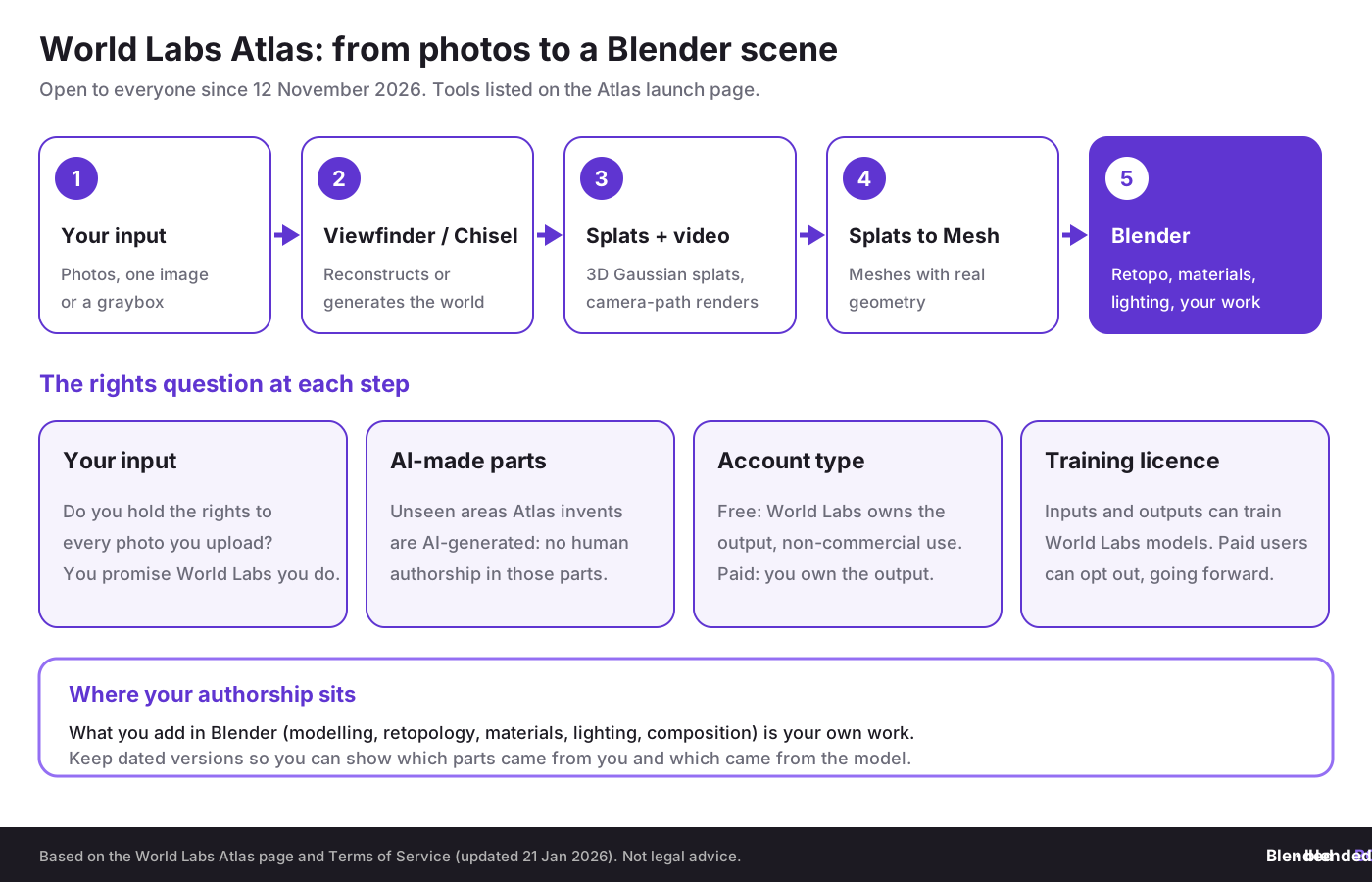
The answer depends on your account type at the moment you generate. The World Labs Terms of Service, last updated on 21 January 2026, split users into free accounts and paid or API accounts:
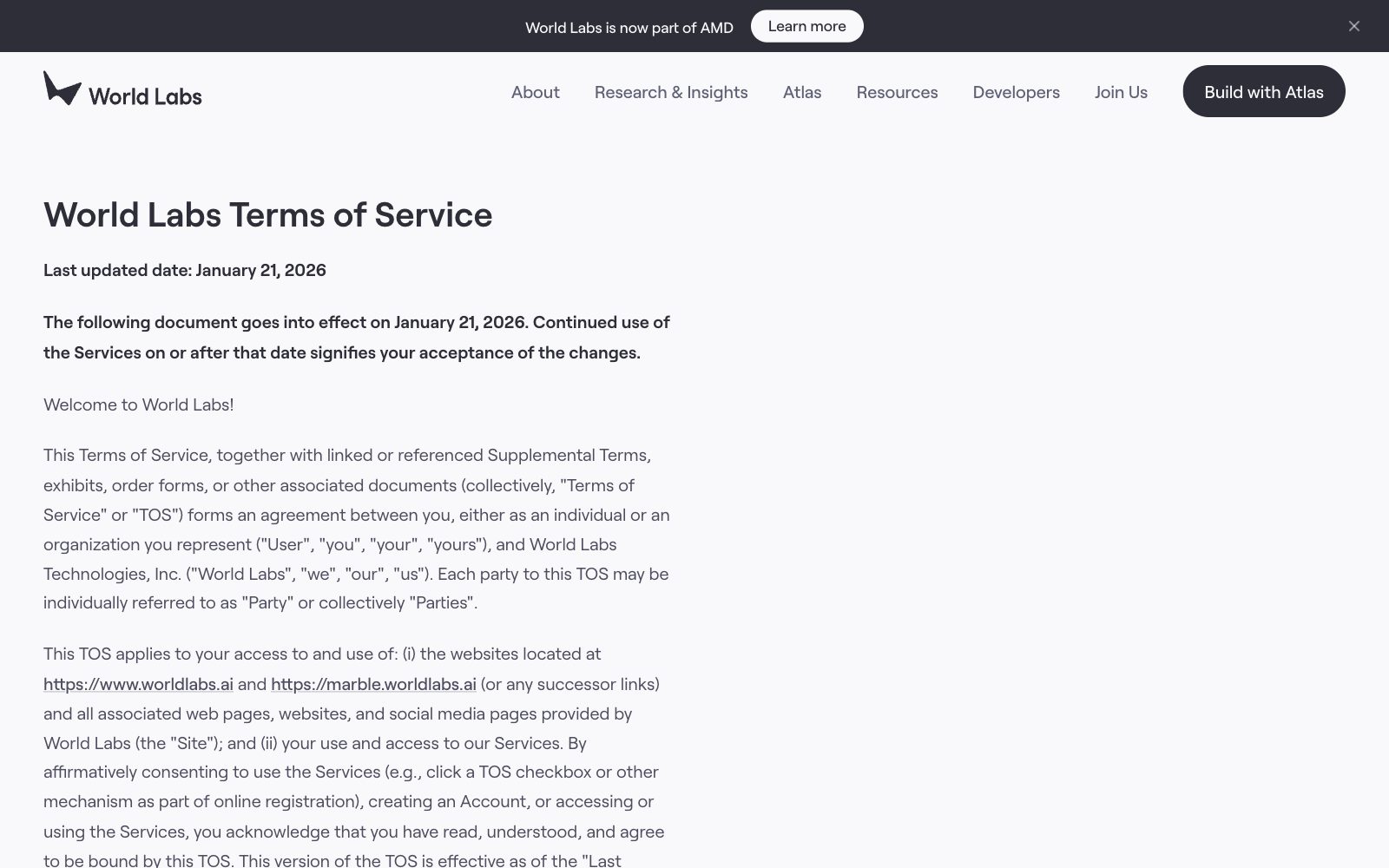
- Free accounts. The terms say "World Labs retains all rights in and to any Output generated by Free Account Users, excluding any portion of User Inputs incorporated into the Output." Free users get a revocable licence to use the output for personal, non-commercial purposes only. The terms define non-commercial broadly: no payment, no business use, no selling, licensing or distribution, no marketing and no use in products for sale.
- Paid and API accounts. Paid users own all rights in their outputs, apart from World Labs' own technology, and may use them for any purpose, including commercial use.
- Upgrading later does not help. Output made while an account had free status stays under the free-account rules, even after you start paying.
For an artist, this is the key point. If you build a set in Atlas on a free account and then use it in a client render, a game asset pack or a print you sell, you are using something World Labs owns outside the licence it gave you. The terms also let World Labs charge others for access to outputs that are displayed publicly on its site.
There is a second layer. Even on a paid account, owning the output under a contract is not the same as having copyright in it. The US Copyright Office does not protect material generated by AI without enough human authorship, and parts of a scene that Atlas invents, such as the unseen back of a building rebuilt from one photo, are AI-generated. What you add in Blender, your modelling, retopology, materials, lighting and composition, is where your own authorship sits. Our guide to copyright basics for 3D artists and the sister blog's explainer on copyrighting AI-generated art cover where that line falls.
What can World Labs do with your photos and scans?
Section 3.6 of the terms gives World Labs a worldwide, sublicensable licence to use "User Content", which the terms define as both inputs and outputs, for business purposes, including product development, marketing and promotion, benchmarking and training its AI models.
- Free users grant this licence irrevocably, subject to applicable law.
- Paid users can opt out, including from their account page. But the terms say revocation "does not require removal of User Content from AI Models already trained prior to revocation." Anything uploaded before you opt out may already be inside a model.
- Moral rights. All users waive moral rights in their inputs to the extent World Labs needs for that licence. Free users also waive moral rights, such as the right to be named, in their outputs. Paid users keep moral rights in their outputs but must not misrepresent how they were made, and must add a credit such as "Generated using World Labs" if the company reasonably asks.
- Visibility. The terms warn that your inputs and your username or profile photo may be visible to others.
This matters most for artists who would upload their own finished work: renders, concept paintings, matte paintings or photos of their sculptures. Once those images are inputs, they fall under the training licence. If you have spent time setting AI training opt-outs on your portfolio and site, uploading the same images to a generator undoes that for this company. Our report on the shared AI training opt-out signal explains why opt-outs only cover what crawlers collect, not what you hand over yourself. The sister blog's piece on artists' rights and AI training gives the wider background.
Keep a dated record of your own work.
Before your renders, scans or concept art go into any AI tool, make sure you can prove they were yours first. BlendedBoris adds a blockchain timestamp to your Blender work from inside Blender, giving you dated proof of authorship.
👉 Protect your Blender work with BlendedBoris
How do free and paid Atlas accounts compare?
Here is what the World Labs terms say for each account type, and what it means in a Blender workflow:
The last row is easy to miss. You promise World Labs that you have all the rights and consents needed for what you upload, you agree to indemnify the company against claims linked to your use, and the terms state that World Labs has no responsibility for third-party intellectual property claims related to AI-generated outputs. Disputes go to binding individual arbitration under California law, unless you opt out by email within 30 days of accepting the terms.
Can you upload any photo of a place or object?
Not safely. Atlas makes it easy to rebuild a real place from photos, but the photos and what they show can belong to other people. The rights questions are the same ones we covered when Blender added native Gaussian splats:
- Other people's photos. A photo from a stock site, a search engine or a social feed is protected by the photographer's copyright. Stock licences often forbid AI uses, and the World Labs terms make you responsible.
- Artworks and designs in the frame. Sculptures, murals, product designs and some buildings can be protected works. Freedom of panorama rules differ by country, and a 3D reconstruction is a stronger reproduction than a photo.
- People. A world rebuilt from street photos can contain recognisable faces. Data protection rules, and new likeness laws such as Denmark's deepfake bill, can apply.
- Client and NDA material. Reference photos from a client job or an unreleased product should never go into a public AI service without written permission.
Your own photos of your own work and of public places are the safest inputs. Our guide to photogrammetry cleanup and integration in Blender shows the manual route, which keeps you in control of every file.
What should Blender artists do before using Atlas?
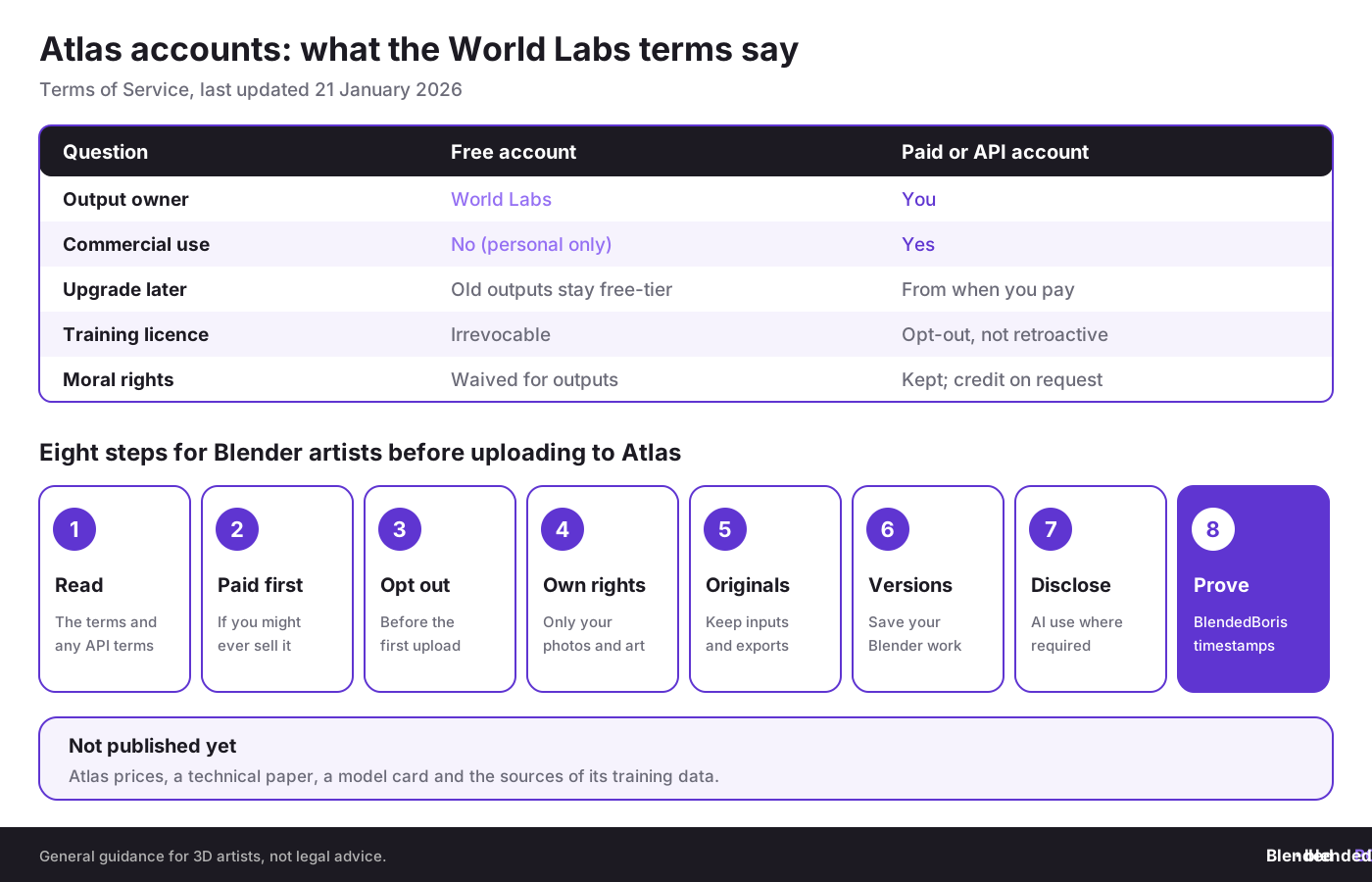
- Read the terms first. The World Labs Terms of Service apply to the whole service. Check whether any extra Atlas or API terms apply to your account.
- Decide free or paid before you start. If the result might ever be sold, licensed or used for a client, generate it on a paid account. Outputs made on a free account cannot be upgraded later.
- Opt out of training before the first upload. On a paid account, use the opt-out on your account page. It does not remove anything already used.
- Upload only what you have the rights to. Use your own photos and your own concept art. Avoid stock images, client references, other artists' work and photos with recognisable people.
- Keep your originals. Store the source photos, block-outs and every exported splat or mesh with dates, so you can show what came from you and what came from the model.
- Record your own work in Blender. Save versions as you retopologise, texture, light and compose. That human work is what supports a copyright claim. Our guides to art registration and registering copyright explain the next step.
- Disclose AI use where it is required. Stores and portfolios ask about AI, as our reports on ArtStation's AI declarations and Steam's AI labels show. A rebuilt Atlas set counts as AI-generated content.
- Timestamp the result. Add a dated record of each finished scene. The sister blog's guide to Blender metadata and watermarking covers the basics.
If you plan to sell a converted mesh, our reports on Sketchfab's terms and Megascans' AI terms on Fab show how closely marketplaces now check where scanned and AI-made assets come from.
Where does this fit in the bigger picture?
Our sister sites covered stories this week about defaults and access that decide who gets your data:
- Public by default. Thousands of apps built with Grok Build opened without a sign-in: what the Grok Build data leak means for internal apps on cadchain.com.
- AI that points to pirated software. Gemini was tricked into naming a site for cracked SOLIDWORKS: why cracked SOLIDWORKS is a security and legal risk on solidboris.com.
- Remote access abused. Attackers used a remote support extension to reach managed computers: what the ScreenConnect attacks on MSPs mean for CAD workstations on borisinventor.com.
Closer to home, our reports on Blender 5.3, the C2PA timestamp flaw and the Frankfurt 'it was AI' ruling show why dated, verifiable records of your own work matter more as AI tools get better at rebuilding the world.
Conclusion
World Labs Atlas is now open to everyone, and it can turn a handful of photos or a rough block-out into a 3D world with splats and meshes you can take into Blender. That is useful for previs, set building and look development. But the terms decide what you can do with the results: free accounts do not own their outputs and cannot use them commercially, and every upload and output can be used to train World Labs' models, with only paid users able to opt out, and only going forward. Use your own photos, pick the right account before you generate, and keep dated proof of everything you add yourself.
Prove what you made, and when.
BlendedBoris records a blockchain timestamp of your Blender work from inside Blender, giving you dated proof of authorship for your models, scenes and renders, whatever tools you used along the way.
👉 Get started with BlendedBoris
FAQ: World Labs Atlas and your rights
What is World Labs Atlas?
Atlas is a world model from World Labs that reconstructs or generates 3D scenes from photos, images, text and simple block-outs. It outputs video, 3D Gaussian splats and, through a converter, meshes.
When did Atlas open to everyone?
World Labs opened Atlas to everyone on 12 November 2026, with the Viewfinder and Chisel apps and developer API endpoints. It was announced for selected partners on 1 September 2026.
Does Atlas work with Blender?
World Labs names Blender among the tools its developer API connects to. Atlas exports splats, and Blender 5.3 can import splats natively. Splats to Mesh turns splats into meshes.
Do I own what I make with a free Atlas account?
No. World Labs' terms say the company retains all rights in outputs generated by free accounts, apart from parts that come from your inputs. Free users may use outputs only for personal, non-commercial purposes.
Can I sell scenes made with Atlas?
Only outputs generated while you had a paid or API account, which you own under the terms. Outputs made on a free account stay under the non-commercial rules even after you upgrade.
Does World Labs train on my uploads?
The terms give World Labs a licence to use your inputs and outputs to train its AI models. It is irrevocable for free users. Paid users can opt out, but not for models already trained.
How much does Atlas cost?
World Labs had not published Atlas prices when this article was written. Check your account page before you generate anything you plan to use commercially.
How can BlendedBoris help?
BlendedBoris adds a blockchain timestamp to your Blender work from inside Blender, giving you dated proof of what you made and when, so you can show which parts of a scene are your own work.


