
On 11 November 2026, Getty Images asked the Court of Appeal in London to revive its copyright claim against Stability AI, the maker of the Stable Diffusion image generator. The appeal turns on one question that UK courts have never answered: can an AI model be an "infringing copy" of the images it was trained on, even if it does not store any of them? The hearing continued on 12 November, and no judgment has been given yet.
The case is the first big UK court fight over generative AI and copyright. In November 2025 the High Court ruled mostly for Stability AI: Getty lost its copyright claim and won only a narrow trade mark point about Getty watermarks appearing in images made by early versions of Stable Diffusion. Getty was given permission to appeal on the copyright question, which the trial judge called novel and important.
For Blender artists, this is not a distant fight between a stock photo agency and an AI company. Renders, turntables, textures and 3D models posted online are exactly the kind of material that image and 3D generators learn from, and most of that training happens outside the UK. The Court of Appeal's answer will shape whether UK copyright law can reach a model that was trained somewhere else on your work and then brought into the UK. This article explains what was decided, what is being argued now, and what you can do while the court decides.
TL;DR: Getty v Stability AI at the Court of Appeal
Getty's appeal against the November 2025 High Court ruling started on 11 November 2026. The High Court held that Stable Diffusion was not an "infringing copy" because the model weights never stored Getty's images. Getty says making a model includes training it on copied images, so a model trained abroad can still be an infringing copy when it is imported into the UK. Stability AI says a copy is judged by what it contains and that any change is for Parliament. The music industry body BPI is supporting Getty. No judgment yet. For Blender artists: training location and evidence decide these cases, watermarks and signatures can matter, and dated records of your work help whatever the court decides.
What happened at the Court of Appeal this week?
The appeal hearing opened on Wednesday 11 November 2026 and ran into a second day on 12 November, according to law firm Burges Salmon's report on the hearing. The reports we found do not name the judges or say when the court will rule. A written judgment usually follows weeks or months after a hearing of this kind.
Getty's argument, as reported by MLex and Burges Salmon, is that the High Court focused on the wrong thing. It looked at the finished model, which contains no copies of Getty's photographs, instead of at how the model was made, which involved copying large numbers of images during training. Getty says the law asks whether making the article in the UK would have infringed copyright, not whether the article itself contains copies.
Stability AI says the High Court was right. Whether something is a copy depends on what is actually produced, not on the process behind it. It also points to an odd result of Getty's reading: importing a model trained abroad would infringe, while copying that same model once it is already in the UK would not. In Burges Salmon's summary, Stability argues that extending the law to models trained overseas is "a matter for Parliament, not the courts." Stability is also asking the Court of Appeal to overturn two findings that went against it: that an intangible model can be an "article" at all, and that Stability itself imported or distributed the model in the UK.
The British Recorded Music Industry (BPI) has permission to intervene in support of Getty. Its concern is that the High Court's approach lets AI developers train models outside the UK and then import them freely. The BPI also told the court that the wider question of whether AI models contain copies of their training data is not part of this appeal, and pointed to two German cases in Munich where courts found that models had memorised copyrighted works. Our report on the Advocate General's opinion in the first EU generative AI case covers the European side of the same debate.
What did the High Court decide in 2025?
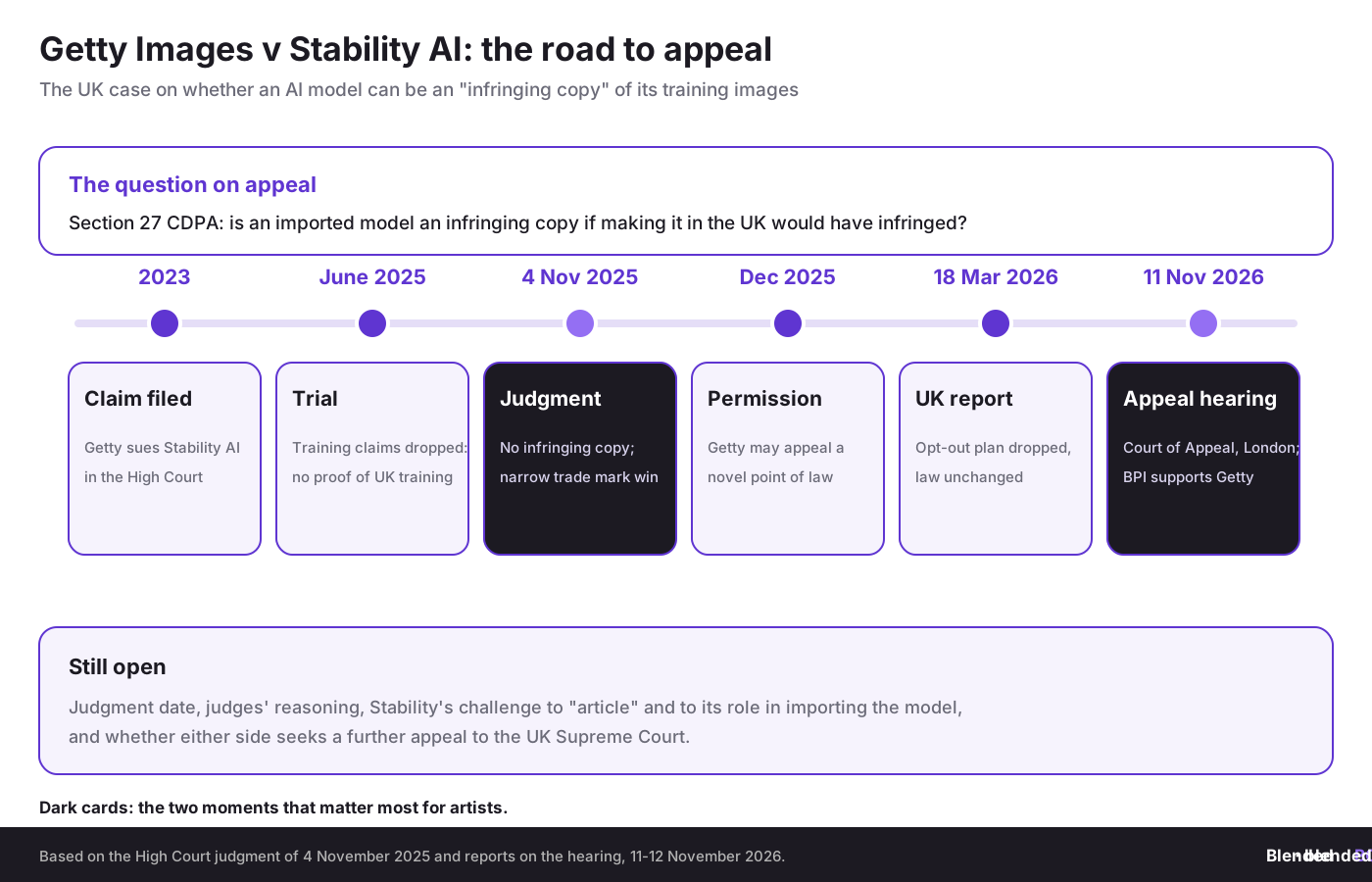
Mrs Justice Joanna Smith gave the High Court judgment in Getty Images v Stability AI on 4 November 2025. By then, the case had shrunk a lot. During the June 2025 trial, Getty dropped its main claims that training Stable Diffusion infringed its copyright and database rights. It conceded there was not enough evidence that the model had been trained or developed in the UK, and UK copyright law generally only covers acts done in the UK. A claim about infringing outputs also fell away after Stability blocked the prompts in question.
What was left, and how it ended:
At a hearing on 16 and 17 December 2025, the judge gave Getty permission to appeal on all its secondary infringement grounds. She described the point as a pure question of law that had never been considered by a court and that could have far-reaching effects for AI models and other intangible articles such as software. Our list of landmark copyright cases for 3D artists puts this case next to the older rulings it builds on.
What is an "infringing copy", and why does it matter for AI models?
UK copyright law has two kinds of infringement. Primary infringement is doing a restricted act yourself, such as copying a work. Secondary infringement is dealing in an infringing copy made by someone else, for example importing it into the UK or distributing it in the course of business, when you know or have reason to believe it is an infringing copy. Section 27 of the Copyright, Designs and Patents Act 1988 says an imported article is an infringing copy if making it in the UK would have infringed copyright.
That wording is the heart of the appeal. If a model was trained in the UK on copied images without permission, the training would infringe. Getty says it follows that a model trained the same way abroad is an infringing copy when it comes into the UK. The High Court said no: an infringing copy must still be a copy, and Stable Diffusion's weights contain learned patterns, not Getty's photographs.
Why this matters to you: almost no major image or 3D generator is trained in the UK. If the Court of Appeal sides with the High Court, a UK artist whose renders were used to train a model abroad has little to work with under UK copyright law unless the model can be shown to contain copies or produces copies of the work. If Getty wins, the import and distribution of such a model in the UK could itself be challenged. Either way, the result will be read closely in other countries. Our guide to international AI art laws on the sister blog compares how different systems approach training.
Proof that does not depend on the verdict.
Whatever the Court of Appeal decides, you will still need to show what you made and when. BlendedBoris adds a blockchain timestamp to your Blender work from inside Blender, giving you dated proof of authorship for every model, scene and render.
👉 Protect your Blender work with BlendedBoris
What could the Court of Appeal decide?
There are three broad outcomes, and none of them is certain:
- Appeal dismissed. The High Court ruling stands: a model that does not store the works is not an infringing copy. Claims against AI developers in the UK would still depend on proving training or copying in the UK, or on outputs that copy protected works.
- Appeal allowed. A model trained abroad on unlicensed works could be an infringing copy when imported. Developers who make models available in the UK would face a new kind of claim, and licensing training data would become more valuable.
- Stability's challenges succeed. If the court finds that an intangible model cannot be an "article", or that Stability did not import or distribute it, Getty's claim would fail on those grounds as well, whatever the meaning of "infringing copy".
A further appeal to the UK Supreme Court would need permission, so a Court of Appeal judgment may not be the last word. In the meantime, the UK Government published its report on copyright and AI on 18 March 2026, as required by the Data (Use and Access) Act 2025. According to law firm summaries, it dropped the earlier plan for a training exception with an opt-out, said more evidence was needed, and floated removing the special protection for computer-generated works without a human author. The law itself did not change. Our reports on the shared robots.txt AI training opt-out and Australia's opt-out debate show how other places are handling the same choice.
What does this case teach Blender artists right now?
Location and evidence decide AI cases. Getty, a company with large legal resources, dropped its training claims because it could not prove where training happened. Individual artists will rarely know more than Getty did. What you can control is evidence on your side: what you made, when you made it and where you published it. Our guide to registering artwork, 3D models and renders explains the options, and how to register copyright covers the US system, where registration matters for damages.
Marks in outputs can be a separate claim. Getty's only win so far came from its watermark showing up in generated images, which is a trade mark issue, not copyright. If your name, logo or signature appears in AI outputs, that can be a different route to a remedy. Our report on AI tools adding real artists' signatures looks at that problem.
US and EU cases move differently. In the US, the fight is about fair use, as in the Thomson Reuters v. ROSS appeal ruling and the OpenAI copyright litigation. In the EU, it is about the text and data mining exception and opt-outs. The UK case is about where the copying happened and what the model is. Your work can be affected by all three at once.
Licences are where control starts. Platform terms and asset licences decide whether your uploads can be used for training. Our reports on Megascans' new AI training terms and the Roblox NoAI tag ruling show how much depends on the words in those licences.
What should Blender artists do now?
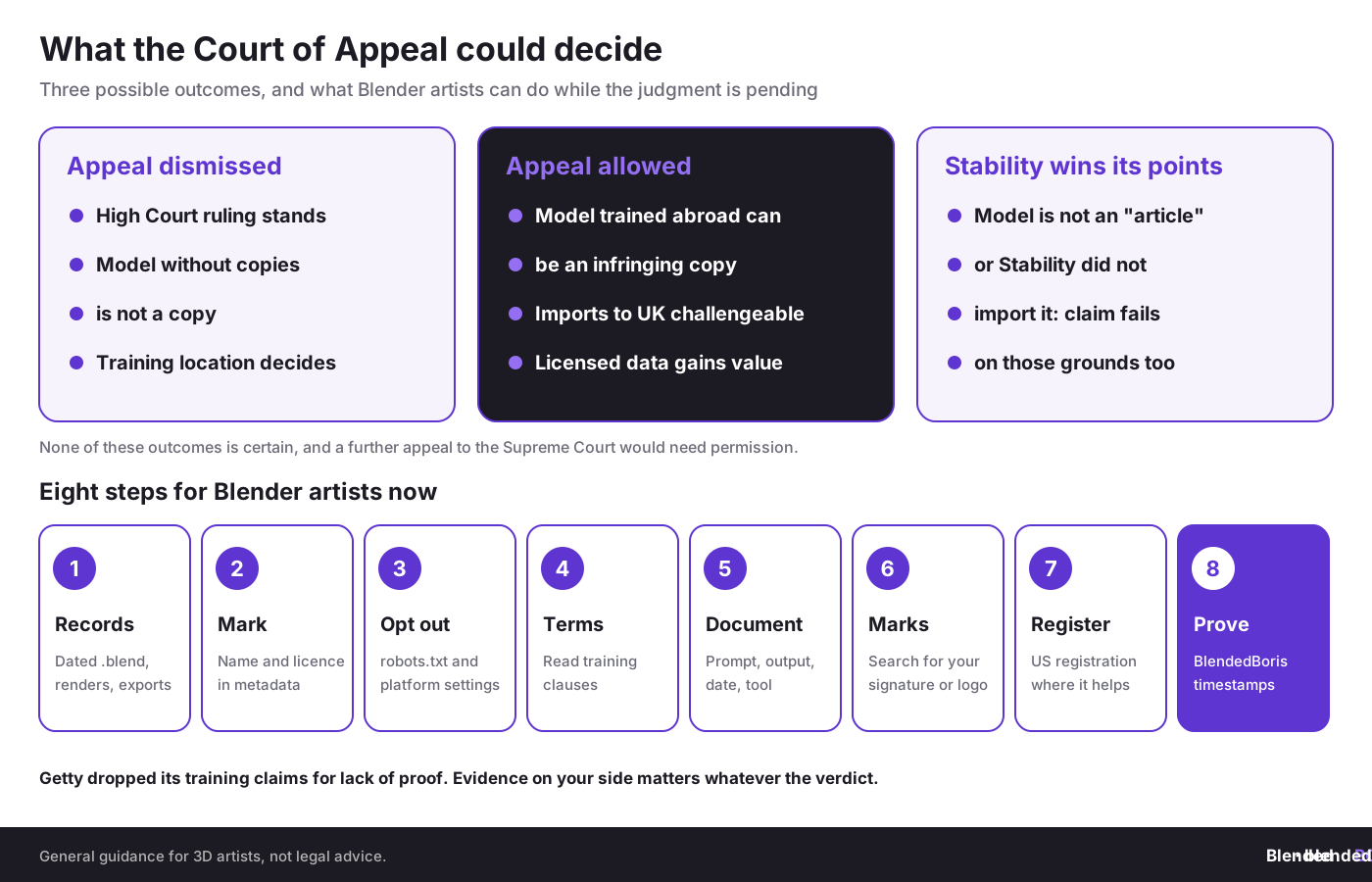
- Keep dated records. Save source .blend files, renders and exports with dates, and timestamp the versions you publish.
- Mark your published work. Add your name and licence to image metadata and portfolio pages. The sister blog's guide to metadata and watermarking in Blender shows how.
- Set AI training opt-outs on your own site and on every platform that offers them. Our guide to opting out of AI training datasets lists the robots.txt rules.
- Read platform and marketplace terms for training clauses before you upload, and recheck them when they change.
- Document AI outputs that copy your work. Save the prompt, the output, the date and the tool, and compare them with your dated originals.
- Watch for your marks. Search for your name, signature or logo in AI-generated images, since marks can support a separate claim.
- Register where it helps. In the US, registration before infringement affects the damages you can claim. The UK has no copyright register, so dated proof matters more.
- Follow the judgment. When the Court of Appeal rules, check what it says about models trained abroad before you decide on any claim, and take legal advice for real disputes. The sister blog's overview of artist rights and AI training is a good starting point.
Where does this fit in the bigger picture?
Our sister sites covered other stories this week where control over systems and files decided who stays in charge of the work:
- A critical PLM flaw. PTC released a patch for a critical remote code execution flaw in Windchill and FlexPLM, the fourth critical Windchill flaw of 2026: what the Windchill vulnerability means for companies that keep design data in PLM on cadchain.com.
- A weekend without the cloud. Dassault Systemes is upgrading the 3DEXPERIENCE public cloud to R2027x on 21 and 22 November 2026, with full downtime: how SOLIDWORKS users can prepare for the 3DEXPERIENCE R2027x upgrade on solidboris.com.
- File transfer under attack. CISA added an IBM Aspera Faspex flaw and an OpenSSH bug to its list of exploited vulnerabilities: what the Aspera Faspex vulnerability means for Inventor teams that send files on borisinventor.com.
Our report on Getty Images' Chapter 11 filing explains what is happening to the company behind this appeal.
Conclusion
The Court of Appeal is deciding a narrow question with wide effects: whether an AI model trained abroad on copied images can be an infringing copy in the UK, even though it stores none of those images. The High Court said no in 2025. Getty, backed by the music industry, says that reading leaves a gap any developer can use by training offshore. Stability says only Parliament can close it. Until the judgment arrives, nothing has changed in UK law. What has not changed either is the value of evidence: Getty's training claims failed for lack of proof. Keep dated records of your work, mark it, opt out where you can and read the licences you agree to.
Make every version provable.
BlendedBoris records a blockchain timestamp of your Blender work from inside Blender, giving you dated proof of authorship for your models, scenes and renders, so you can show they were made by you, and when.
👉 Get started with BlendedBoris
FAQ: Getty Images v Stability AI appeal
When did the Getty v Stability AI appeal hearing start?
On 11 November 2026 at the Court of Appeal in London. It continued on 12 November. No judgment has been given yet.
What did the High Court decide?
On 4 November 2025, Mrs Justice Joanna Smith dismissed Getty's secondary copyright claim because Stable Diffusion's weights never stored Getty's images. Getty won only a limited trade mark claim about watermarks in images from Stable Diffusion v1.x and v2.x.
Why did Getty drop its claim that training infringed copyright?
Getty conceded during the June 2025 trial that there was not enough evidence that Stable Diffusion was trained or developed in the UK, and UK copyright law generally covers acts done in the UK.
What is an infringing copy?
Under section 27 of the Copyright, Designs and Patents Act 1988, an imported article is an infringing copy if making it in the UK would have infringed copyright. Importing or distributing such an article in business can be secondary infringement.
Who supports Getty in the appeal?
The British Recorded Music Industry (BPI) has permission to intervene in support of Getty. It is concerned that models can be trained abroad and imported into the UK.
Does the appeal decide whether AI models contain copies of training data?
No. That question is not part of this appeal. Whether a particular model has memorised works depends on the facts of that model.
Has UK copyright law on AI training changed?
No. The Government's March 2026 report dropped the earlier opt-out exception plan and called for more evidence, but it did not change the law.
How can BlendedBoris help?
BlendedBoris adds a blockchain timestamp to your Blender work from inside Blender, giving you dated proof of what you made and when, which helps in any dispute.


