
Etsy's new Terms of Use, published on 26 October 2026 and taking effect on 16 December 2026, add one sentence that lets Etsy and its third party partners and vendors use sellers' content to develop, train, test and improve artificial intelligence and machine learning technologies. After longtime sellers began closing their shops in protest, Etsy told The New York Times on Friday, 20 November, that it will revise the terms and send the new version to sellers soon.
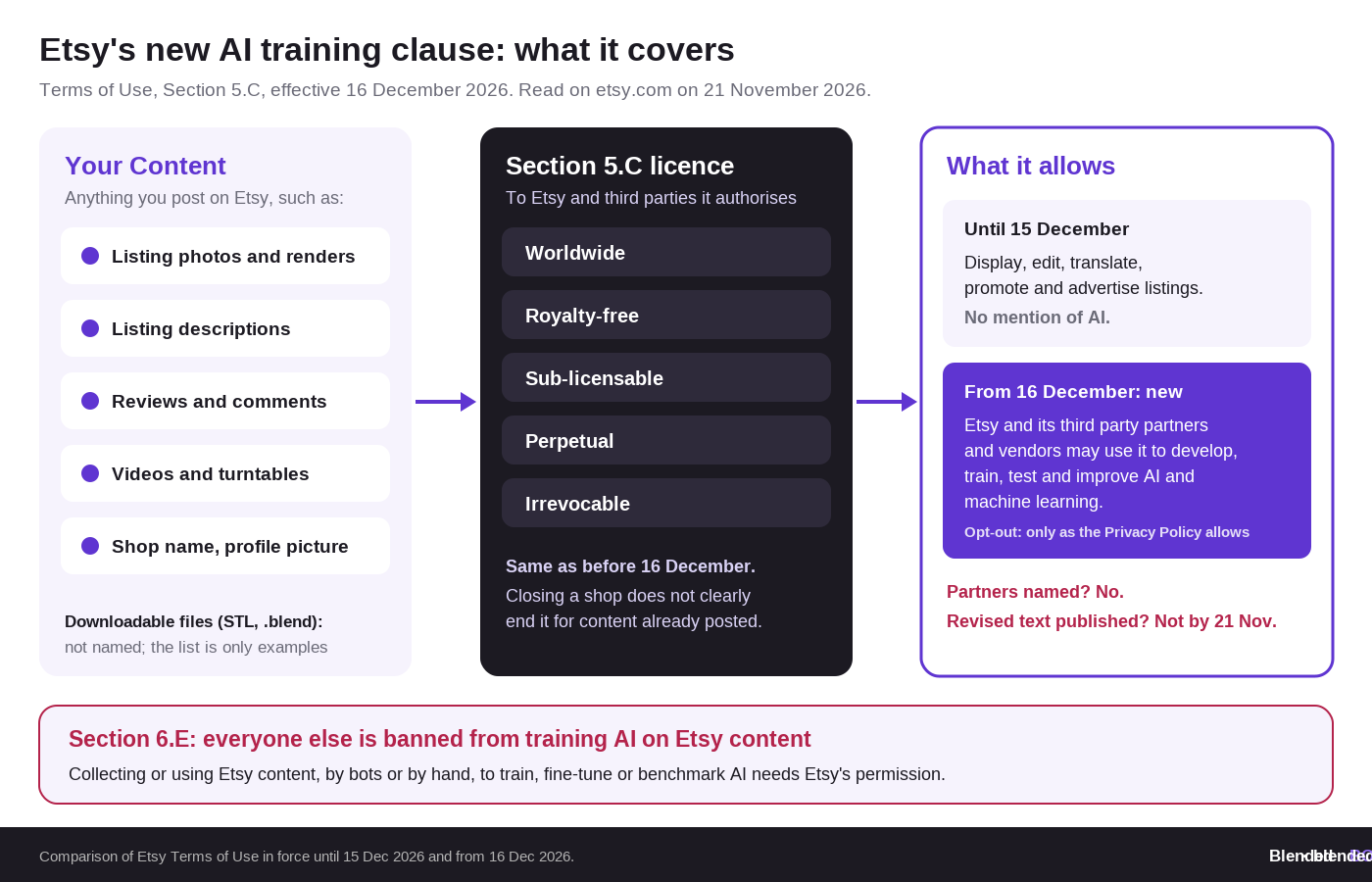
The change sits in Section 5.C, the licence every seller already gives Etsy over what they post: shop names, profile pictures, listing photos, listing descriptions, reviews, comments, videos and more. That licence was already broad. It is worldwide, royalty-free, sub-licensable, perpetual and irrevocable, and it covers editing, reproducing and preparing derivative works. What is new is that the licence now names AI development and training, and extends that right to partners and vendors. The version of the terms in force until 15 December does not mention artificial intelligence at all.
For Blender artists who sell on Etsy, this is not an abstract legal point. Your listing photos are often your renders, and for many 3D sellers the render is the most finished piece of creative work in the whole listing. Whether you sell prints of your artwork, 3D printed figures, STL files or digital downloads, those images and descriptions are exactly the kind of content the clause covers. Here is what the new text says, what Etsy has said since, and what you can do before 16 December.
TL;DR: Etsy's AI training clause
Etsy's new Terms of Use take effect on 16 December 2026. Section 5.C adds the right for Etsy and its third party partners and vendors to use Your Content, including listing photos and descriptions, to develop, train, test and improve AI and machine learning, subject to any opt-out rights in the Privacy Policy. We found no dedicated AI training opt-out in the new Privacy Policy. At the same time, Section 6.E bans everyone else from using Etsy content to train AI without permission. Etsy says it does not train AI to copy sellers' work and has promised revised terms, which had not been published by 21 November. For Blender artists: read both versions, decide what you upload, and keep dated proof of your original files off the platform.
What exactly changes in Etsy's terms on 16 December?
We compared the new Etsy Terms of Use with the version in force through 15 December 2026, reading both on Etsy's site on 21 November. Section 5 still starts by saying that content you post is yours and that Etsy makes no claim to it. The licence wording in Section 5.C is almost the same as before. The big change is one sentence added at the end:
New in Section 5.C (effective 16 December 2026)
The licence now includes the right for Etsy and its third party partners and vendors to use Your Content to "develop, train, test and improve artificial intelligence and machine learning technologies". The sentence adds that this includes improving Etsy's services and helping keep them safe, and that it is subject to any applicable opt-out rights described in Etsy's Privacy Policy.
The new terms also add three AI rules in Section 6 that were not there before. Section 6.C treats bots, scripts, browser extensions and AI agents as use of Etsy, and makes whoever deploys an agent responsible for what it does. Section 6.D covers Etsy's own AI tools: you must check their output and you carry the risk if you rely on it. Section 6.E, the rule against taking Etsy's content, now bans anyone from collecting or using content from Etsy, by bots or by hand, to develop, train, fine-tune, evaluate, benchmark or test AI systems without Etsy's permission.
Put together, the terms give Etsy and the partners it picks a right to train AI on seller content, while closing that door to everyone else. Etsy's new Privacy Policy, also published on 26 October and also effective on 16 December, sits alongside the terms.
Why are Etsy sellers closing their shops?
The clause spread among sellers on social media in November. According to The New York Times report by Reggie Ugwu, reprinted by The Philadelphia Inquirer on 21 November, illustrator Aaron Millard deleted the Etsy shop he had run for nearly a decade, and Kristen and Geoff Zephyrus closed Cognitive Surplus, their stationery and home goods brand, after 13 years on Etsy. There is no official count of closed shops.
The objection is simple. Many of these sellers make things by hand, and they see the clause as letting a platform they pay fees to feed their work into AI systems they never agreed to support. The licence is perpetual and irrevocable, so closing a shop does not clearly end Etsy's permission to use content already posted, a point several commentators have raised. The terms do not say how content from closed shops is handled in AI training.
Etsy sellers have pushed back before. In 2022, more than 20,000 sellers took part in a strike over a fee rise from 5% to 6.5%, as the Times noted. This time the protest is about rights, not money, and some sellers chose to leave rather than wait for a revision.
What has Etsy said?
James Ossman, Etsy's vice president of customer operations, posted a statement for sellers on 16 November. He wrote: "We do not use your content to train AI models designed to copy your original work or replace your creativity." In an email to the Times on 20 November, he said Etsy is clarifying the terms and will share the revised version directly with sellers soon. He named fraud detection tools and advertising as reasons partners need access to seller content.
That statement answers part of the worry, but not all of it. As of 21 November, the revised terms had not been published, and the version due on 16 December still contains the sentence quoted above. Etsy has not said which partners and vendors receive the right, whether they may use seller content for AI products unrelated to Etsy, whether content posted in the past is included, or how an opt-out would work in practice.
Keep dated proof of your originals.
Whatever Etsy's revised terms say, your listing images are only a copy of your work. BlendedBoris adds a blockchain timestamp to your .blend files and renders from inside Blender, so you hold dated proof of authorship that no platform licence can change.
👉 Timestamp your Blender work with BlendedBoris
What does the clause mean for Blender artists who sell on Etsy?
Most 3D sellers on Etsy upload exactly what the clause names. A shop selling 3D printed miniatures uses renders as listing photos. A shop selling STL files or Blender assets shows turntables, wireframes and close-ups. A shop selling art prints uploads the finished render itself. All of that is Your Content under Section 5, together with the descriptions that explain your process, materials and style.
The terms do not say directly whether downloadable files, such as STL, OBJ or .blend files sold as digital items, count as Your Content. The list in Section 5 only gives examples, so it is not complete. Until Etsy's revised text answers this, assume that anything you post through Etsy could fall under the licence. Our guide to selling STL files on Cults3D, Thingiverse and MyMiniFactory covers other places to sell files.
This comes on top of rules Etsy introduced in October. As our report on Etsy's new photo, guide and bot rules explains, most listings now need at least one real photo of the actual item, and AI may not be used to change an item's core design. Earlier, AI copies of makers' work flooded the marketplace. So Etsy is tightening what sellers may do with AI while widening what it and its partners may do with sellers' content.
Etsy is not alone. We have covered new AI training terms on Fab, AI training permissions on Nexus Mods, the new Sketchfab terms of use and World Labs terms that take free users' outputs. The pattern is the same: platforms update their licences so they can use uploaded work for AI, and the details sit deep in long legal documents.
Can you opt out of AI training on Etsy?
The new clause is subject to any applicable opt-out rights described in Etsy's Privacy Policy. We read the new Privacy Policy on 21 November. It does not mention artificial intelligence or machine learning, and we found no setting or form for keeping your content out of AI training. Section 7 lists rights that depend on applicable law, naming the EU's General Data Protection Regulation, including a right to object, in some cases, to processing based on Etsy's legitimate interests. It also lists a contact address for Etsy's Data Protection Officer.
Several reports say that writing to the Data Protection Officer is the only route sellers have. That has limits. Data protection rights cover personal data, and a render of a sculpted dragon is not personal data in most cases. Sellers in the EU and UK have stronger rights here than sellers in the United States, but none of them gives a simple switch for creative work.
An opt-out signal on your own website does not help either. Tools such as robots.txt rules, covered in our report on the shared AI training opt-out signal, tell crawlers not to collect your work. A licence you grant by accepting a platform's terms is a contract, and it works differently. Our step-by-step guide on opting out of AI training datasets as a Blender artist covers what you can control on your own sites, and the sister blog explains how to protect art from AI training.
What should Blender artists do before 16 December?
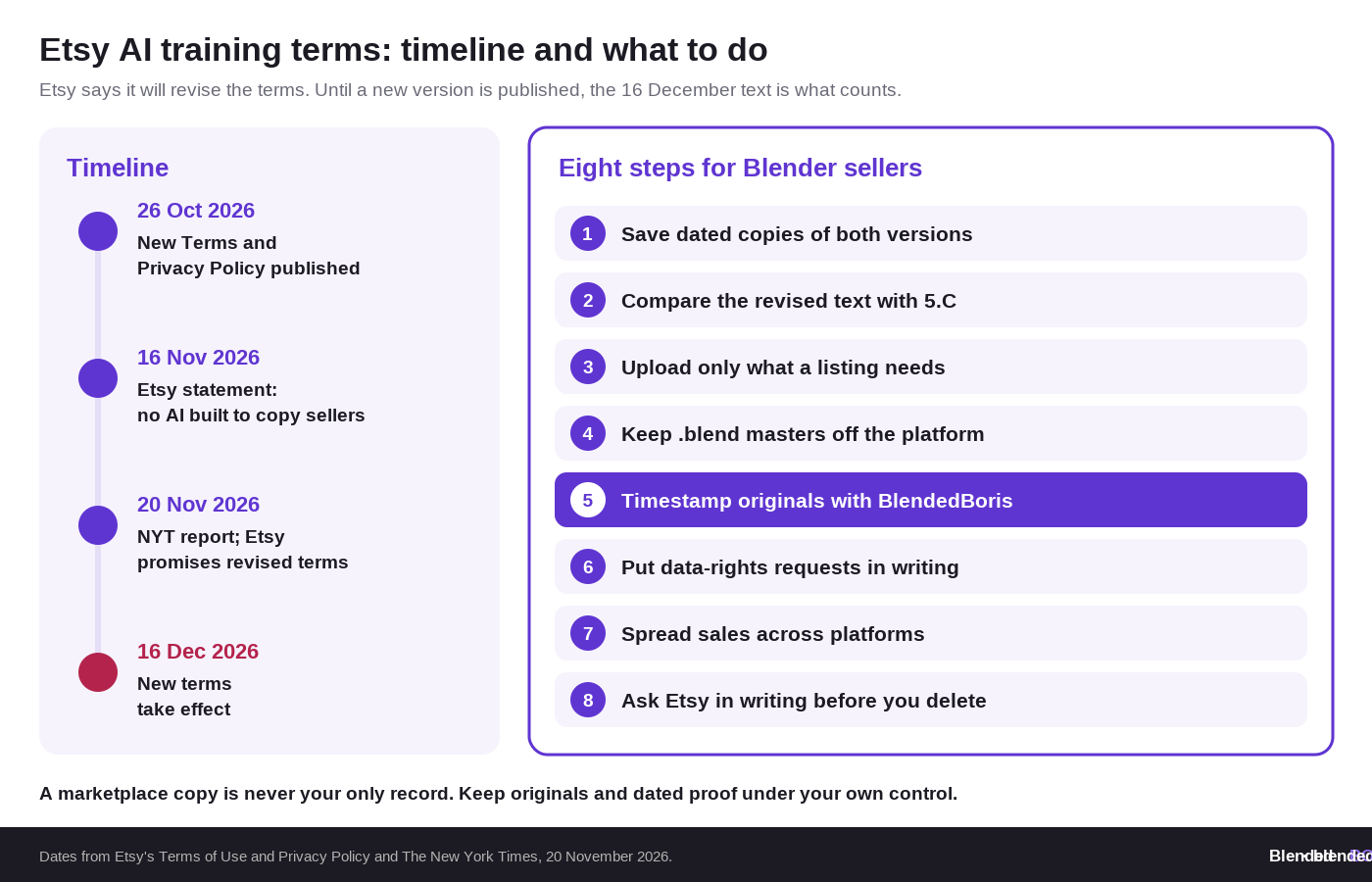
- Read both versions now. Save dated copies of the Terms of Use in force until 15 December and the version taking effect on 16 December, especially Sections 5.C and 6. If the terms change again, you will want to show what you agreed to and when.
- Watch for the revised text. Etsy says it will send revised terms to sellers. Compare them line by line with Section 5.C and check whether partners, past content and an opt-out are covered.
- Decide what you upload. Listing images only need to sell the item. Smaller renders, crops and watermarked turntables show the work without handing over your best full-resolution images.
- Keep masters off the platform. Your .blend files, high-resolution renders and source textures belong on your own storage, not in listings. A copy on a marketplace is never your only record.
- Timestamp your originals. Record dated proof of your files before you list them. If an AI system later produces something close to your design, you can show what you made and when. See our report on Content Credentials for why an independent date matters.
- Use your data rights in writing. If you are in the EU or UK, you can write to Etsy's Data Protection Officer and object to processing. Keep a copy of your message and the reply, and do not rely on a promise that is not in the terms.
- Spread your sales. If you rely on one marketplace, a terms change hits your whole income. Compare options in our 3D marketplace fee comparison and the sister blog's guide to selling 3D models.
- Think before you delete. Closing a shop removes your listings, but the licence over content already posted is described as perpetual and irrevocable. If you leave, ask Etsy in writing what happens to your past content, and keep dated screenshots of your shop first.
Where does this fit in the bigger picture?
Platform terms are one front. Our reports on the EVOX lawsuit over 7,095 scraped car photos and on Irish artists telling lawmakers that scraping is theft show the other: AI companies taking work with no licence at all. The Advocate General's opinion in the EU Gemini case and the Australian opt-out debate show governments still working out the rules. The sister blog sums up artist rights in AI training.
Our sister sites covered other stories this week about rules, versions and records:
- New security standards. The first two European standards for the Cyber Resilience Act, EN 40000-1-1 and EN 40000-1-2, were published on 18 November 2026: what the first Cyber Resilience Act standards mean for product makers on cadchain.com.
- A new release, new requirements. SOLIDWORKS 2027 SP0 became available on 20 November 2026, and SOLIDWORKS 2026 and 2027 run on Windows 11 only: what SOLIDWORKS 2027 SP0 means for your systems and files on solidboris.com.
- A zero-day in the server room. Broadcom fixed a VMware vCenter flaw that Google's threat intelligence team says was exploited by a suspected China-nexus espionage group: what the vCenter zero-day means for design teams on borisinventor.com.
Conclusion
Etsy's new Section 5.C turns a licence that sellers already granted into an explicit right to train AI, for Etsy and for the partners and vendors it picks, while banning everyone else from doing the same. Etsy says it will not train AI to copy sellers' work and promises clearer terms, but until the revised text is published, the version taking effect on 16 December is what counts. For Blender artists, the safe approach is to read both versions, upload only what a listing needs, keep your masters and dated proof of authorship under your own control, and put any objection in writing.
Your files, your proof.
BlendedBoris records a blockchain timestamp of your Blender work from inside Blender, giving you dated proof of authorship for models, scenes and renders, wherever you sell them.
👉 Get started with BlendedBoris
FAQ: Etsy AI training terms
When do Etsy's new terms take effect?
Etsy published the new Terms of Use and Privacy Policy on 26 October 2026. Both take effect on 16 December 2026. The previous terms stay in force until 15 December.
What does the new AI clause say?
Section 5.C now includes the right for Etsy and its third party partners and vendors to use Your Content to develop, train, test and improve artificial intelligence and machine learning technologies, subject to any applicable opt-out rights in the Privacy Policy.
Which content does it cover?
Your Content includes anything you post through Etsy, such as shop names, profile pictures, listing photos, listing descriptions, reviews, comments, videos and usernames. The list is not complete, and the terms do not say directly whether downloadable files count.
Is Etsy changing the clause?
Etsy told The New York Times on 20 November 2026 that it will revise the terms and share the new version with sellers soon. The revised text had not been published by 21 November.
Can I opt out of AI training on Etsy?
We found no dedicated AI training opt-out in the new Privacy Policy. It describes data protection rights, such as a right to object in certain circumstances, that depend on the law where you live. Sellers in the EU and UK have stronger rights than US sellers.
Does closing my shop stop Etsy using my content?
Not clearly. The licence in Section 5.C is described as perpetual and irrevocable, and the terms do not say how content from closed shops is handled in AI training. Ask Etsy in writing before you delete anything.
Can other companies scrape Etsy to train AI?
Section 6.E of the new terms bans anyone from collecting or using Etsy content to develop, train, fine-tune or benchmark AI without Etsy's permission, whether by bots or by hand.
How can BlendedBoris help?
BlendedBoris adds a blockchain timestamp to your Blender work from inside Blender, so you keep dated proof of authorship of your originals, separate from any copy you upload to a marketplace.


