
On Tuesday 17 November 2026, Irish artists and writers told the Oireachtas Joint Committee on Artificial Intelligence that AI companies are scraping their work without consent or payment. Robbie Kitt, chair of Praxis, the Artists' Union of Ireland, told the committee: "What is happening is theft."
Kitt was joined by Noel Kelly, chief executive of Visual Artists Ireland, and Conor Kostick of the Irish Writers Union. Between them they described AI models trained on material taken from galleries, archives, museums and artists' own websites, public bodies using AI-generated posters and photos instead of paying artists, and individual creators who have no realistic way to enforce their rights. No minister responded at the hearing, and the committee did not announce any next steps.
The hearing was about Irish artists, but the questions apply to anyone who posts 3D art online. If you share renders on ArtStation, sell models on a marketplace or keep a portfolio site, your work is the kind of material AI companies collect. This article sums up what the committee heard, where the law stands in Ireland and the rest of the EU, and what Blender artists can do now.
TL;DR: AI scraping and artists
At the Oireachtas AI committee on 17 November 2026, Praxis called AI scraping of creative work theft and asked for ways to get recourse and compensation. Visual Artists Ireland asked who used artists' work to train AI, and on what basis. The Irish Writers Union asked for consent, payment and transparency. Nothing changed in law that day. EU law already lets you reserve your work against text and data mining, and requires AI model makers to publish training summaries. For Blender artists, the practical steps are an opt-out in machine-readable form, licence terms that ban AI training, smaller public previews, and dated proof of your work.
What did artists tell the Oireachtas AI committee?
Three speakers from the arts set out the case, according to reports by RTÉ, the Irish Examiner and The Irish Times:
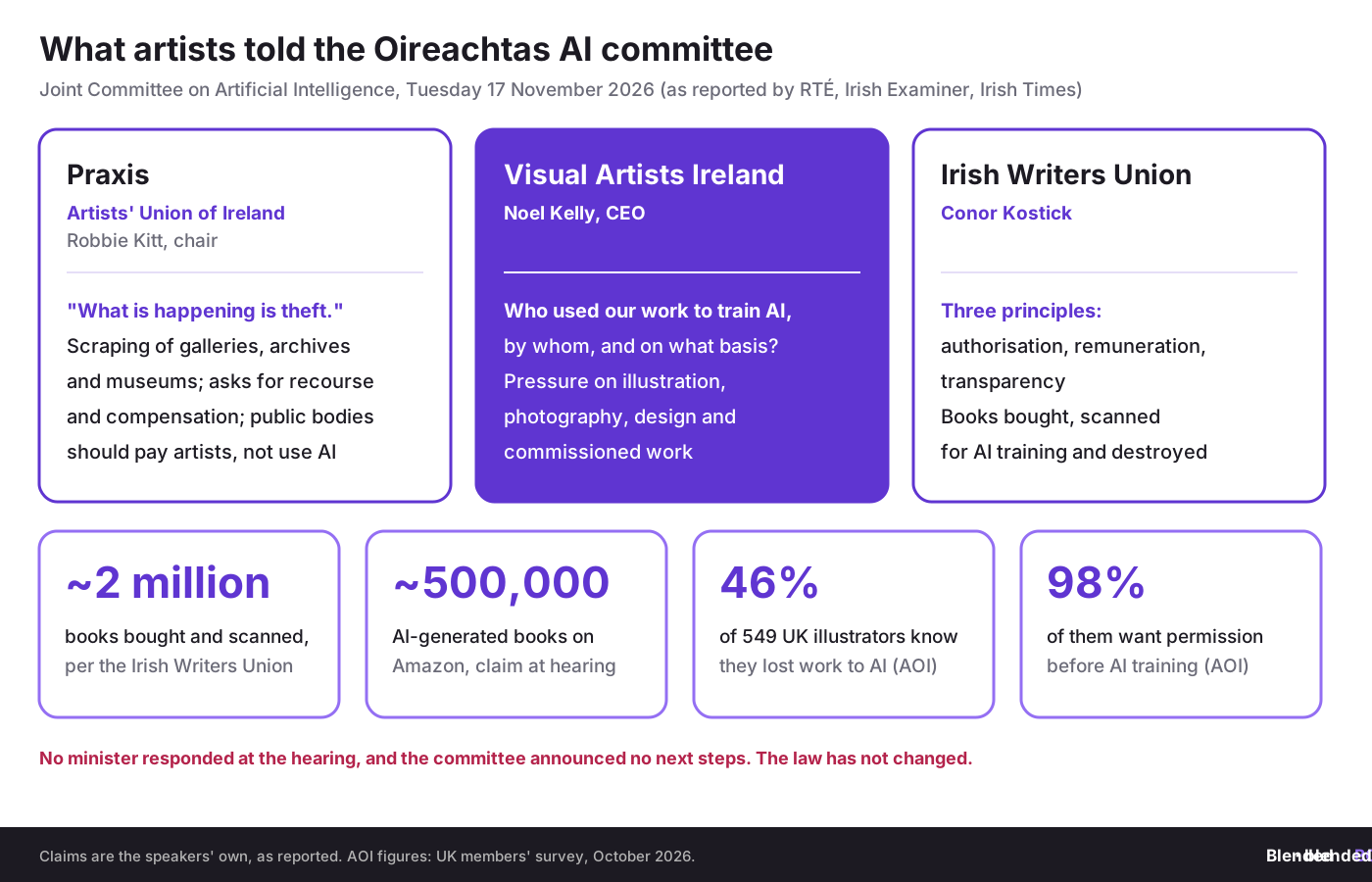
- Robbie Kitt, Praxis. Kitt, a musician and DJ, said AI models scrape free, publicly available material from galleries, archives and museums, and that publicly funded institutions are under pressure from automated bot traffic. He said the value of creative work is being taken by brute force, with no compensation for the people who made it, and asked for routes to recourse for unlawfully scraped content and adequate compensation mechanisms. He also said local authorities and publicly funded bodies had used AI-generated photos, posters and videos, and called for a national policy that public bodies employ creatives rather than replace them with AI.
- Noel Kelly, Visual Artists Ireland. Kelly said generative AI adds pressure on visual artists who already face financial uncertainty, particularly in illustration, photography, design and commissioned work. He said artists are not against the technology itself, but that producing something and creating something are not the same. His central question: "Artists want to know whether our work has been used to train AI systems, by whom, and on what basis." He also said individual artists do not have the legal resources to enforce their rights.
- Conor Kostick, Irish Writers Union. Kostick, who also sits on the board of the European Writers' Council, said tech companies had bought around two million books through second-hand and antique booksellers, scanned them for AI training and destroyed them. RTÉ also reported a claim at the hearing that around half a million AI-generated books had been published on Amazon. His published statement builds on three principles: authorisation, remuneration and transparency.
Independent Senator Alice-Mary Higgins raised concerns that cultural heritage items are being destroyed. In a separate session, the International Labour Organisation told the committee that one in four workers worldwide is in a job with some exposure to generative AI.
Why does an Irish hearing matter to Blender artists elsewhere?
Ireland is the European base for many of the largest technology companies, which is why Kostick asked the government to use that position to push for compliance with EU copyright law. Ireland is also an EU member, so the rules it applies are largely EU rules. What Irish lawmakers decide to press for in Brussels can affect how AI companies treat artists' work across the EU, including work by artists who have never been to Ireland.
The complaints are also familiar to 3D artists. Kelly's question about who trained on whose work is the same one behind the EVOX lawsuit over scraped car photos and the Getty Images appeal against Stability AI. Kitt's point about public bodies using AI images instead of commissions echoes the Manchester Animation Festival's AI ban and the AI controls on ArtStation: creative communities are drawing their own lines while lawmakers decide.
The hearing also came with fresh data from next door. The UK's Association of Illustrators reported in late October that 46% of 549 illustrators who answered its survey know a client chose generative AI over them, up from 32% a year earlier. In games and interactive media, 80% had seen AI material in briefs, and 98% of all respondents want AI firms to ask permission before training on their work. It is a poll of the association's members, not a census, but it shows the same pressure Kelly described.
Keep dated proof of every piece of 3D art you share.
If your models or renders are scraped, copied or claimed by someone else, the first question is who made what, and when. BlendedBoris adds a blockchain timestamp to your Blender work from inside Blender, giving you dated proof of authorship.
👉 Protect your Blender work with BlendedBoris
What does EU law already say about scraping art for AI training?
Two sets of EU rules already apply. The first is the 2019 Copyright in the Digital Single Market Directive, which Ireland put into law in 2021. Its Article 4 allows text and data mining of lawfully accessible content for any purpose, unless the rights holder has reserved that use "in an appropriate manner, such as machine-readable means" for content made available online. In practice, this is the opt-out that AI companies point to, and that artists' groups say does not work.
The second is the EU AI Act. Since 2 August 2025, providers of general-purpose AI models must have a copyright policy that respects those reservations and must publish a sufficiently detailed summary of the content used for training, using a template from the European Commission. Kostick's statement cites a Trinity College Dublin study which found that more than 30 AI models had not provided those template summaries. Whether the exception covers generative AI training at all is also being tested at the EU's top court: the Advocate General gave his opinion in Like Company v Google on 3 November 2026, and Kostick cited that case too.
None of these demands has become law. The committee heard them, and it is now up to its members and the government to decide what, if anything, to recommend.
What should Blender artists do now?
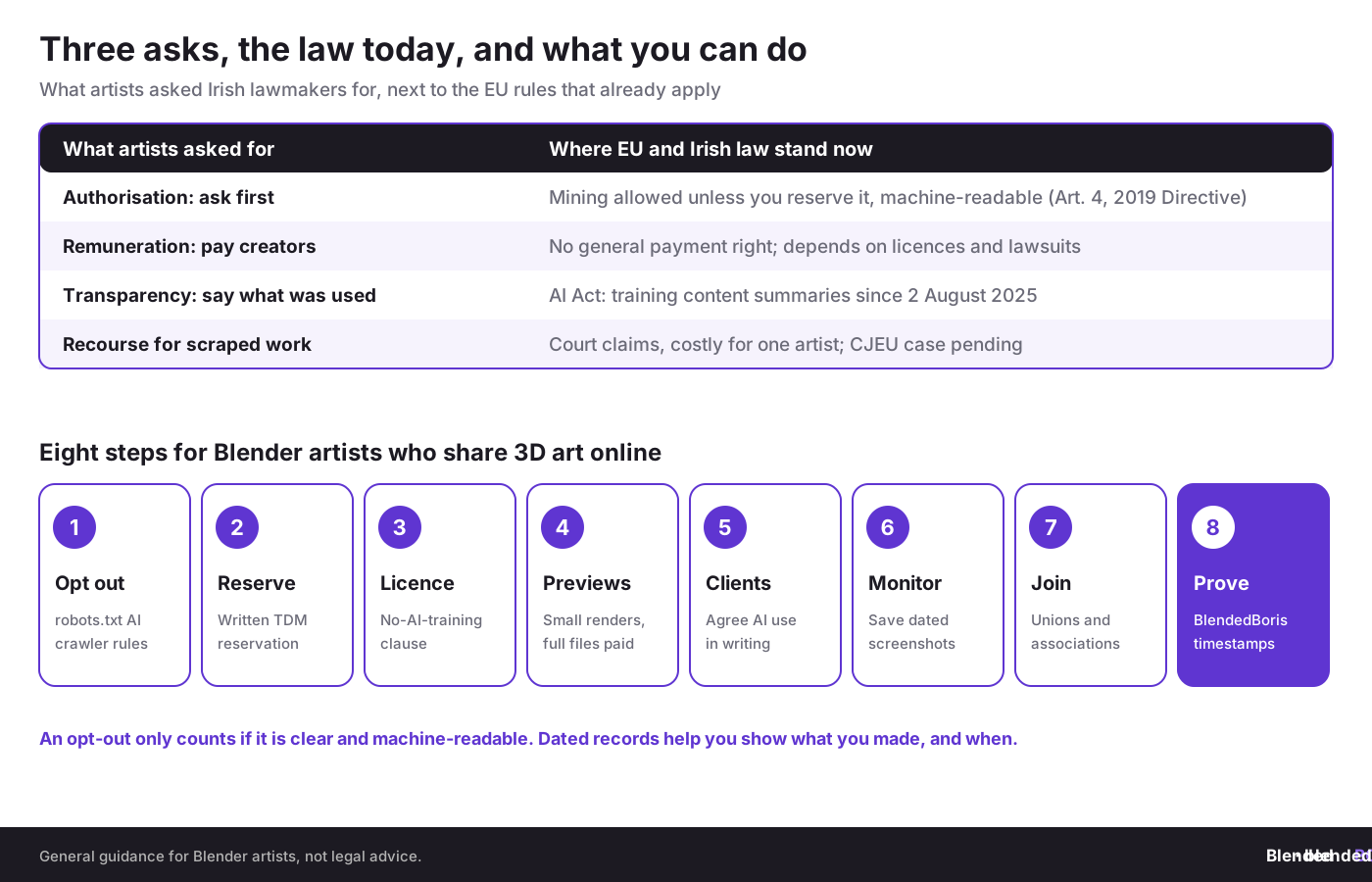
- Reserve your rights in machine-readable form. Add AI training rules to your robots.txt, as explained in how to opt out of AI training datasets and our report on the shared robots.txt training signal.
- Say it in words too. Add a short text and data mining reservation to your site terms, portfolio and marketplace profiles. The sister blog covers dataset opt-out strategies.
- Put a no-AI-training clause in your licences. State that buyers may not use your models, textures or renders to train AI. See how to protect art from AI training.
- Show previews, not full files. Post watermarked, lower-resolution renders and turntables publicly, and deliver full-resolution files and .blend scenes only after a sale.
- Ask clients about AI. If a brief contains AI images, or a client wants to feed your work into an AI tool, agree on it in writing first.
- Watch for copies. Run reverse image searches on key renders and save dated screenshots of close matches. The sister blog lists your options when AI copies your art.
- Work with others. Artist unions and associations can do what one person cannot: give evidence to lawmakers and back test cases. Our guide to copyright basics for 3D artists explains the rights you have.
- Keep dated proof. Keep incremental .blend files, render passes and timestamps for each project. Our art registration guide compares the options, and our report on Content Credentials explains why a date you can prove matters.
Where does this fit in the bigger picture?
Our sister sites covered stories this week about proof of origin, records and access to valuable files:
- Proof of file integrity. A European patent court dismissed KeeeX's case against Adobe, OpenAI and C2PA and found all contested claims of its file integrity patent invalid: what the C2PA patent ruling means for proof of file ownership on cadchain.com.
- Simulation records. SOLIDWORKS listed eleven Simulation, Plastics and Flow Simulation 2027 enhancements, including a separate storage path for plastics results: what SOLIDWORKS Simulation 2027 means for your simulation data on solidboris.com.
- Wiki attacks. Attackers are exploiting an Apache Axis flaw in self-hosted Confluence Data Center with the remote API on: what the Confluence vulnerability means for Inventor teams on borisinventor.com.
Closer to home, the Irish hearing is one more country weighing the same question. Our reports on Australia's AI training opt-out debate, Indonesia's AI copyright bill and the Gruffalo illustrator's AI dispute show lawmakers and artists in different places asking who may use creative work as training data, and who gets paid.
Conclusion
The 17 November hearing did not change the law, but it put three plain demands in front of Irish lawmakers: ask first, pay creators, and say what was used. Until those demands turn into rules, Blender artists have to rely on the tools that exist now: a machine-readable opt-out, licence terms that ban AI training, careful previews and good records. Kelly's question, who used our work and on what basis, is much easier to answer when you can show exactly what you made and when you made it.
Prove what you made, and when.
BlendedBoris records a blockchain timestamp of your Blender work from inside Blender, giving you dated proof of authorship for your models, scenes and renders.
👉 Get started with BlendedBoris
FAQ: AI scraping and artists
What happened at the Oireachtas AI committee on 17 November 2026?
The Joint Committee on Artificial Intelligence heard from Praxis, the Artists' Union of Ireland, Visual Artists Ireland and the Irish Writers Union about how AI affects artists and writers. They described AI training on their work without consent or payment.
Who called AI scraping theft?
Robbie Kitt, chair of Praxis, told the committee "What is happening is theft" and asked for routes to recourse and compensation for creators whose work was scraped, according to the Irish Examiner and The Irish Times.
Did the hearing change the law in Ireland?
No. The committee heard evidence. No minister responded at the hearing, and no next steps or recommendations had been reported.
Is scraping art for AI training legal in the EU?
EU law allows text and data mining of lawfully accessible online content unless the rights holder has reserved that use in an appropriate, machine-readable way. Whether this exception covers generative AI training is being tested at the Court of Justice of the EU.
What does the EU AI Act require from AI companies?
Since 2 August 2025, providers of general-purpose AI models must have a copyright policy that respects opt-outs and must publish a sufficiently detailed summary of the content used for training, using a European Commission template.
How can I opt my 3D art out of AI training?
Use robots.txt rules for AI crawlers, a written text and data mining reservation on your site and profiles, NoAI settings where platforms offer them, and licence terms that forbid AI training.
What did the AOI survey find?
The UK Association of Illustrators reported that 46% of 549 illustrators who answered know a client chose generative AI over them, up from 32% a year earlier, and 98% want AI firms to ask permission before training on their work.
How can BlendedBoris help?
BlendedBoris adds a blockchain timestamp to your Blender work from inside Blender, giving you dated proof of authorship if your models or renders are scraped, copied or claimed by someone else.


