
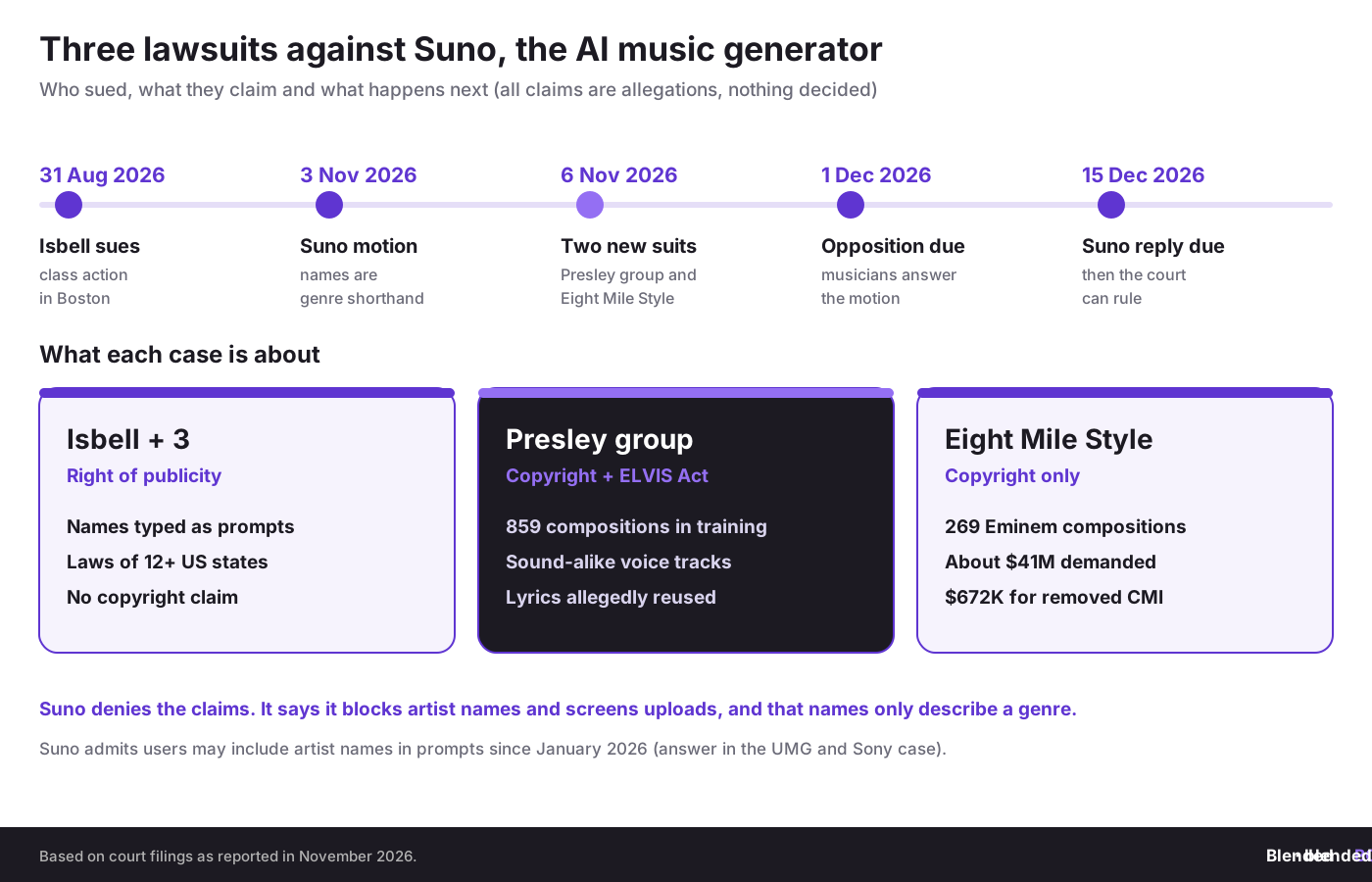
On 6 November 2026, two new copyright lawsuits were filed against Suno, the AI music generator. A group of Elvis Presley rights holders, including Authentic Brands Group and Raleigh Music Publishing, sued in federal court in Northern California, and Eight Mile Style, the publisher that controls hundreds of Eminem songs, filed its own complaint in San Francisco. Three days earlier, Suno had asked a court in Boston to throw out a separate class action by singer Jason Isbell and three other musicians, arguing that typing an artist's name into a prompt is "shorthand" for a genre.
These are music cases, but the questions inside them are the ones Blender artists keep running into with image and 3D generators. Can a tool let people type your name to get work that looks or sounds like yours? Is your style protected, or only your actual works? What happens when a generator reproduces pieces of a specific work, or when credits and metadata are stripped on the way into a dataset? And who is responsible: the user who typed the prompt or the company that built the tool?
None of these lawsuits has been decided, and Suno denies wrongdoing. But the way the claims are built shows which rights hold up best and what evidence an artist needs. This article explains the three cases and what Blender artists can do now.
TL;DR: the Suno lawsuits for Blender artists
Elvis Presley's rights holders and Eminem's publisher sued Suno on 6 November 2026 over AI training, sound-alike output and copied lyrics. Suno separately argues that an artist's name in a prompt only describes a genre. For 3D artists the lesson is practical: copyright protects your specific models, textures and renders, not your style. Your name and likeness may be protected by other laws that differ by state and country. Claims are strongest with registered works, intact credits and dated records of what you made.
What did the Presley rights holders claim?
According to Variety's report, the Presley group's 51-page complaint accuses Suno of copyright infringement and of breaking Tennessee's ELVIS Act, the 2024 law that protects a person's voice as well as their name and likeness against unauthorised use, including AI voice cloning. The group says users can type Presley's name and get tracks that imitate his "rich vocal timbre", and the complaint includes sample songs that allegedly sound like him.
Several outlets report that the complaint says Suno copied 859 Presley compositions to train its system. Local coverage adds that lyrics were allegedly pulled from Presley songs such as "Blue Suede Shoes" and "Can't Help Falling in Love". The filing's most quoted line is a warning about what happens to new artists if this continues: "The next Elvis won't pick up a guitar."
What does Eminem's publisher want from Suno?
Eight Mile Style's complaint is about copyright only. Eminem himself is not a party. As reported, it lists 269 Eminem compositions and asks for $150,000 in statutory damages for each, about $40.4 million, plus $672,000 for allegedly removed copyright management information, for a total demand of about $41 million. That is the maximum the US Copyright Act allows for wilful infringement, so it is a demand, not a likely award.
The publisher's examples are specific:
- Style terms instead of names. Suno allegedly blocks prompts that name Eminem but not descriptions of his style, such as horrorcore or rapid-fire flow.
- Reused lyrics. Generated tracks allegedly reuse lines from "Lose Yourself", "The Real Slim Shady" and "Houdini".
- Likeness in the packaging. One track allegedly used an AI-generated picture of Eminem as cover art.
Why does Suno say an artist's name is just a genre?
The most useful document for visual artists may be Suno's answer to a different case. Jason Isbell, David Lowery, Guy Forsyth and Eduardo Calle filed a proposed class action in Boston on 31 August 2026. Their 84-page complaint has no copyright claim at all. It relies on the right of publicity, the right to control commercial use of your name and identity, under the laws of more than a dozen US states, plus an Illinois biometric privacy claim.
On 3 November, Music Business Worldwide reported, Suno moved to dismiss. Its core argument: "When people describe styles of music, they often use artists' names as shorthand for the genre they perform in." Suno also argues that any use of a name in a prompt is made by the user, not by Suno, that the name is turned into a style description before it reaches the model, that the right of publicity does not cover secondary liability, and that the First Amendment and federal copyright law, which leaves styles unprotected, block the claims.
Two details matter here. The Isbell complaint says users got around Suno's artist-name filter by typing names with spaces between the letters. And in a separate case brought by Universal and Sony, Suno's own answer admits that it used to block artist names in prompts and that users have been allowed to include them since January 2026. The musicians must answer the motion by 1 December, and Suno replies by 15 December.
Is your art style protected, or only your works?
Suno's motion leans on an old rule: copyright protects specific works, not ideas or styles. That rule applies to Blender artists too. A low-poly look, a toon shader approach or a moody lighting style is not owned by anyone. What is protected is the work itself: your mesh, your sculpt, your textures, your renders and the arrangement of a scene. Our guides to non-photorealistic rendering styles in Blender and 30+ landmark copyright cases for 3D artists show where courts have drawn that line.
That is why the strongest parts of the music complaints are the concrete ones: lyrics allegedly copied from named songs, sample tracks that allegedly sound like a specific voice, and a training set that allegedly included specific compositions. A 3D artist who says "the generator copies my style" has a weak case. One who can show that a generated model or render reproduces a particular sculpt, texture or composition they made, with dates, has a much stronger one. We saw the same pattern in the Gruffalo character copies and in the report on Midjourney's character copies.
Can a generator use your name or likeness?
This is where the cases differ most from ordinary copyright. Your name, face and voice are not "works", but many places protect them through other laws. Tennessee's ELVIS Act covers voice expressly. Other US states have their own right of publicity rules, and the Isbell case will test whether those rules reach an AI company when the user types the name. In Europe, Denmark's proposed deepfake law would require consent for realistic digital imitations of a person's appearance, voice and movements.
For Blender artists this matters in two directions. First, your own name: generators that accept artist names as prompts can produce work marketed as "in the style of" you, and we covered a related problem when ChatGPT added real cartoonists' signatures to AI images. Second, other people's likeness in your work: if you make digital doubles, scan faces or add a recognisable voice to an animation, you need consent, and the risks are growing as these laws spread.
Your models. Your name. Your dates.
BlendedBoris adds a blockchain timestamp to your Blender work from inside Blender, so you hold dated proof of which models, sculpts and scenes you made, and when, if a generator or a copycat ever produces something too close to yours.
👉 Protect your Blender work with BlendedBoris
What can 3D artists learn from the claims?
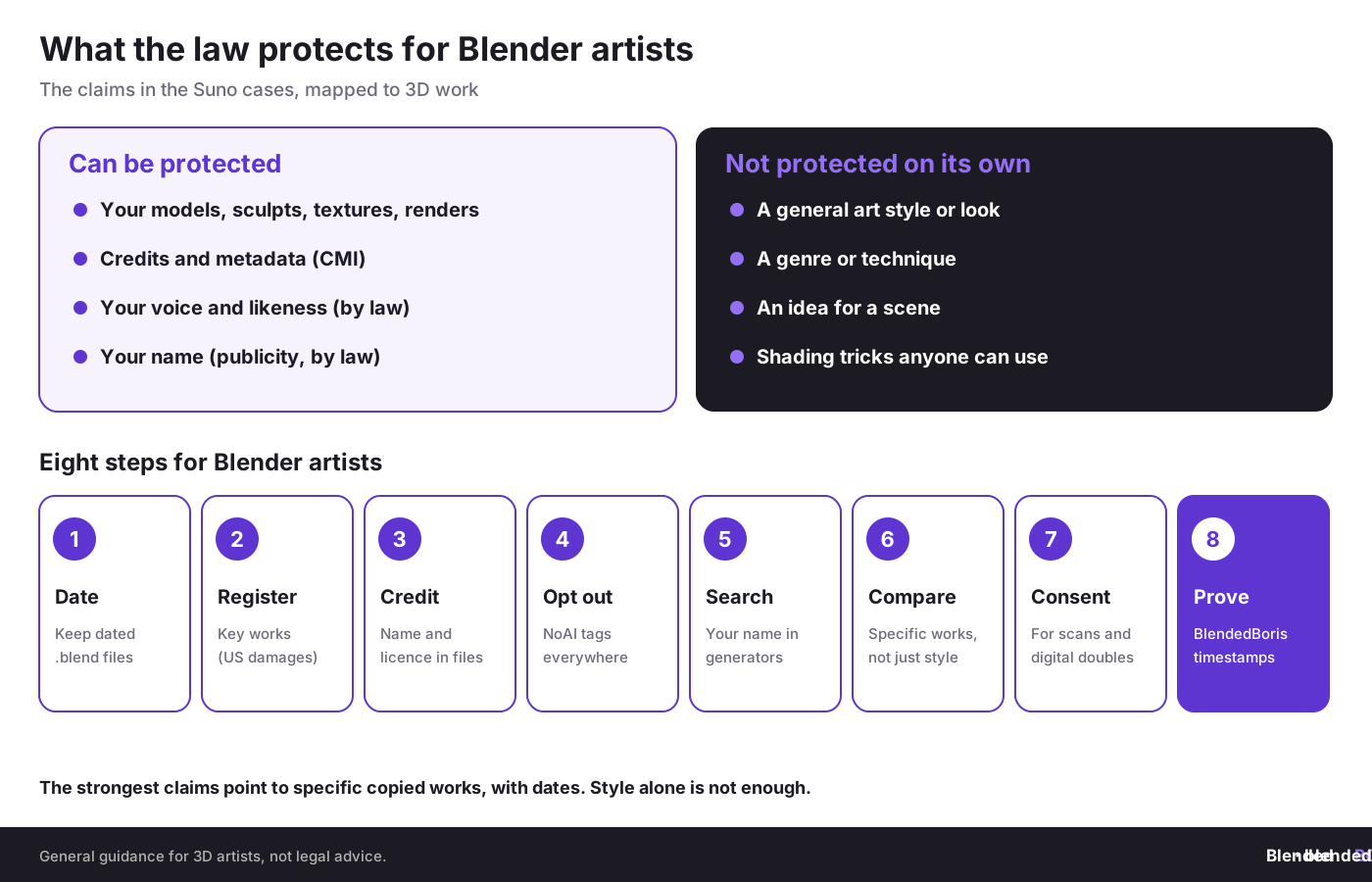
Each claim in these cases maps to something a Blender artist can protect or record today:
The last row deserves a closer look. Under US law, statutory damages and legal fees are generally only available if a work was registered before the infringement began, or within three months of publication. Large music publishers register their catalogues, which is why they can ask for $150,000 per work. Most independent 3D artists never register anything. Our guide to registering artwork, 3D models and renders explains when registration is worth it and what alternatives exist.
The $672,000 claim for removed copyright management information is also familiar territory. In the NoAI tag ruling in the Roblox case, a court accepted that a Sketchfab NoAI tag could count as copyright management information, but the artist still had to show the tag was actually removed. Credits that stay attached to your files, and records that show they were there, make that kind of claim possible.
How is this different from earlier AI copyright cases?
Most AI copyright cases so far have focused on training. The authors and photographers in the OpenAI copyright case argue that copying their work into training data is not fair use, and the Thomson Reuters v. ROSS appeal is the first US appeals ruling on that question. The new Suno suits keep the training claims but add output claims: specific songs and voices that allegedly come out of the tool when users ask for them by name.
Suno has been in court before in Europe too. In the Frankfurt "it was AI" decision, a German court ruled that lyrics keep their copyright even though Suno was used later in production. And Suno is no longer fighting every rights holder: Warner Music Group settled with it and signed a licence, and BMG and Believe made deals, while Universal and Sony are still suing. Licensing deals for some catalogues and lawsuits over others are likely to become the normal pattern for 3D data as well.
What should Blender artists do now?
- Keep dated working files. Save .blend versions, sculpt stages and texture sources with dates. Concrete, dated work is what makes a copying claim strong.
- Register your key works where it matters. If you sell in the US or license high-value models, consider registering your most important pieces before you publish widely.
- Keep credits attached. Put your name, licence and contact details in file metadata, listing descriptions and render captions, and keep screenshots of how they looked when you uploaded.
- Set your AI preferences everywhere. Use NoAI tags where platforms offer them and follow our guide to opting out of AI training datasets.
- Search generators for your name. Check whether image and 3D tools accept your name as a prompt, and save dated screenshots of what they produce.
- Protect concrete works, not just a look. When you compare an AI output with your work, list the specific shapes, textures and compositions that match, not only the style.
- Get consent for real people. Keep written permission for every face scan, digital double or recognisable voice you use in a project.
- Timestamp your work. Dated proof of authorship helps when an output looks too close to your models or when your authorship is questioned.
For more context, read why dated proof of authorship needs more than Content Credentials and how AI game clones copy art and assets. The sister blog has guides to court decisions that matter for artists and artist rights in AI training. It also explains metadata and watermarking for Blender work.
Where does this fit in the bigger picture?
This week our sister sites looked at other cases where knowing exactly what you own, and who can reach it, made the difference:
- Rules for funded innovation. The European Innovation Council's 2027 work programme sets out IP strategy and data-sharing rules for funded companies: what the EIC Work Programme 2027 means for startups that own designs and data on cadchain.com.
- A VPN login that skips MFA. A SonicWall flaw lets attackers with valid passwords bypass SAML sign-in and multi-factor authentication on SSL-VPN: what the SonicWall VPN vulnerability means for SOLIDWORKS teams on solidboris.com.
- An attack that started on engineers' laptops. Binance's report traces its October hack back to fake job offers and tampered developer tools: what the Binance hack means for Inventor engineers on borisinventor.com.
Conclusion
The Elvis Presley and Eminem lawsuits against Suno are not about 3D art, but they test the rights Blender artists depend on. The strongest claims point to specific copied lyrics, voices and training files. Style alone is not protected, which is exactly what Suno argues in the Isbell case, while names, faces and voices sit under separate laws. The first ruling to watch is on Suno's motion to dismiss in Boston. Until then, the best protection is concrete, dated, credited work that you can prove is yours.
Make your authorship provable.
BlendedBoris records a blockchain timestamp of your Blender work from inside Blender, giving you dated proof of authorship for your models, sculpts and renders before anyone else copies them or uses your name to sell look-alikes.
👉 Get started with BlendedBoris
FAQ: the Suno lawsuits and Blender artists
Who sued Suno in November 2026?
A group of Elvis Presley rights holders, including Authentic Brands Group and Raleigh Music Publishing, and Eight Mile Style, the publisher of hundreds of Eminem songs. Both suits were filed on 6 November 2026 in federal court in California.
What does the Presley lawsuit claim?
Copyright infringement and a breach of Tennessee's ELVIS Act. It alleges that Suno trained on Presley compositions and lets users generate songs that imitate his voice by typing his name.
How much does Eminem's publisher want?
About $41 million: $150,000 in statutory damages for each of 269 compositions, plus $672,000 for allegedly removed copyright management information. That is a demand, not a court award.
Has a court ruled against Suno?
No. All three cases are at an early stage. Suno's motion to dismiss the Isbell class action is due to be fully briefed by 15 December 2026.
Is my 3D art style protected by copyright?
No. Copyright protects specific works such as your models, textures and renders, not a general style. Suno relies on this rule when it argues that artist names in prompts only describe a genre.
Can someone use my name in an AI prompt?
It depends on where you live and how the name is used. Right of publicity laws differ by US state and by country, and the Isbell case will test whether they apply to AI companies when users type an artist's name.
Do I need to register my Blender work?
Copyright exists without registration, but in the US statutory damages and legal fees generally require registration before the infringement or within three months of publication.
How can BlendedBoris help?
BlendedBoris adds a blockchain timestamp to your Blender work from inside Blender, giving you dated proof of what you made and when.


