
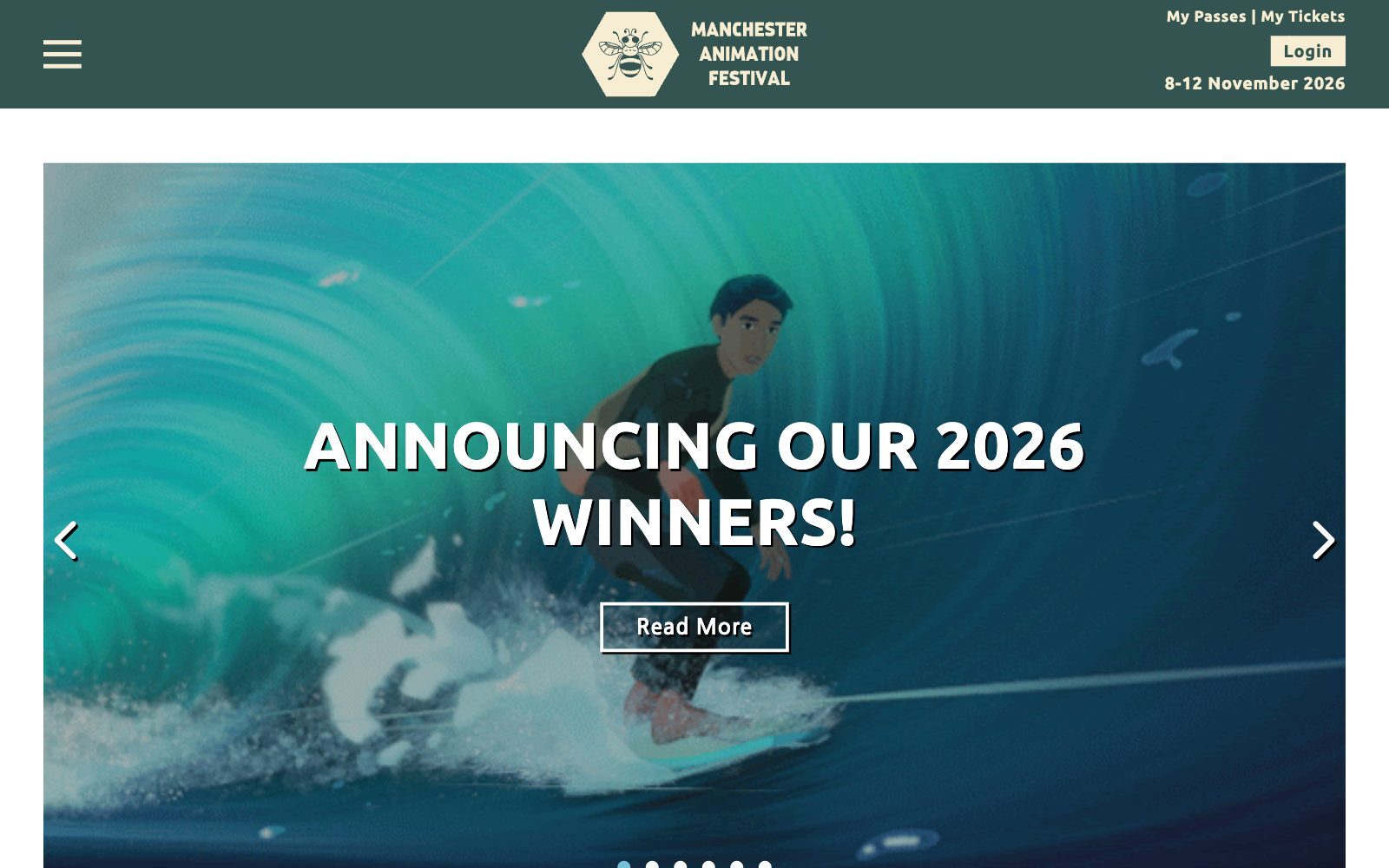
On 13 November 2026, Manchester Animation Festival (MAF) announced that films created using generative AI will no longer be accepted for submission from 2027 onwards. Its new policy says a film is ineligible if any part of the final moving image was generated or transformed by a generative audio, image or video model.
The festival made the announcement together with its 2026 awards, at the end of a five-day edition in Manchester that drew almost 12,000 admissions. MAF is the UK's largest festival dedicated to animation, and its awards qualify films for the Oscars and BAFTAs. The 2027 edition runs from 14 to 18 November 2027, and its call for entries is already open.
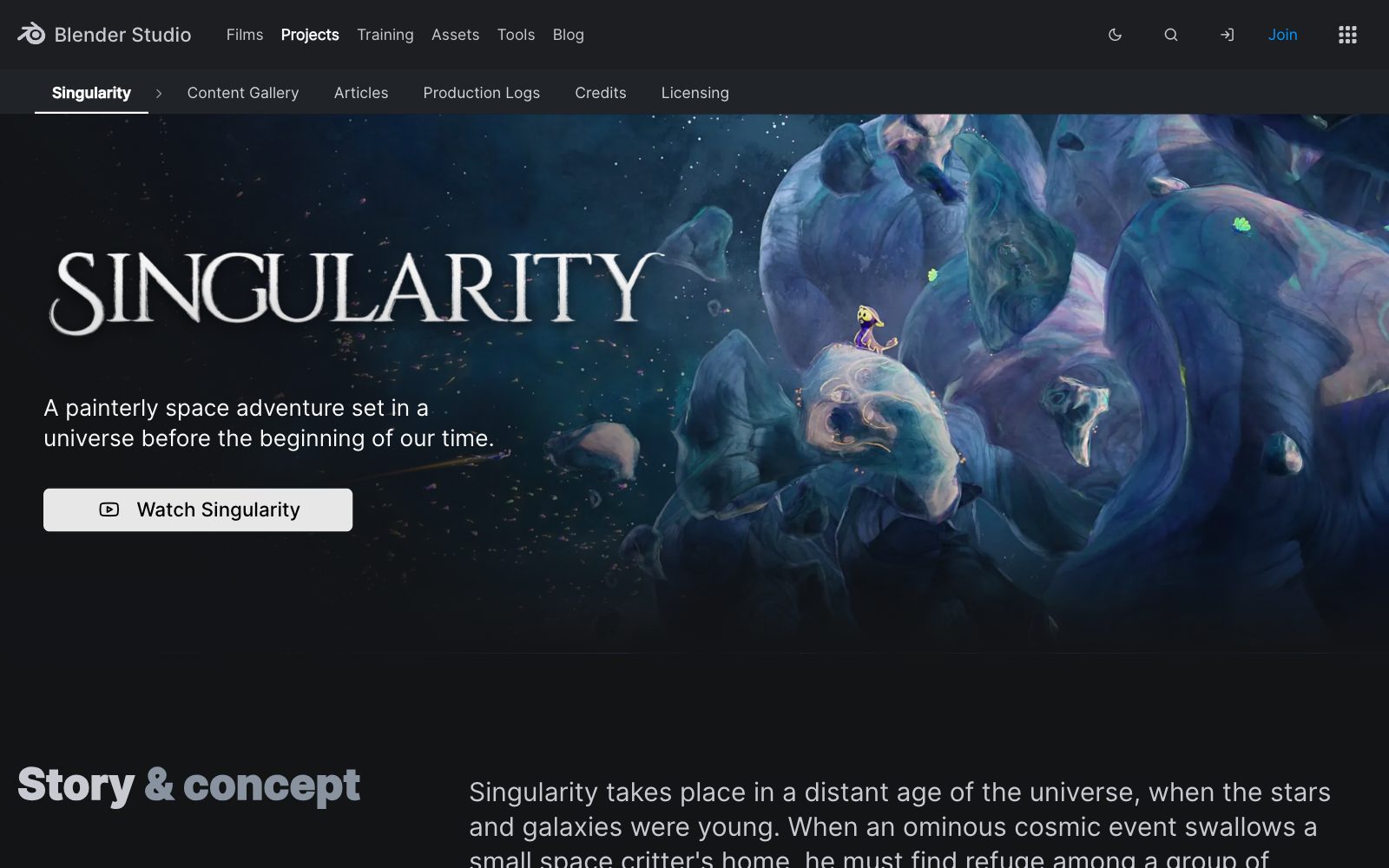
One of this year's winners was made in Blender. The Children's Award went to Singularity, the painterly space short from Blender Studio directed by Andy Goralczyk. That makes the timing useful for every Blender animator: the new rule draws a line between animation made by artists, including procedural and simulated motion, and films made with generative AI. This article explains what the policy says, where Blender workflows sit, what it leaves open, and how to prove your film was made by hand.
TL;DR: Manchester Animation Festival AI ban
From MAF 2027, films made with generative AI are not accepted. If any part of the final moving image was generated or transformed by a generative audio, image or video model, the film is ineligible, the festival does not have to watch it, and the fee is not refunded. Computer-made motion that the artist controls, such as crowd scenes made with code, hair simulation and in-betweens, stays eligible. The policy does not mention AI denoisers, upscalers or frame interpolation. If the festival questions your film, you must show evidence that it follows the rules, so keep dated project files from day one.
What did Manchester Animation Festival announce?
The festival published a two-page Generative A.I Policy for Filmmakers with the announcement. Festival director Steve Henderson said: "Our new Gen AI policy puts artists first". The festival said the policy reflects its commitment to celebrating human creativity and protecting the artistic skills at the heart of animation.
The policy is built on a few clear definitions:
- Animation. MAF describes animated films as the result of movement "created by the hands of an artist".
- Generative AI. Final pixel, on-screen work produced using generative AI, such as generative audio, image or video models. It takes input from an operator, written or visual prompts, and calculates an approximation of what was asked for.
- Generated Animation. Using a computer to complete motion, for example code that generates crowd scenes, hair simulation, colouring multiple frames, or tweening to create in-betweens. This is allowed, as long as the artist controls both the input and the outcome.
- Three forms of filmmaking. Animation is the creation of movement, live action is the capture of movement, and generative AI is a calculation of movement. MAF screens the first two, and hybrids where more than 50% of the film is animated.
The policy gives two reasons: copyright questions about how generative AI is made, and its environmental impact. While those questions remain open, MAF says it will not exhibit generative AI films. The policy was last reviewed in November 2026 and is due for its next review in August 2027.
Where do Blender workflows sit under the new rule?
Most of what Blender animators do every day is clearly on the allowed side. The policy even names crowd scenes and hair simulation as examples of acceptable computer-made motion. Singularity is a good case: according to Blender Studio, the team used Geometry Nodes for crowd animation and its Brushstroke Tools to get a watercolour look, all inside Blender.
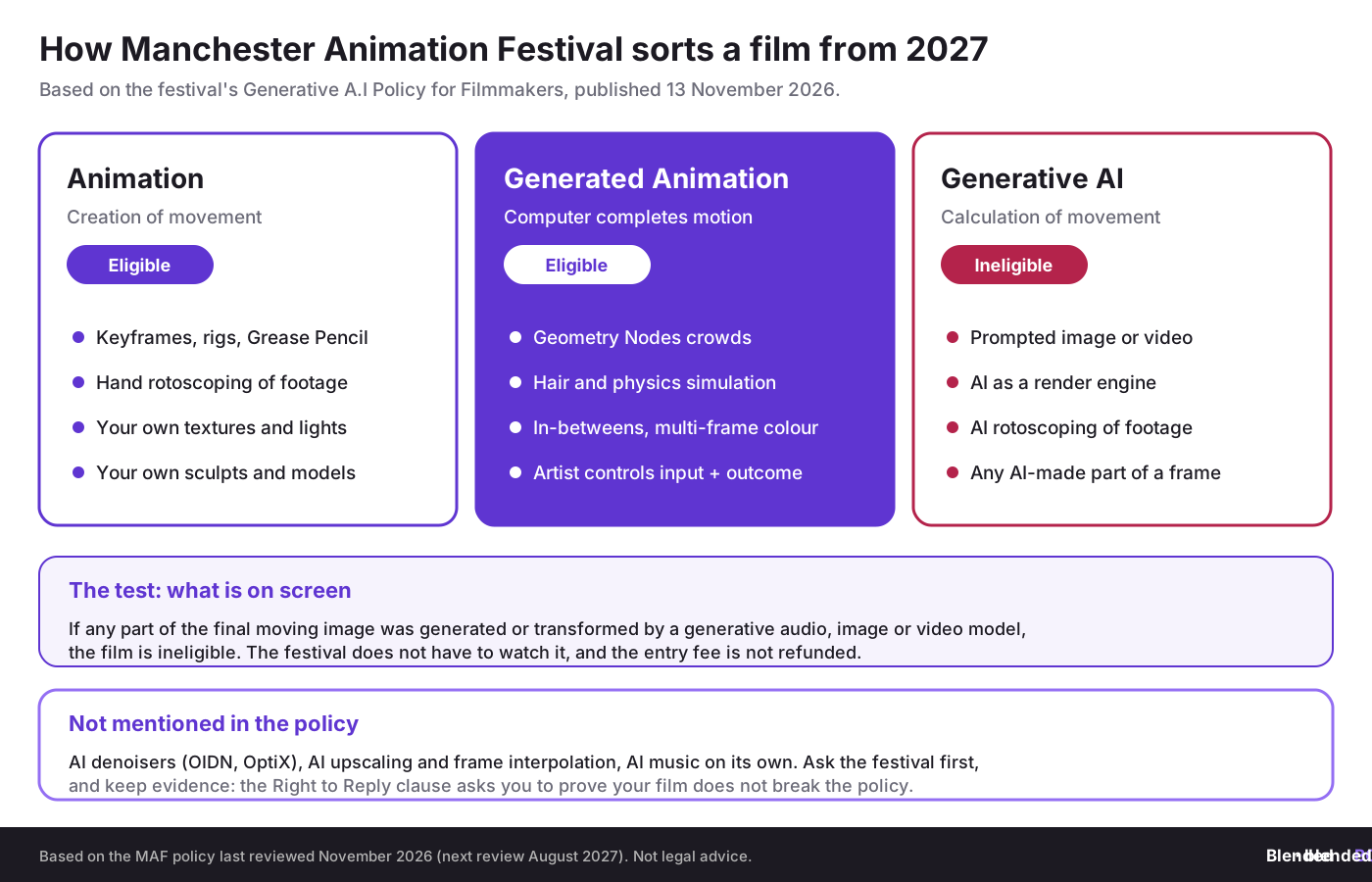
Here is how common Blender work lines up with the policy text:
- Keyframing, rigging and Grease Pencil. Movement created by the artist. See our guides to Grease Pencil 2D animation and animation and rigging in Blender.
- Geometry Nodes, simulations and modifiers. Generated Animation, allowed when you control the setup and the result. Our guides to procedural animation with Geometry Nodes and hair simulation and grooming cover the tools.
- Rotoscoping. Drawing frame by frame over live-action reference counts as fully animated. Running footage through a generative AI model to calculate the motion counts as fully generated, and is ineligible.
- AI as a render engine. The policy treats a film that uses generative AI as its render engine as fully generative AI. That includes passing your Blender renders through an AI video model to restyle them.
- AI-made parts of a frame. A generated texture, sky, matte painting or background that ends up on screen is part of the final moving image, so it falls under the ban. The same question applies to meshes made with image-to-3D generators.
Show how your film was made, step by step.
If a festival, client or platform asks whether your work is AI-free, dated versions of your project are your best answer. BlendedBoris adds a blockchain timestamp to your Blender work from inside Blender, giving you dated proof of authorship.
👉 Protect your Blender work with BlendedBoris
What about denoisers, upscalers and other AI tools in Blender?
This is where the policy is silent. It names generative audio, image and video models, but it does not mention the neural tools many Blender users rely on:
- Denoisers. Cycles can use OpenImageDenoise and the NVIDIA OptiX denoiser, both based on neural networks trained to clean up render noise. They work from your own render, not from a prompt, but the policy does not say whether that counts as "transformed". Our guide to denoising in Blender explains how they work.
- Viewport AI. Blender 5.3 added an NVIDIA DLSS denoiser for the Cycles viewport. Viewport previews are not the final image, but check your final render settings.
- Upscaling and frame interpolation. AI upscalers and tools that invent in-between frames create new pixels. Under a strict reading of "generated or transformed", they are a risk.
- Music, voices and sound. The policy lists generative audio models among the tools it means, while its test speaks of the final moving image. If your soundtrack or voices are AI-made, ask the festival before you enter.
The safe approach is simple. If a tool learned from data and changes what appears on screen, ask before you pay the entry fee. The policy offers a Right to Reply: you can contact the festival team to clarify or defend a method, and the team will ask for evidence that your film does not break the policy. That evidence may be reviewed by the festival team or by third parties.
How does the MAF policy compare with other rules artists face?
Festivals and platforms are taking different routes. Many festivals only ask filmmakers to declare AI use, and Annecy saw protests by animation guild members over generative AI in June 2026. Here is how the MAF rule compares with rules we have covered:
Why does proof of process matter now?
The MAF rule puts the burden on the filmmaker. A festival cannot see inside your render, so if a judge or another entrant raises doubts, you will need to show how the film was made. The same need is growing elsewhere: platforms ask for AI declarations, clients ask for AI-free work, and courts ask who the human author is.
Copyright law points the same way. In the US, the Copyright Office does not register material generated by AI without enough human control, and a German court has already rejected an "it was AI" defence, as we explained in the Frankfurt ruling. Labels alone are not enough either: our report on the C2PA timestamp flaw showed how metadata dates can be faked. The strongest evidence is a full trail of your own files: dated .blend versions, playblasts, node trees, simulation caches, texture sources and render passes. The sister blog explains immutable proof of art creation.
What should Blender animators do now?
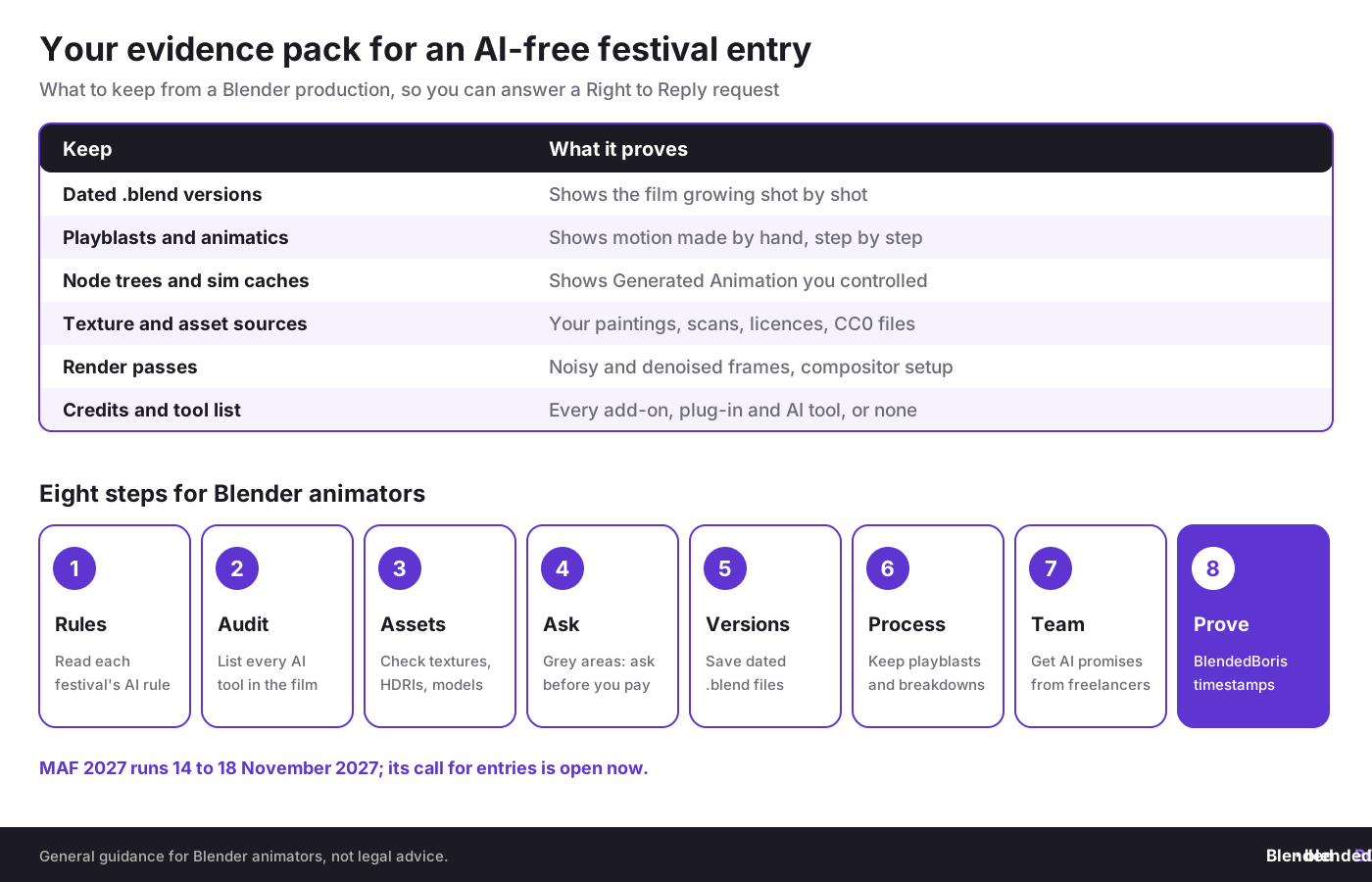
- Read each festival's AI rule before you start. Rules range from disclosure to a full ban. Check the rules of every festival on your list, not just MAF.
- Audit your pipeline. List every tool in the film, including add-ons, plug-ins, denoisers, upscalers and online services.
- Check your assets. Textures, HDRIs, skies, sound effects and models from marketplaces may include AI-made content. Our list of free texture resources points to sources such as Poly Haven.
- Ask about grey areas before you pay. Use the festival's contact route for denoisers, upscaling or AI audio, and keep the answer.
- Save dated versions. Keep incremental .blend files per shot instead of overwriting one file.
- Keep process material. Playblasts, animatics, breakdowns and compositor setups show how motion and images were made.
- Put AI terms in team agreements. If freelancers or collaborators work on your film, agree in writing that they will not use generative AI, and keep their source files.
- Timestamp your work. Register key works where it helps (see how to register copyright and our copyright basics for 3D artists), and record dated proof of each stage of your film.
Where does this fit in the bigger picture?
Our sister sites covered stories this week about AI, control and who holds valuable files:
- AI paid by use. Dassault Systèmes told investors that usage-based pricing will complement seat licences for work done by its AI companions: what Dassault's AI pricing plans mean for SOLIDWORKS users on solidboris.com.
- Platform flaws. Critical flaws in the 3DEXPERIENCE Station Launcher App allow remote code execution: what the 3DEXPERIENCE vulnerability means for engineering data on cadchain.com.
- Ransomware in industry. Dragos counted 1,266 industrial ransomware incidents in the third quarter of 2026: what the latest industrial ransomware figures mean for Inventor teams on borisinventor.com.
Closer to home, our reports on the Adobe and Disney AI alliance, the GDC survey on AI in game studios and World Labs Atlas show how fast AI is moving into the same pipelines Blender artists work in. Some studios are training models on their own art; some events are closing their doors to AI work. The sister blog's round-up of court decisions for artists and its guide to fair use in digital art give more background on the legal side.
Conclusion
Manchester Animation Festival is the clearest line yet drawn by a major animation festival: from 2027, if a generative model made or changed any part of what is on screen, the film is out. Blender's core tools, from keyframes and Grease Pencil to Geometry Nodes crowds and simulations, sit on the allowed side, and a Blender Studio film won an award on the same night the rule was announced. The open questions are about neural denoisers, upscaling and AI audio, and about proof. Read each festival's rules, ask before you enter when a tool is unclear, and keep a dated record of every stage of your film.
Prove what you made, and when.
BlendedBoris records a blockchain timestamp of your Blender work from inside Blender, giving you dated proof of authorship for your shots, scenes, models and renders.
👉 Get started with BlendedBoris
FAQ: the Manchester Animation Festival AI ban
Has Manchester Animation Festival banned AI films?
Yes. On 13 November 2026, MAF announced that films created using generative AI will not be accepted for submission from 2027 onwards. The first edition under the rule runs from 14 to 18 November 2027.
What counts as generative AI under the MAF policy?
Final on-screen work produced with generative audio, image or video models that take prompts and calculate an approximation. If any part of the final moving image was generated or transformed by such a model, the film is ineligible.
Are Geometry Nodes and simulations allowed?
Yes. The policy calls this Generated Animation and names crowd scenes made with code and hair simulation as examples. It is allowed when the artist controls both the input and the outcome.
Can I use AI denoisers like OpenImageDenoise or OptiX?
The policy does not mention denoisers. They work from your own render rather than a prompt, but the policy does not say whether they count. Ask the festival before you enter and keep your render passes.
Is rotoscoping allowed?
Hand rotoscoping, drawing frame by frame over live-action reference, counts as fully animated and is eligible. Using a generative AI model to calculate motion from footage counts as fully generated and is ineligible.
What happens if my film breaks the rule?
It is deemed ineligible, the festival is not obliged to watch it, and you are not entitled to a refund. You can use the Right to Reply to contest a decision, but you must provide evidence.
Which Blender film won at MAF 2026?
Singularity, the Blender Studio short directed by Andy Goralczyk, won the Children's Award. Blender Studio made it with Blender, using Geometry Nodes for crowd animation.
How can BlendedBoris help?
BlendedBoris adds a blockchain timestamp to your Blender work from inside Blender, giving you dated proof of each stage of your film, which helps when you need to show it was made by hand.


