
On 6 November 2026, the Court of Genoa in Italy refused to stop the sale of trading cards, stickers and 3D figures based on viral AI-made "Italian Brainrot" characters. The judge found that two creators and their rights agency had not shown that the characters were the result of human creative work, as Italy's amended copyright law now requires. The order became public on 17 and 18 November 2026.
The case was brought by a French company that manages and licenses the rights of digital creators, together with two of its creators: an Indonesian creator known as Noxa, described in the order as a leading figure of "Indonesian Brainrot", and a Brazilian creator who is a minor and was represented by parents. They asked the court for an urgent injunction against a collectibles company and its exclusive European licensee, which sell "Skifidol Italian Brainrot" trading card games, sticker albums, a magazine and 3D figures. The court rejected every request and ordered the claimants to pay EUR 8,059 in legal fees, plus expenses and tax.
This is an interim decision, not a final ruling on whether AI-assisted art can ever be protected. But it is the first published Italian decision under the new wording of the copyright law, and it shows in detail what a judge looked for and did not find. For Blender artists who use AI tools anywhere in their pipeline, or who simply need to prove who made a character, the lesson is about evidence as much as about AI.
TL;DR: the Genoa Brainrot copyright order
The Court of Genoa (fifth civil section, Judge Raffaella Gabriel, order no. 3178 of 6 November 2026) rejected an urgent bid to block Brainrot trading cards, stickers and 3D figures. The main character was made with six or seven short ChatGPT prompts in about 15 minutes. The judge called the prompts generic, noted that a prompt asking for one human leg produced an image with two, and found no proof that the result expressed the author's own creative choices. Unsigned tables and process descriptions had no value as evidence, and the exported prompt log was only circumstantial. For Blender artists: keep dated, verifiable records of your own creative decisions, not only the final file.
What did the Genoa court decide?
The claimants asked for a lot. According to the full text of the order, published by the Italian law journal La Nuova Procedura Civile, they wanted the court to:
- ban the two companies from producing, selling, licensing or promoting products with the characters, in Italy and abroad;
- set penalties of at least EUR 5,000 per violation and EUR 2,000 per day of delay;
- order the companies to disclose sales figures, production quantities, licensees, income and contracts within 10 days;
- order publication of the decision in two national newspapers and as a pop-up banner on the companies' websites and social media for 30 days.
The companies replied that Italian Brainrot is a viral, collective trend made of AI-generated characters that users copy and rework all the time, that the characters appear on Wikimedia Commons as public domain content, and that their card game contains about 1,000 characters, mostly drawn by their own designers.
The judge did not need to decide most of those points. Under the quick review used in urgent proceedings, she found that the claimants had not shown a likely right in the first place (in Italian law, the fumus boni iuris). Without that, there could be no injunction.
How were the characters made, and why was that not enough?
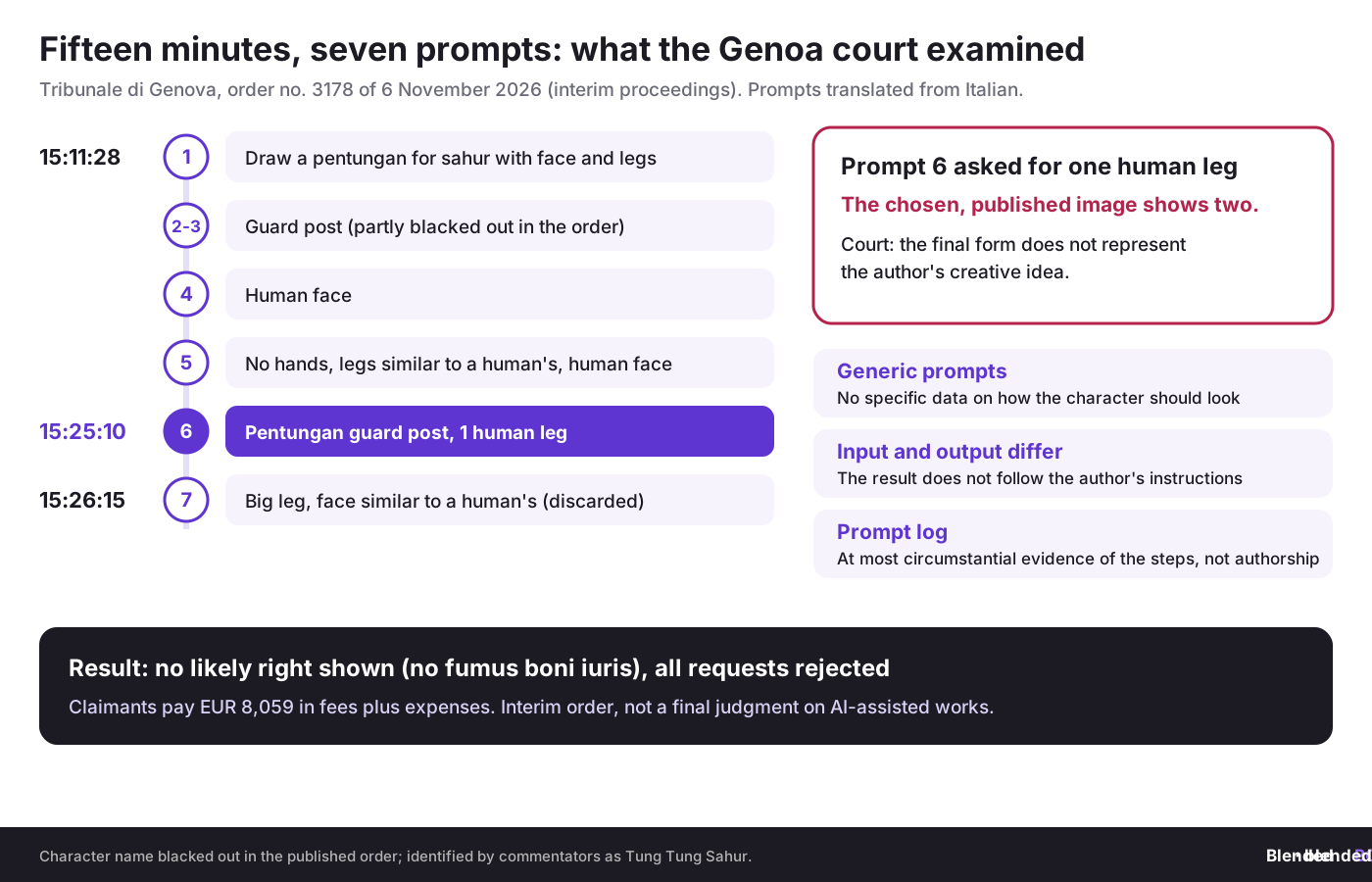
The key evidence was a reconstruction of how the most important character was made. Commentators identify it as Tung Tung Sahur; its name is blacked out in the published order. The reconstruction listed the ChatGPT prompts in Italian. The first asked the AI to "draw a pentungan for sahur with face and legs" (a pentungan is a wooden stick, and sahur is the meal before dawn during Ramadan). Later prompts added a guard post, a human face, legs similar to a human's and no hands. The sixth asked for a "pentungan guard post, 1 human leg". Its result was the image that was published. A seventh prompt asked for a big leg, and that result was dropped.
The whole session ran from 15:11:28 to 15:25:10, or 15:26:15 counting the discarded step. The judge described these as six or seven prompts sent in "only 15 minutes" and generic in tone. In her view, they gave ChatGPT no specific data about how the character should actually look, so it could not be said that the result came from the creator's inputs or expressed the creator's own personality.
She also pointed to one detail. The sixth prompt asked for one human leg, but the chosen image shows two. For the court, that gap between what was asked and what came out showed that the final form did not represent the author's creative idea. Together with the rest of the evidence, it ruled out a protectable human work. The scrutiny, she added, must be even stricter when AI tools are used, relying on a 2023 Italian Supreme Court decision about an image made with software.
Why did the court reject the creators' evidence?
The judge also found that the claimants had not proven who made the characters. Three documents failed:
- A table of characters with names, dates of first publication, view counts, links and images. It had no signature, attestation or anything else that tied the characters to the people claiming them, so the court gave it no value as evidence.
- A grid describing the creative process for each character. Nobody showed who wrote it or where it came from, or that it described the process the creators actually followed.
- The reconstruction of the ChatGPT session, filed at a hearing on 28 July 2026, signed by the rights company's legal representative and backed by JSON files exported from the platform. The judge accepted it might be circumstantial evidence of the steps followed, but said it was not evidence of an authorial work.
Put simply, the creators described their creative process but could not prove it, and the process they could prove was too thin. Italian lawyer Nicola Berardi, who shared the order on LinkedIn, called it the first decision applying the new provision on works created with AI, and stressed that it is "an interim decision, not a full-scope judgment ruling out copyright for AI-assisted works in general", as reported by PPC Land.
What does Italy's new AI copyright rule say?
Italy's AI law, Law 132 of 23 September 2025, in force since 10 October 2025, changed Article 1 of the 1941 copyright law. Protection now covers works of the "human" intellect, "even where created with the help of artificial intelligence tools, provided that they are the result of the author's intellectual work". As La Legge per Tutti explains, the change was made by Article 25 of the AI law.
The Genoa judge read the new text as confirming, not changing, the old rule: copyright protects the form in which an idea is expressed, not the idea itself, and that form must reflect the author's personality and free creative choices. She cited the EU Court of Justice's case law on originality (Infopaq, Painer, Levola Hengelo and Cofemel) and, as food for thought only, a Prague court ruling that an AI-generated image was not a protected work. The order does not discuss whether the 2025 wording should apply to characters made in early 2025, before it took effect.
This lines up with other systems. In the United States, the Copyright Office has said that prompts alone are generally not enough for authorship, and the courts have kept human authorship as a requirement. In Germany, by contrast, a court in Frankfurt rejected an "it was AI" defence and kept protection for a songwriter's lyrics, as we reported in our report on the Frankfurt AI copyright ruling. The common thread is proof: who made the creative choices, and can they show it.
Make your creative process provable.
The Genoa claimants could describe their process but not prove it. BlendedBoris adds a blockchain timestamp to your Blender work from inside Blender, so each saved stage of a model or scene carries dated proof of authorship.
👉 Timestamp your Blender work with BlendedBoris
Does this mean AI-assisted 3D art cannot be protected?
No. The order says AI-assisted works can be protected in Italy if they are the result of the author's intellectual work. What failed here was a short, generic prompt session with weak paperwork. A character you model, sculpt, retopologise, UV, texture, rig and pose in Blender is full of human choices, and those choices are where copyright sits. The guide to copyright in 3D models covers the basics.
The risk grows when AI does more of the visible work. If a character starts as an AI image, or as a mesh from an AI 3D model generator or a tool like Meshy's AI part editing, the human part is what you change by hand afterwards, and you need to be able to show it. The same goes for viral characters: once a design spreads and gets reworked by thousands of people, as with Brainrot or the Running Away Balloon meme template, proving the first version and its author becomes the whole case.
What should Blender artists do now?
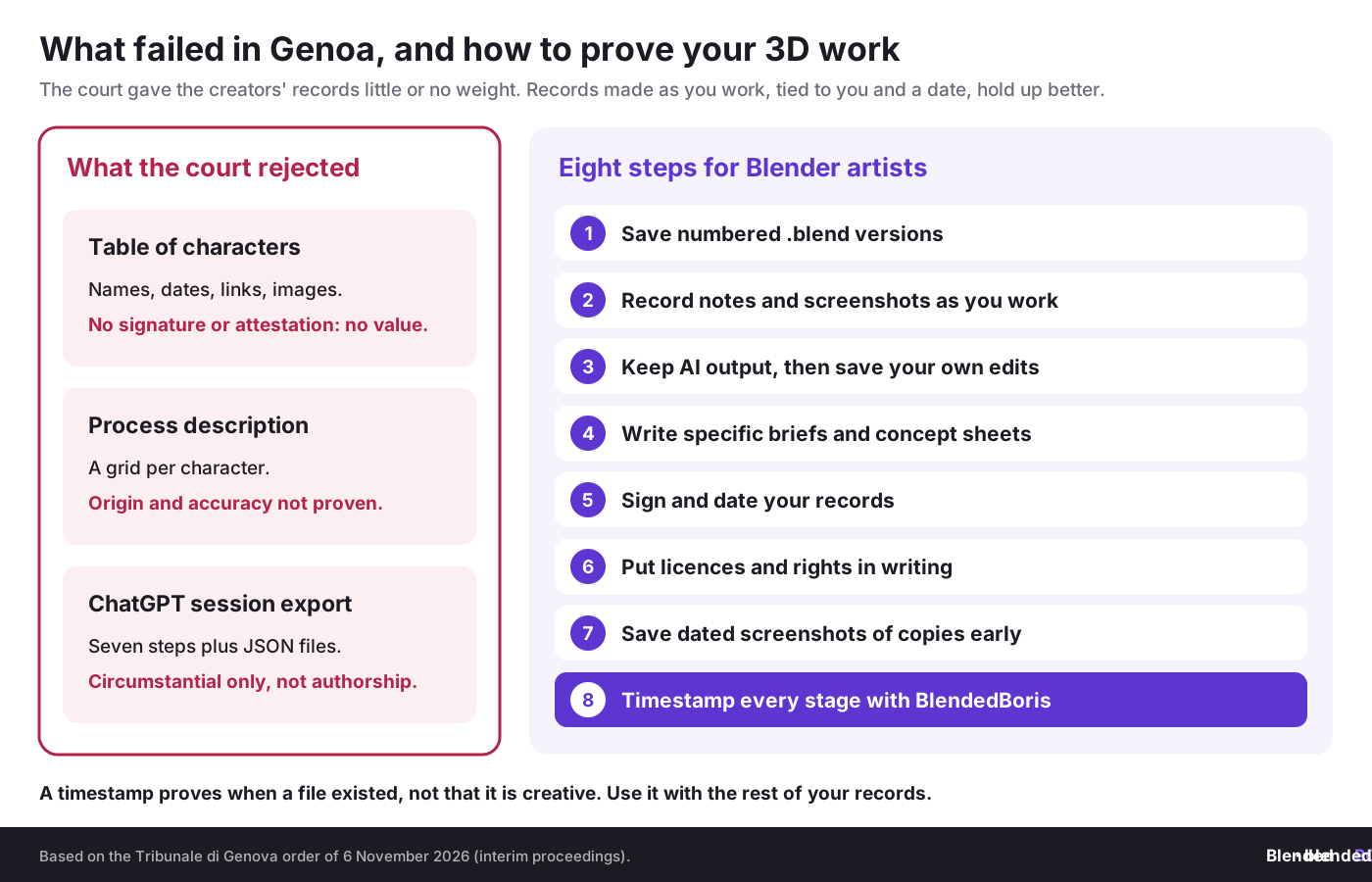
- Save incremental versions. Use numbered .blend files (character_v001, v002 and so on) instead of overwriting one file, so the growth of a design is visible. Our Blender 5.3 release report covers the new project and saving features.
- Record while you work, not afterwards. Viewport screenshots, sketches, reference boards and short notes made at the time are stronger than a description written for a court case. The sister blog explains immutable proof of art creation.
- If you use AI, show your hand. Keep the AI output, then save each stage of your own changes: remodelling, sculpting, retopology, materials, rigging. Your edits are the part a judge will look for. See copyrighting AI-generated art.
- Write specific briefs and keep them. If prompts are part of your process, the Genoa order shows that short, generic ones count for little. Detailed concept sheets and design decisions carry more weight.
- Sign and date your records. Tables and process notes need a link to you: your name, your accounts, your files and a date someone else can check. Our art registration guide and how to register copyright compare the options.
- Put licences in writing. If an agency or platform licenses your characters, agree in writing who holds which rights and who keeps the evidence. The sister blog has court decisions every artist should know.
- Watch for copies early. Merchandise built on popular characters spreads fast. Save dated screenshots of copies as soon as you see them; our report on AI knock-offs on Etsy shows how quickly it happens.
- Timestamp every stage. A blockchain timestamp of each saved version gives you dated proof that a file existed at a point in time. It does not prove creativity by itself, but it backs up the rest of your records. Our report on Content Credentials explains why an independent date matters.
Where does this fit in the bigger picture?
Our sister sites covered stories this week about what happens when proof, records and access are missing:
- Screens in public. US prosecutors charged a man they say acted as a Russian agent and was told to photograph the laptop screens of tech company employees in a coffee shop: what the Russian spy case means for engineers who work in public on cadchain.com.
- Recovery depends on records. An AXA XL report says a cyberattack can stop production without touching machinery, and recovery needs configuration files and engineering documentation: what the OT cyber risk report means for SOLIDWORKS teams on solidboris.com.
- New plans, new terms. Autodesk Fusion moves to Starter, Standard, Professional and Enterprise plans from 28 January 2027: what the new Autodesk Fusion plans mean on borisinventor.com.
Our reports on AI copies of famous characters in Midjourney, the Gruffalo illustrator's AI dispute and Indonesia's AI copyright bill look at the other side: AI copying human artists' characters. Our list of landmark copyright cases puts these disputes in context.
Conclusion
The Genoa order does not say AI-assisted art is unprotected. It says that a few generic prompts, an output that ignores part of the brief and unsigned paperwork are not enough to prove a human author, at least in urgent proceedings. The claimants may still bring a full case, but they lost the first round on evidence. For Blender artists, the practical answer is the same whether or not you use AI: keep your versions, record your choices as you make them, and make sure every record can be tied to you and to a date.
Prove what you made, and when.
BlendedBoris records a blockchain timestamp of your Blender work from inside Blender, giving you dated proof of authorship for your characters, models, scenes and renders.
👉 Get started with BlendedBoris
FAQ: Brainrot copyright and the Genoa order
What did the Court of Genoa decide about Brainrot characters?
On 6 November 2026, the Court of Genoa rejected an urgent request by two Brainrot creators and their rights agency to stop the sale of trading cards, stickers, albums and 3D figures with their characters. The judge found they had not shown that the characters were the result of human creative work.
Is this a final ruling?
No. It is an interim order made after a quick review in urgent proceedings. The claimants can still bring a full case on the merits, and the order does not rule out copyright for AI-assisted works in general.
How many prompts were used to make the character?
According to the order, six prompts led to the published image and a seventh result was discarded. The session took about 15 minutes, from 15:11:28 to 15:25:10, or 15:26:15 counting the last step.
What does Italian copyright law now say about AI?
Since Law 132 of 2025 took effect on 10 October 2025, Article 1 of the Italian copyright law protects works of the human intellect, even if created with AI tools, as long as they are the result of the author's intellectual work.
Why was the creators' evidence rejected?
A table of characters and a description of the creative process had no signature or attestation linking them to the claimed authors. The exported ChatGPT session was accepted only as circumstantial evidence of the steps, not as proof of an authorial work.
Can a Blender character made with AI help still be protected?
It can, if the result reflects your own creative choices. Modelling, sculpting, texturing and rigging by hand are human work. Keep dated versions that show what you changed after any AI step.
How can BlendedBoris help?
BlendedBoris adds a blockchain timestamp to your Blender work from inside Blender, so each saved version carries dated proof that backs up your other records of authorship.


