
Australia's creative industries launched a national campaign called Not AI's To Take on 18 November 2026, asking the government to reject any copyright change that would let AI companies train on Australian work unless creators opt out. Three days later, on 21 November, the law firm Shine Lawyers said it is investigating whether visual artists, authors and musicians have a claim against AI developers such as OpenAI, Microsoft, Meta, Google and Anthropic. Both moves land just before a parliamentary committee on AI hands the government its final report, due by 30 November.
The campaign was launched on the red carpet of the ARIA Awards in Sydney, where Sir Elton John backed it in a pre-recorded video, and was followed by newspaper, TV, online and outdoor ads. More than 30 music, publishing, screen, media and visual arts organisations have signed on, including APRA AMCOS, ARIA, the Australian Publishers Association, the Australian Society of Authors, the National Association for the Visual Arts (NAVA) and the Copyright Agency. Their message is short: AI companies should ask first and pay, and the law should not change to let them do otherwise.
This matters well beyond Australia. If one country lets AI developers train on any work that has not been opted out, a Blender artist in Berlin, Austin or Manila could find their renders, models and turntables in a training set without ever hearing about it. Here is what happened this week, what has and has not been decided, and what 3D artists can do while governments decide who carries the burden of saying no.
TL;DR: Australia's AI copyright fight reaches decision week
On 18 November 2026, more than 30 Australian creative and media groups launched Not AI's To Take, asking the government to keep existing copyright law and reject an AI training opt-out. NAVA, the visual arts body, is among them. On 21 November, Shine Lawyers said it is investigating a possible class action for artists and musicians against AI developers. Nothing has been filed. The Joint Select Committee on Artificial Intelligence must report by 30 November 2026, and reports say it may report early. The government says AI companies should seek permission, and it is still consulting. For Blender artists everywhere: an opt-out regime anywhere puts the work of watching and objecting on you. Keep dated records of your work, set your opt-outs and write your AI terms into your licences now.
What is the Not AI's To Take campaign?
Not AI's To Take is a campaign run by Australia's creative and media sector, with a petition, a poll, a letter to local MPs and a toolkit on its campaign website. It says the sector is worth $70.3 billion to the Australian economy and supports almost 600,000 workers. It asks Parliament to keep existing copyright protections in place and says AI companies should not use Australian creative work without permission and agreed payment.
The campaign says it is not against AI. Its FAQ calls AI a useful tool and says AI companies should simply play by the same rules as everyone else. Its central worry is an opt-out model, which it describes as a rule letting anyone take what they like unless you have put up a sign saying keep out. It also makes a point that matters to every artist: once an AI system has learned from a work, it cannot unlearn it, so permission has to come first.
Visual artists have a clear voice in the campaign. NAVA's executive director, Penelope Benton, says visual artists spend years developing their skills and bodies of work, and that AI companies should not profit from that labour without permission or payment. Her conclusion is the campaign's core demand: "Consent should be opt-in, not opt-out."
Music groups supplied the loudest moment. At the ARIA Awards on 18 November, Elton John asked the government in his video message not to let AI use any Australian artist's work without full permission, and musicians including Jack River, Josh Pyke, Dobby and KLP repeated the call on stage. ARIA's chief executive, Annabelle Herd, said an opt-out process can be so convoluted that it is impossible to use, adding: "No artist should be left to police every copy of their work."
What is Shine Lawyers investigating?
Shine Lawyers, one of Australia's largest law firms, said on 21 November that it is investigating whether copyrighted works, including music, lyrics, sound recordings and visual art, were copied and scraped by developers such as OpenAI, Microsoft, Meta, Google/Alphabet and Anthropic to train and run AI models without consent, according to the AAP report. Its head of class actions, Craig Allsopp, said the firm wants to find out whether Australian creators have a claim and wants to hear from artists and musicians across the country.
Be precise about the stage. This is an investigation, not a lawsuit. No claim has been filed, no class has been formed, no court has said anything, and none of the named companies has been found to have done anything unlawful. Firms often announce investigations to find claimants and evidence before deciding whether to sue. Whether a case follows will depend on what Shine finds about which works were used, where the copying happened and which law applies.
That last point is hard for any AI training case. Training often happens outside the country where the artist lives, and copyright is territorial. It is the same problem Irish artists raised when they told their parliament they cannot tell whether, by whom or on what basis their work was used. It has already shaped the biggest UK case: Getty Images dropped its training claim against Stability AI because the training happened outside the UK, and the Getty Images v Stability AI appeal is now about whether the model itself is an infringing copy.
Why is Australia's copyright decision a global issue?
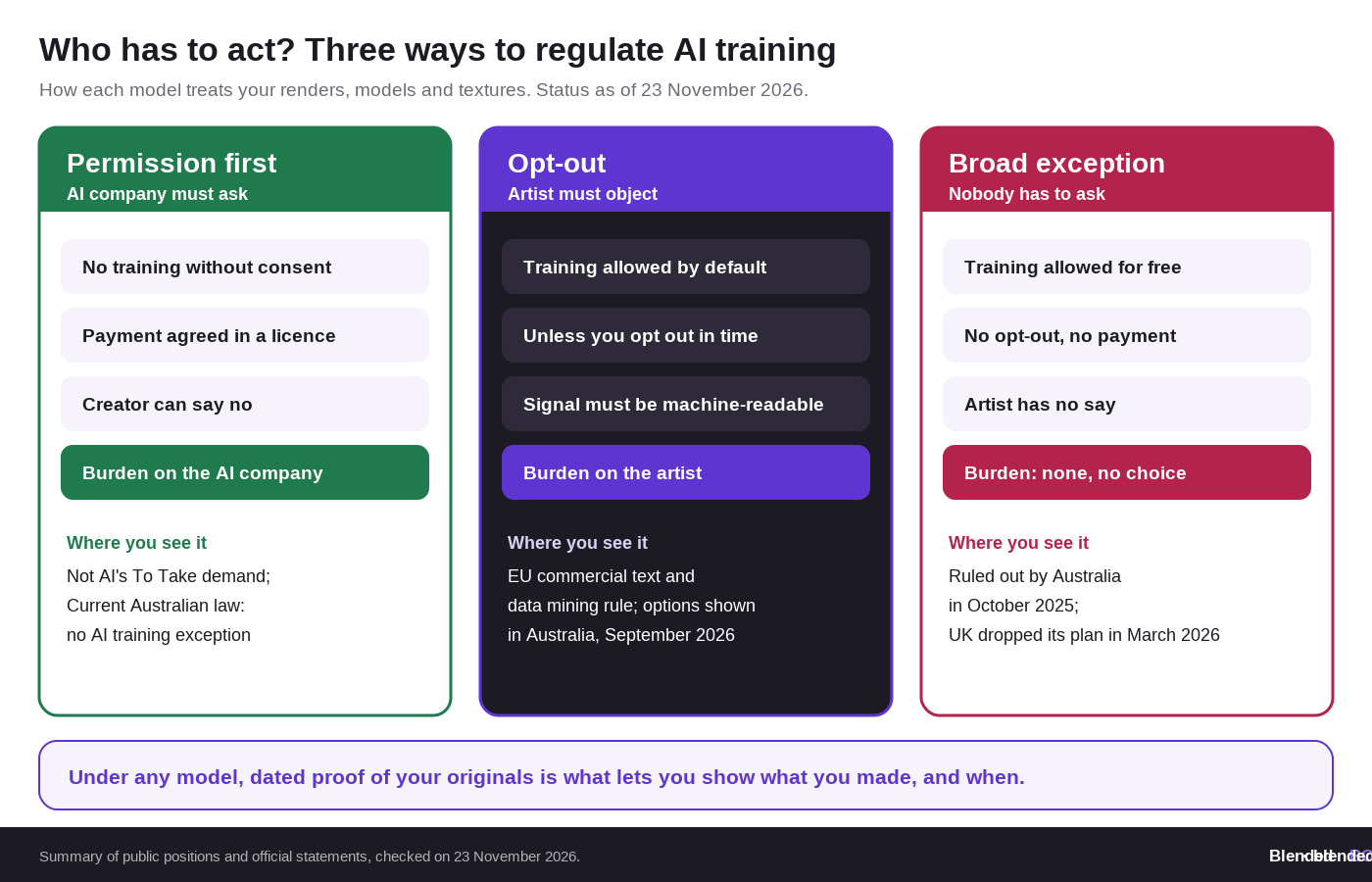
Australia has been arguing about this for over a year. In October 2025, the government ruled out a text and data mining exception that would have let AI firms train on creative work for free. In July 2026, Prime Minister Anthony Albanese said no company should use Australian books, music, art or news to train AI without the artist's control. Then, in September, the Attorney-General's Department showed rights holders consultation slides with two options that both included an opt-out. We explained those options in our report on the Australian AI training opt-out fight.
Campaigners point to other countries. The UK government dropped its own preferred plan for an AI training exception with an opt-out in March 2026 after a long fight with its creative industries. The EU already has a commercial text and data mining exception with a machine-readable opt-out, which is now being tested at the EU's top court in the Like Company v Google case. Indonesia is debating a ban on AI copying a creator's distinctive style.
Supporters of the campaign argue that a permissive Australian regime would not only affect Australians. If AI developers can train legally in Australia on anything that has not been opted out, the work of artists from any country could be swept in, as long as the copying happens there. Greens senator David Shoebridge, whose party holds the balance of power in the Senate, warned against giving AI companies a carve-out that would reach global artists too. AI companies, for their part, are lobbying to relax the rules, arguing that asking permission for every work is unworkable and slows development.
What happens next in Australia?
The Joint Select Committee on Artificial Intelligence was set up in August 2026 and its terms include the use of Australian creative, cultural and media content to train AI models. It must deliver its final report by 30 November 2026. Its chair, Labor's Jo Briskey, and deputy chair, Liberal senator Jonno Duniam, already wrote to the Prime Minister in October saying copyright settings should be examined while keeping creators in control and paid. That letter caused a row when it emerged that the Prime Minister's office had edited it before it was sent.
The report will not change the law on its own. It is advice to the government, which is still consulting creators, media groups and AI companies. Ministers have said AI companies should be seeking permission and are not. Rights holders released polling showing that 65% of 1,464 people surveyed across 21 electorates opposed AI training on creative work without permission. Expect the report, the government's response and any draft bill to be the next moments to watch.
Proof that does not depend on the law of the week.
Whatever Canberra, London or Brussels decides, you need dated proof of what you made. BlendedBoris adds a blockchain timestamp to your .blend files and renders from inside Blender.
👉 Timestamp your Blender work with BlendedBoris
Why should a Blender artist outside Australia care?
An opt-out regime moves the work from the AI company to you. You have to know that a crawler is collecting your portfolio, find the right signal or form, and keep doing it on every platform where your work appears. A single artist with a few hundred renders on ArtStation, Sketchfab, Instagram and a personal site cannot check every copy. That is the point ARIA made about policing, and it applies just as much to 3D work.
Platforms are already writing AI training into their terms, sometimes in favour of artists and sometimes not. Etsy's new terms let its partners train AI on seller content subject to opt-out rights, while ArtStation now requires AI declarations and hides AI art by default. In the US, the question is going to the courts: photographers and illustrators are lining up against Midjourney's fair use brief in the OpenAI copyright litigation, and EVOX has sued ByteDance over 7,095 car photos allegedly scraped for an image model.
Any future case, in Australia or elsewhere, will turn on evidence. Claimants will need to show what they made, when they made it and where it was published. Artists who can show dated originals, publication dates and the licence terms attached to each work start from a much stronger position than artists who only have a username and a feeling that their style turned up in an AI tool.
What should Blender artists do now?
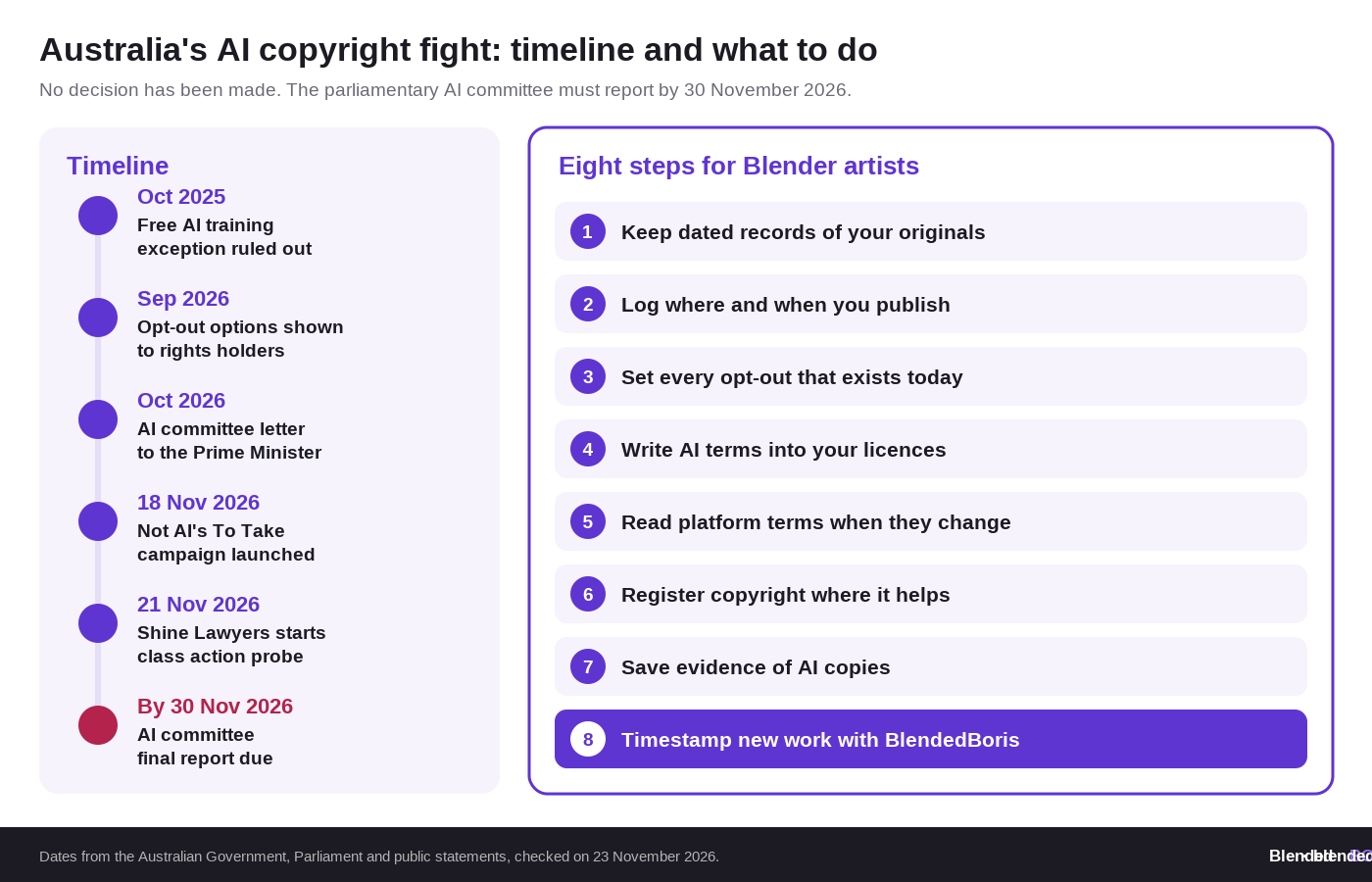
- Keep dated records of your originals. Save your .blend files, source textures and final renders with their dates, and keep them somewhere you control. If you ever join a claim or send a takedown, dates and originals are what count.
- Log where you publish. Keep a simple list of each work, the platforms it went to and the date. It helps show what a scraper could have seen and when.
- Set the opt-outs that exist today. Use platform settings such as NoAI tags and AI training toggles, and add rules to your own site. Our guide to opting out of AI training datasets and our report on the shared robots.txt training signal show how.
- Write AI terms into your licences. Say plainly whether buyers and clients may use your models, textures and renders to train AI. Clear terms make any later claim easier to explain.
- Read platform terms when they change. Training clauses are appearing in marketplace and social media terms. Check who can train on your uploads, whether partners are included, and how to opt out.
- Register where it helps. In the US, registration is needed before you can sue over a US work and affects the damages you can claim. See how to register copyright as a 3D artist.
- Keep evidence of copies. If you see AI output that reproduces your work, save the output, the prompt if you have it, the date and the tool. The sister blog's guide to recourse for AI art theft explains the options.
- Have your say if you are Australian. Australian artists can contact their MP or a representative body such as NAVA. If you think your work was used, keep your records ready before you speak to any lawyer, and get independent legal advice before joining a claim.
Where does this fit in the bigger picture?
The fight over AI training is now running in parliaments, courts and platform terms at the same time. The sister blog tracks AI art laws country by country and the practical opt-out strategies for AI datasets. Our overview of international AI art copyright laws explains how the main systems differ, and the music cases in our Suno lawsuit report show how fast claims follow once rights holders find evidence.
Our sister sites covered other stories this week about control over data and access:
- Rules for sending designs abroad. The EU's updated dual-use control list came into force on 20 November 2026 and can cover technology sent as files: what the new EU dual-use list means for CAD and design data on cadchain.com.
- Access for sale. Intel 471 found manufacturing was the sector most targeted by ransomware and extortion claims in 2026, with access brokers selling ways into factories: what initial access brokers mean for SOLIDWORKS teams on solidboris.com.
- A hacked cloud service. GL.iNet says attackers used a flaw in its cloud management service to put malware on some routers and remote KVM devices: what the GL.iNet KVM attack means for Inventor workstations on borisinventor.com.
Conclusion
Australia's creative sector has made its position clear: permission first, payment agreed, no opt-out. A law firm is now testing whether artists already have a claim, and a parliamentary report is days away. Nothing has been decided yet. But the question at the centre, whether artists must ask to be left out or AI companies must ask to come in, is the same one Blender artists face on every platform and in every country. Until the law settles it, the safest position is to keep dated proof of your work, set every opt-out you can and put your AI terms in writing.
Your work, on the record.
BlendedBoris records a blockchain timestamp of your Blender work from inside Blender, giving you dated proof of authorship for models, scenes and renders, whatever the rules on AI training turn out to be.
👉 Get started with BlendedBoris
FAQ: Not AI's To Take and the Australian AI copyright fight
What is Not AI's To Take?
It is a national campaign by more than 30 Australian creative and media organisations, launched on 18 November 2026. It asks the government to keep existing copyright law and reject any change that would let AI companies train on creative work without permission and agreed payment.
Has Australia introduced an AI training opt-out?
No. The government ruled out a free text and data mining exception in October 2025, but options that include an opt-out were shown to rights holders in September 2026. No decision has been made and no bill has been published.
Is there an Australian class action against AI companies?
Not yet. On 21 November 2026, Shine Lawyers said it is investigating whether visual artists, authors and musicians have a claim against developers such as OpenAI, Microsoft, Meta, Google and Anthropic. No claim has been filed.
When will the Australian AI committee report?
The Joint Select Committee on Artificial Intelligence must deliver its final report by 30 November 2026. Reports say it may report about a week early. The report is advice to the government, not a change in the law.
Are visual artists part of the campaign?
Yes. NAVA, the National Association for the Visual Arts, and the Copyright Agency are among the supporters. NAVA says consent should be opt-in, not opt-out.
Does this affect artists outside Australia?
It can. Copyright is territorial, so the rules where AI training takes place matter. A permissive regime in one country could allow training on work from artists anywhere, which is why campaigners call it a global issue.
How can I protect my 3D work from AI training today?
Set the opt-outs your platforms and website offer, write AI terms into your licences, read platform terms when they change and keep dated records of your original files and where you published them.
How can BlendedBoris help?
BlendedBoris adds a blockchain timestamp to your Blender work from inside Blender, so you have dated proof of authorship of your originals if you ever need to show what you made and when.


